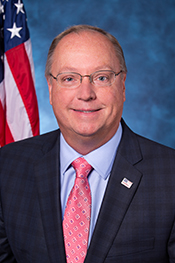
James Lee Hagedorn (HAG-e-dorn; August 4, 1962 – February 17, 2022) was an American politician who served as the U.S. representative for Minnesota’s 1st congressional district from January 3, 2019, until his death in 2022. A member of the Republican Party, he represented a largely rural district stretching across southern Minnesota along the Iowa border, including the cities of Rochester, Austin, and Mankato. His service in Congress, encompassing two terms in office, occurred during a significant period in American political life, and he participated actively in the legislative process and in representing the interests of his constituents.
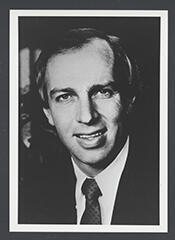
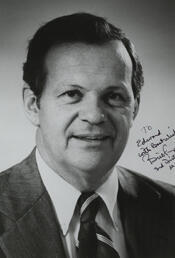
Hagedorn was born in Blue Earth, Faribault County, Minnesota, on August 4, 1962, the son of former U.S. Representative Tom Hagedorn and Kathleen (Mittlestadt) Hagedorn. He spent his childhood on the family farm near Truman, Minnesota, and also in McLean, Virginia, near Washington, D.C., while his father served in Congress from 1975 to 1983. Growing up partly in the nation’s capital during his father’s tenure in the U.S. House of Representatives exposed him early to national politics and congressional life. He attended public schools and graduated from Langley High School in McLean, Virginia.
Hagedorn pursued higher education in the Washington, D.C., area and graduated from George Mason University in Fairfax, Virginia, in 1993 with a Bachelor of Arts degree in government and political science. His academic training in government complemented his early exposure to politics and helped prepare him for a career in federal public service and, eventually, elective office.
Hagedorn began his professional career on Capitol Hill. From 1984 to 1991, he served as a legislative aide to U.S. Representative Arlan Stangeland of Minnesota, working on policy and constituent matters during Stangeland’s tenure in Congress. He subsequently joined the U.S. Department of the Treasury, where from 1991 to 1998 he was director for legislative and public affairs for the Financial Management Service, a bureau responsible for the federal government’s financial and payment services. He then served as a congressional affairs officer for the Bureau of Engraving and Printing, the agency that produces U.S. currency and other security documents, a position he held until 2009. These roles placed him at the intersection of Congress and the executive branch, dealing with legislative outreach and public affairs on fiscal and monetary issues.
In addition to his government service, Hagedorn engaged in political commentary. From 2002 to 2008 he authored a blog titled “Mr. Conservative,” which was later deleted. Reporting by Mother Jones characterized the blog as making Native Americans a “favorite punching bag” and noted that it included comments about female Supreme Court justices and about Barack Obama’s ancestry “in ways many voters won’t appreciate.” Hagedorn defended the blog as intended to be humorous and satirical. The controversy surrounding his past writings persisted into his later campaigns; in 2018 the conservative Washington Examiner published an editorial describing him as “the worst midterm candidate in America,” citing his blogging history.
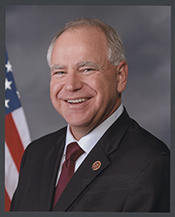
Hagedorn sought elective office several times before winning a seat in Congress. He first ran for the Republican nomination for Minnesota’s 1st congressional district in 2010 but lost in the primary. Returning more fully to Minnesota politics in 2013, he again pursued the seat and won the Republican nomination in 2014, but was defeated in the general election by Democratic–Farmer–Labor (DFL) incumbent Tim Walz, who would later become governor of Minnesota. Hagedorn secured the Republican nomination again in 2016 and again lost to Walz, though by a narrower margin than in 2014. These repeated campaigns helped establish his profile in southern Minnesota and solidified his standing within the district’s Republican base.
With Tim Walz vacating the 1st district seat to run for governor in 2018, Hagedorn once more sought the Republican nomination. He prevailed in the primary despite the National Rifle Association Political Victory Fund endorsing another Republican candidate, state senator Carla Nelson, who also received financial backing from national Republican figures including Representative Elise Stefanik and donors Richard Uihlein and Paul Singer. Hagedorn presented himself as the most conservative candidate in the race and emphasized his loyalty to President Donald Trump. After he won the primary, then–National Republican Congressional Committee chair Steve Stivers said he had been unaware of the controversial viewpoints expressed on Hagedorn’s former blog, and an NRCC spokeswoman stated that the posts were inappropriate and not condoned by the committee. In the November 2018 general election, Hagedorn defeated Democratic nominee Dan Feehan, a former Department of Defense official, in a very close race, thereby winning the open seat and entering the 116th Congress.
Hagedorn took office on January 3, 2019, as the U.S. representative for Minnesota’s 1st congressional district and was reelected in 2020, again narrowly defeating Feehan in a rematch. During his tenure in the House of Representatives, he participated in the democratic process through committee work, floor votes, and constituent representation at a time marked by intense national polarization and major debates over health care, immigration, trade, and the federal response to the COVID-19 pandemic. According to the McCourt School of Public Policy at Georgetown University, Hagedorn held a Bipartisan Index Score of -0.0 in the 116th Congress (2019–2021), ranking 190th out of 435 members in terms of bipartisan legislative activity. FiveThirtyEight’s congressional vote tracker at ABC News reported that he voted in line with President Donald Trump’s stated public policy positions 94.4% of the time, placing him near the average for House Republicans in that Congress when measured against district partisanship and voting record.
Hagedorn’s public statements occasionally drew national attention and controversy. In 2020, responding to activist Shaun King’s assertion that depictions of Jesus as white should be destroyed, Hagedorn wrote that the Democratic Party and the Black Lives Matter movement “are at war with our country, our beliefs and western culture.” When critics noted that the phrase “Western culture” had been used in some contexts to promote white nationalism, Hagedorn replied that “the notion that statues and images of Jesus Christ somehow represent white supremacy and should be destroyed is ludicrous and represent a growing intolerant movement on the left to silence any voices that do not align with their radical secular views.” These comments prompted several corporate donors, including Intel and UnitedHealth Group, to request the return of their political contributions to his campaign.
Jim Hagedorn continued to serve in Congress until his death on February 17, 2022. His passing brought an end to a congressional career rooted in a lifelong association with politics, from his upbringing as the son of a Minnesota congressman to his own years of service representing southern Minnesota in the U.S. House of Representatives.
Congressional Record