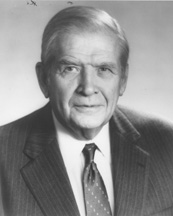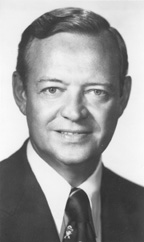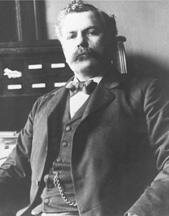
Jeter Connelly Pritchard (July 12, 1857 – April 10, 1921) was an American lawyer, newspaperman, legislator, United States Senator from North Carolina, and later a United States circuit judge of the United States Court of Appeals for the Fourth Circuit and of the United States Circuit Courts for the Fourth Circuit, as well as an associate justice of the Supreme Court of the District of Columbia. A Republican, he emerged as a key figure in the late nineteenth-century fusion movement between Republicans and Populists in North Carolina before later aligning with the “lily-white” wing of his party and opposing civil rights for African Americans. His service in Congress from 1895 to 1903 occurred during a significant period in American history, and he participated actively in the legislative process while representing the interests of his constituents.
Pritchard was born on July 12, 1857, in Jonesboro, Washington County, Tennessee. He attended Martins Creek Academy in Tennessee, receiving a basic formal education before entering the world of work at a young age. Apprenticed to the printer’s trade, he acquired skills that would lead him into journalism and political advocacy. In 1873 he moved to Bakersville, Mitchell County, North Carolina, where he became joint editor and owner of the Roan Mountain Republican, a newspaper that reflected his growing commitment to Republican politics in the post–Civil War South.
Pritchard’s early political involvement developed alongside his work in journalism. He served as a Presidential Elector on the Republican Party ticket in North Carolina in 1880, signaling his emergence as a party leader in a region still dominated by Democrats. He read law and was admitted to the bar in 1889, entering private legal practice in Marshall, Madison County, North Carolina, that same year. Even before his formal admission to the bar, he had begun a legislative career, serving as a member of the North Carolina House of Representatives from 1885 to 1889 and again from 1891 to 1893. During this period he was an unsuccessful candidate for Lieutenant Governor in 1888 and an unsuccessful candidate for the United States Senate in 1891. In 1891 he also served as President of the North Carolina Protective Tariff League, reflecting his support for protective tariff policies. He ran unsuccessfully for election to the United States House of Representatives for the 53rd Congress in 1892, but these campaigns enhanced his visibility within the Republican Party.
Pritchard’s national prominence began with his election to the United States Senate. In 1894 he was chosen as a Republican to fill the vacancy caused by the death of Senator Zebulon Baird Vance. Benefiting from the victory of the Republican–Populist “fusion” alliance in the 1894 North Carolina legislative elections and the subsequent domination of the General Assembly by that coalition, he was elected to the Senate and took his seat on January 23, 1895. He was reelected in 1897 and served two terms, from January 23, 1895, to March 3, 1903. During his tenure, Pritchard served as Chairman of the Committee on Civil Service and Retrenchment in the 54th and 55th Congresses and as Chairman of the Committee on Patents in the 56th and 57th Congresses. As a member of the Senate, he contributed to the legislative process and participated in the democratic governance of the nation at a time of intense political and racial conflict in the South.
Pritchard’s record on civil rights and race relations evolved in complex and ultimately contradictory ways. On October 21, 1898, he wrote to President William McKinley requesting that federal marshals be sent to North Carolina to protect Black voters in the upcoming election. In that letter he warned that Democrats were stockpiling weapons and threatening Black voters, and he rejected Democratic claims of “Negro domination” as baseless. McKinley and his cabinet discussed the letter on October 24, 1898, but federal marshals were not dispatched because North Carolina’s Republican Governor, Daniel Lindsay Russell, had not made a formal request. In the absence of federal protection, intimidation by the white supremacist Red Shirts kept many Black voters from the polls, contributing to a sweeping Democratic victory. The day after the election, the Wilmington insurrection of 1898, a violent coup d’état against a multiracial city government, broke out. Around 1900, however, Pritchard began reversing his views on civil rights, becoming associated with the lily-white faction of the Republican Party and opposing Black officeholders, a shift that aligned him with broader efforts in the South to disenfranchise African Americans.
After leaving the Senate, Pritchard embarked on a significant judicial career. On November 10, 1903, President Theodore Roosevelt nominated him to an Associate Justice seat on the Supreme Court of the District of Columbia (now the United States District Court for the District of Columbia), to fill the vacancy created by the death of Associate Justice Harry M. Clabaugh. The United States Senate confirmed his nomination on November 16, 1903, and he received his commission the same day. His service on that court was relatively brief, terminating on June 1, 1904, due to his elevation to the federal appellate bench. While serving in this period of his judicial and political career, Pritchard twice offered resolutions calling upon the Senate to declare so‑called “grandfather clauses,” which were used to disfranchise Black voters, a violation of the Fourteenth and Fifteenth Amendments, though both attempts failed.
On April 27, 1904, President Roosevelt nominated Pritchard to a joint seat on the United States Court of Appeals for the Fourth Circuit and the United States Circuit Courts for the Fourth Circuit, succeeding Judge Charles Henry Simonton. The Senate confirmed him and he received his commission on the same day, April 27, 1904. He served on both the Court of Appeals and the Circuit Courts until December 31, 1911, when the Circuit Courts were abolished; thereafter he continued to serve solely on the Court of Appeals for the Fourth Circuit. His judicial service on that court, based in the region where he had long been a political figure, continued until his death on April 10, 1921, in Asheville, North Carolina.
In his personal life, Pritchard married Augusta L. Ray in 1877. They had three sons and a daughter: William D. Pritchard, an army officer who was killed in the Philippines in 1904; George M. Pritchard, who later became active in Republican politics; Thomas A. Pritchard; and a daughter, Ida, who became Mrs. Thomas S. Rollins. After Augusta’s death in 1886, he married Melissa Bowman, with whom he had another son, J. McKinley Pritchard. Following the death of his second wife in 1902, he married Lillian E. Saum in 1903. Pritchard was interred in Riverside Cemetery in Asheville, North Carolina, where he lies near fellow North Carolina Senators Thomas Lanier Clingman and Zebulon Baird Vance. In recognition of his prominence in the city and state, Pritchard Park in downtown Asheville was named in his memory.
Congressional Record