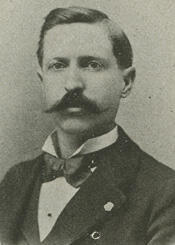
Jesse E. Overstreet (December 14, 1859 – May 27, 1910) was an American lawyer and Republican politician who served seven consecutive terms as a U.S. Representative from Indiana from 1895 to 1909. Overstreet’s congressional career spanned a significant period in American history marked by industrial expansion, monetary reform, and the emergence of the United States as a global power. In 1900, he introduced the legislation that was ultimately enacted as the Gold Standard Act, a landmark measure that placed the nation’s currency firmly on a gold basis.
Overstreet was born in Franklin, Johnson County, Indiana, on December 14, 1859. He attended the public schools of his native city and completed his secondary education at Franklin High School, from which he graduated in 1877. He then enrolled at Franklin College in Franklin, Indiana, a small liberal arts institution affiliated with the Baptist Church, and was graduated in 1882. Following his college studies, he read law, preparing for a legal career through the traditional method of supervised study rather than formal law school, which was common in the late nineteenth century.
After completing his legal studies, Overstreet was admitted to the bar in 1886 and commenced the practice of law in Franklin, Indiana. He quickly became active in Republican Party politics, reflecting the party’s strength in Indiana during the post–Civil War era. By 1892 he had risen to a position of influence within the state organization, serving as a member of the Republican State Central Committee of Indiana. This role helped establish his reputation as a party leader and provided a springboard for his entry into national politics.
Overstreet was elected as a Republican to the Fifty-fourth Congress and to the six succeeding Congresses, serving from March 4, 1895, to March 3, 1909. Representing his Indiana constituency in the U.S. House of Representatives, he participated actively in the legislative process and worked to represent the interests of his district during a time of rapid economic and social change. A loyal member of the Republican Party, he supported the party’s pro-business and sound-money policies and became particularly associated with monetary legislation. His introduction in 1900 of the bill that became the Gold Standard Act placed him at the center of one of the era’s most consequential financial debates, helping to resolve the long-standing national controversy over bimetallism and currency stability.
During his congressional service, Overstreet held several important committee assignments that reflected his growing seniority and influence in the House. He served as chairman of the Committee on Expenditures in the Department of Justice during the Fifty-sixth and Fifty-seventh Congresses, overseeing matters related to the fiscal administration of the Justice Department. He later became chairman of the Committee on the Post Office and Post Roads in the Fifty-eighth through the Sixtieth Congresses, a powerful position at a time when the postal service was a critical national institution and the development of post roads was closely tied to the country’s expanding transportation and communications networks. Through these roles, he contributed to shaping federal policy in areas central to government operations and public service.
Overstreet’s congressional tenure came to an end when he was an unsuccessful candidate for reelection in 1908 to the Sixty-first Congress. After leaving office on March 3, 1909, he returned to Indiana and resumed the practice of law, drawing on his long experience in public service and legislative affairs. He continued to reside in Indianapolis, the state capital and a growing commercial center, where he remained engaged in professional and civic life until his death.
Jesse E. Overstreet died in Indianapolis, Indiana, on May 27, 1910. He was interred in Columbus City Cemetery in Columbus, Indiana. His fourteen years in the U.S. House of Representatives, his leadership on key committees, and his central role in sponsoring the legislation that became the Gold Standard Act secured his place in the political history of Indiana and the United States at the turn of the twentieth century.
Congressional Record