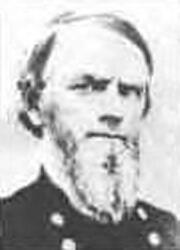
Jesse Hale Moore (April 22, 1817 – July 11, 1883) was a U.S. Representative from Illinois, a Methodist clergyman, and an officer in the Union Army during the American Civil War. Born near Lebanon in St. Clair County, Illinois, he spent his early life in the developing communities of southern Illinois, an experience that would shape his later commitments to education, religion, and public service.
Moore pursued higher education at McKendree College in Lebanon, Illinois, one of the earliest colleges in the state, and graduated in 1842. Immediately after completing his studies, he embarked on a career in education, teaching school in Nashville, Illinois, from 1842 to 1844 and in Georgetown, Illinois, from 1844 to 1848. During these years he became increasingly drawn to religious work, and after studying for the ministry he was ordained a Methodist minister in 1849, beginning a vocation that he would continue to balance with his later military and political responsibilities.
With the outbreak of the American Civil War, Moore entered military service on behalf of the Union. On September 13, 1862, he was appointed colonel of the 115th Illinois Volunteer Infantry Regiment. Under his command, the regiment saw its first major combat at the Battle of Chickamauga in 1863, one of the war’s bloodiest engagements. Moore and his regiment later took part in the Atlanta Campaign, a critical series of operations in 1864 that contributed to Union control of the Deep South, and subsequently fought in the battles of Franklin and Nashville in Tennessee. He was honorably mustered out of the service on June 11, 1865, and in recognition of his wartime service received a brevet promotion to brigadier general.
After the war, Moore resumed his religious and civic work in Illinois. He served as presiding elder of the Decatur district of the Illinois Conference of the Methodist Episcopal Church in 1868 and made his home in Decatur, Illinois. His prominence as a clergyman and veteran, together with his alignment with the Republican Party during the Reconstruction era, helped propel him into elective office. As a member of the Republican Party representing Illinois, Jesse Hale Moore contributed to the legislative process during two terms in office, participating in the democratic process and representing the interests of his constituents during a significant period in American history.
Moore was elected as a Republican to the Forty-first and Forty-second Congresses, serving from March 4, 1869, to March 3, 1873. During his tenure in the U.S. House of Representatives, he represented Illinois at a time when Congress was grappling with Reconstruction policies, veterans’ issues, and the reintegration of the Southern states into the Union. In the Forty-second Congress he served as chairman of the Committee on Invalid Pensions, a position that placed him at the center of legislative efforts to provide support and compensation for disabled veterans and their families. He sought renomination in 1872 for the Forty-third Congress but was unsuccessful.
Following his congressional service, Moore continued in federal and religious roles. From 1873 to 1877 he served as a United States pension agent in Springfield, Illinois, administering benefits to former soldiers and their dependents, work that complemented his earlier legislative focus on invalid pensions. He also returned to the pulpit, serving as pastor of the Methodist church in Mechanicsburg, Illinois, further underscoring his lifelong commitment to the Methodist ministry and to community leadership at the local level.
In the later years of his life, Moore entered the diplomatic service. On October 27, 1881, President Chester A. Arthur appointed him United States consul at Callao, Peru, a major Pacific port and commercial center. He served in that capacity until his death in Callao on July 11, 1883. Initially interred in Callao, his remains were later reinterred in Greenwood Cemetery in Decatur, Illinois, reflecting his enduring ties to the state he had served in war, in the ministry, and in Congress. Moore was also a family man; he had at least one child, a daughter, Alice Moore McComas, who would go on to have a public life of her own.
Congressional Record