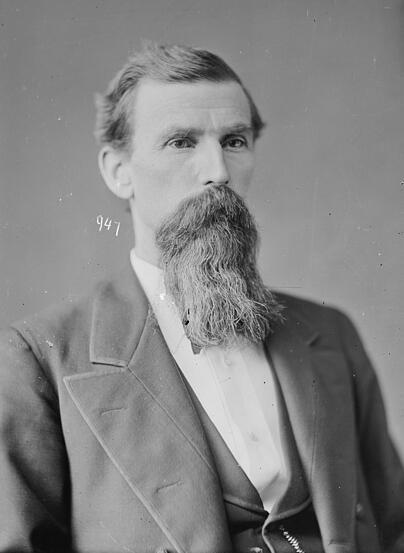
Jeremiah Norman Williams (May 29, 1829 – May 8, 1915) was a Democratic lawyer, state legislator-elect, and two-term U.S. Representative from Alabama whose election to Congress marked the return of Democratic control of Alabama’s 2nd congressional district after Republican dominance during the earlier years of Reconstruction. He was born near Louisville, Barbour County, Alabama, on May 29, 1829, to Judge Stith Williams and Euphemia Williams. Raised in the rural Black Belt region, he attended the preparatory schools of Barbour County before pursuing higher education.
Williams continued his studies at the University of South Carolina in Columbia, from which he graduated in 1852. After completing his collegiate education, he read law in Montgomery and Tuskegee, Alabama, and was admitted to the bar in 1855. He then commenced the practice of law in Clayton, Alabama, the county seat of Barbour County, establishing himself as a local attorney in the years immediately preceding the Civil War.
With the outbreak of the American Civil War, Williams volunteered for service in the Confederate States Army. He was first commissioned as captain of the “Clayton Guards,” a local company, and subsequently rose to the rank of major in the First Regiment, Alabama Infantry. His active military service was cut short when he was compelled to resign his commission due to illness. During the war years he married Mary Eliza Screws, with whom he had five children, and after his resignation he returned to civilian life in Alabama.
Following the conclusion of the Civil War and during the turbulent Reconstruction era, Williams resumed his legal practice in Clayton and entered public life. In 1872 he was elected to the Alabama House of Representatives; however, he was not permitted to take his seat, reflecting the contested and often partisan nature of political power in Alabama during Reconstruction. Despite this setback, he remained active in Democratic Party politics and emerged as a leading figure in efforts to restore Democratic control in his region.
Williams was elected as a Democrat to the United States House of Representatives in 1874, winning the seat for Alabama’s 2nd congressional district in the Forty-fourth Congress. His election marked the return of Democratic control of that district after a period of Republican representation during the early Reconstruction years. He took office on March 4, 1875. After a redistricting of Alabama’s congressional boundaries, he successfully stood for reelection and served in the Forty-fifth Congress as the representative of Alabama’s 3rd congressional district. In the House of Representatives, Williams served from March 4, 1875, to March 3, 1879, completing two full terms. During the Forty-fifth Congress he was chairman of the Committee on Expenditures in the Post Office Department, where he participated in overseeing federal spending and contributed to the legislative process on matters related to postal administration and fiscal accountability. Throughout his tenure, he represented the interests of his constituents and participated in the broader national debates of the post-Reconstruction era.
After leaving Congress in 1879, Williams returned to Clayton and resumed the practice of law. His legal career continued to advance, and he was appointed Chancellor of the third division of the Alabama chancery court, serving in that judicial capacity from 1893 to 1899. In this role he presided over equity cases and contributed to the development and administration of Alabama’s chancery jurisprudence. His experience as both legislator and jurist made him a respected figure in state legal and political circles.
In the later phase of his public service, Williams participated in the Alabama Constitutional Convention of 1901, a pivotal gathering that drafted a new state constitution and reshaped the legal and political framework of Alabama at the turn of the twentieth century. After this service he largely withdrew from public office, continuing to reside in Clayton. Jeremiah Norman Williams died in Clayton, Alabama, on May 8, 1915, and was interred in the City Cemetery, closing a long life that spanned antebellum Alabama, the Civil War, Reconstruction, and the reestablishment of Democratic political control in the state.
Congressional Record