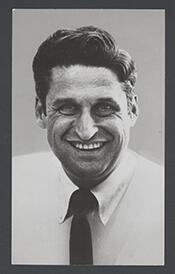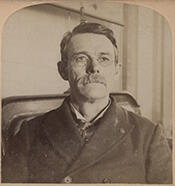
Jeremiah Simpson (March 31, 1842 – October 23, 1905), nicknamed “Sockless Jerry” Simpson, was an American politician from the state of Kansas and a leading figure of late nineteenth-century agrarian radicalism. An old-style populist, he was elected to the United States House of Representatives three times and served as a Representative from Kansas in the United States Congress from 1891 to 1899. A member of the Populist (People’s) Party, he was also a former Greenbacker and an adherent of Georgist single-tax ideas, and he became nationally known as one of the party’s principal congressional leaders.
Simpson was born on March 31, 1842, in Prince Edward Island, Canada. When he was about six years old, his family moved to Oneida County, New York, where he spent his boyhood. Although he performed poorly in formal schooling, he was regarded as intelligent and became a voracious reader, educating himself outside the classroom. During the American Civil War he enlisted in the Illinois Volunteer Infantry, but his military service was cut short when he was discharged for medical reasons.
After the war, Simpson moved to Indiana and went to work on the Great Lakes, signing on as a deckhand on a steamship. Over time he rose to the position of captain, and during this period he married and began a family; he married in 1870. Seeking a more settled life than that of a lake captain, he moved west to Kansas, settling first in Jackson County, where he purchased a farm and took up agriculture. In the late 1870s, however, a combination of general hard times for farmers and personal tragedy—the death of his child in a sawmill accident—prompted him to move farther south within the state.
Simpson relocated to Barber County, Kansas, where he bought a ranch and a herd of cattle and attempted to rebuild his fortunes as a stockman. In the severe winter of 1883–1884, a prolonged spell of bitter weather killed his entire herd, leaving him financially ruined. Reduced to taking whatever work he could find, he served as town marshal in Medicine Lodge, Kansas. It was during these difficult years that Simpson, angered by his own economic plight and that of his neighbors, first became deeply involved in politics. He became an organizer for the Union Labor Party, a local offshoot of the defunct Greenback Party, of which he had been a member. Running under the Union Labor banner, he was a candidate for the Kansas state legislature in 1886 and 1888, but on both occasions he was defeated by Republican T. A. McNeal, reflecting the continuing dominance of the Republican Party in the state.
By the late 1880s, conditions for Kansas farmers deteriorated further. In 1889 the price of corn, the state’s principal crop, fell so low that it was widely burned as fuel across Kansas. In response, agrarian activists associated with the Farmers’ Alliance organized the People’s Party, or Populist Party, and Simpson joined their ranks. At the convention of the Kansas People’s Party he was easily nominated as the party’s candidate for Congress. In the ensuing campaign he faced Republican Colonel James Reed Hallowell, a railroad attorney popularly known as “Prince Hal,” who campaigned from the back of a private rail car. Simpson ran on a populist platform calling for public ownership of railroads, a graduated income tax, the abolition of national banks, and universal suffrage. He denounced Hallowell as a pampered representative of wealth whose feet were “encased in fine silk hosiery.” Hallowell retorted that owning silk socks was better than having none at all. The exchange, amplified by the efforts of prominent Populist campaigner Mary Elizabeth Lease, helped fix Simpson’s enduring nickname, “Sockless Jerry,” and he defeated Hallowell by a margin of about 8,000 votes.
Simpson took his seat in the U.S. House of Representatives in 1891 and served three terms, with his congressional service extending from 1891 to 1899. As a member of the House of Representatives from Kansas, he participated actively in the legislative process and represented the interests of his agrarian and small-town constituents during a significant period in American political and economic history. In Congress he quickly emerged as a forceful advocate for Populist causes and was widely regarded as the party’s congressional leader. A committed Georgist, he supported land-value taxation and in 1894 was one of only six members of Congress to vote for a single-tax amendment to the Wilson–Gorman Tariff Act, proposed by Democrat James G. Maguire of California as a substitute for the bill’s income tax provision. The amendment would have levied a direct tax of $31,311,125 on land values nationwide. After its defeat, Simpson voted for the original version of the Wilson–Gorman bill, though he did not vote on the final version returned by the Senate several months later.
Electorally, Simpson’s congressional career reflected both the rise and decline of the Populist movement. He was re-elected in 1892 by a relatively narrow margin of about 2,000 votes, running slightly behind James B. Weaver, the Populist presidential nominee, who that year also secured the Democratic ballot line in Kansas. By 1894, however, the Populist tide had begun to ebb. In that year’s election Simpson lost his seat in a close race to Republican Chester I. Long. Undeterred, he mounted a vigorous campaign in 1896, again challenging Long and successfully regaining his House seat. His return to Congress proved temporary; in the election of 1898 Long once more defeated him, ending Simpson’s service in the national legislature after three nonconsecutive terms.
After leaving Congress and deciding that he had lost his taste for farming, Simpson moved to New Mexico, where he entered the real estate business. In the early years of the new century he suffered a debilitating brain aneurysm. Aware that his health was failing, he returned by train to Kansas. Jeremiah “Sockless Jerry” Simpson died in a hospital in Wichita, Kansas, on October 23, 1905. He was interred in Maple Grove Cemetery in Wichita, closing the life of one of the most colorful and outspoken figures of the Populist era in Kansas and national politics.
Congressional Record