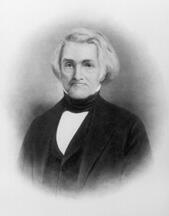
Jeremiah Morrow (October 6, 1771 – March 22, 1852) was a Democratic-Republican Party politician from Ohio who became one of the most prominent early statesmen of the state and the Old Northwest. Born near Gettysburg in the Province of Pennsylvania, he was of Scots-Irish descent; his Irish grandfather, also named Jeremiah Morrow, had emigrated from County Londonderry and was descended from 17th‑century Scottish settlers. Raised in this cultural and religious tradition, Morrow became a member of the Associate Reformed Presbyterian Church, a connection that would remain important throughout his life.
Morrow moved to the Northwest Territory in 1795, during the formative years of American settlement in the region. He first lived at the mouth of the Little Miami River for a short time before relocating to what is now Warren County, Ohio. As a devout member of the Associate Reformed Presbyterian Church, he sought out a minister of his denomination soon after settling in the territory and became one of the original elders of the Mill Creek congregation when it was organized shortly before 1800. His early leadership in religious and community affairs paralleled his growing involvement in territorial politics.
Morrow’s public career began in the government of the Northwest Territory. He served in the Territorial House of Representatives and the Territorial Senate, gaining experience in legislative affairs as the region moved toward statehood. In 1802 he was a Hamilton County delegate to the Ohio Constitutional Convention, which drafted the state’s first constitution and laid the foundation for Ohio’s admission to the Union. Following statehood in 1803, he was elected to the first Ohio State Senate and served there for approximately six months before being chosen to represent the new state at the national level.
Jeremiah Morrow served as a Representative from Ohio in the United States Congress from 1803 to 1843, contributing to the legislative process during eight terms in office. He was Ohio’s first member of the United States House of Representatives, initially elected as a Democratic-Republican. He won four additional full terms in the House in this early phase of his congressional service, representing the interests of his frontier constituents as the nation expanded westward. His service in Congress occurred during a significant period in American history, and as a member of the House of Representatives he participated actively in the democratic process. In 1812 he successfully ran for the United States Senate and served a single term from 1813 to 1819, becoming the first U.S. Senator from Ohio to complete a full six‑year term. During this period he was elected a member of the American Antiquarian Society in 1814, reflecting his standing in national intellectual and political circles. In 1820 he served as one of Ohio’s presidential electors for James Monroe. After an interval back in state politics, he was sent again to Washington in 1841 and served two more years in the House of Representatives. By this later period he was associated with the Whig Party, and he declined renomination in 1842, stating that he believed himself too old to continue in national office.
In addition to his federal service, Morrow played a central role in Ohio’s state government. He served in both the Ohio House of Representatives and the Ohio Senate at various points in his career, helping to shape the state’s early legislative framework. In 1822 he was elected the ninth governor of Ohio and became the last Democratic-Republican to hold that office. He served two two‑year terms as governor, overseeing a period of growth and institutional development in the young state. After declining to run for a third term, he returned once more to the Ohio legislature, continuing his long record of public service at the state level.
After retiring from active politics following his final term in Congress, Morrow returned to his farm and gristmill in Warren County, Ohio. He lived there quietly in his later years, remaining a respected figure in the community he had helped to establish and represent. He died on March 22, 1852. His legacy endured in Ohio’s political memory and geography: the Jeremiah Morrow Bridge, the highest bridge in Ohio, was named in his honor, as were Morrow County and the town of Morrow, Ohio. His family also continued a tradition of public and educational service; his grandson, George E. Morrow, became a professor at the University of Illinois and Iowa State University and later served as president of Oklahoma State University.
Congressional Record