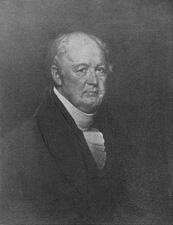
Jeremiah Mason (April 27, 1768 – October 14, 1848) was a United States senator from New Hampshire and a prominent Federalist lawyer and statesman during the early national period. He served as a Senator from New Hampshire in the United States Congress from 1813 to 1817, completing one term in office. As a member of the Federalist Party, he contributed to the legislative process during a significant period in American history, participating in the democratic process and representing the interests of his New Hampshire constituents in the Senate.
Little is recorded in the provided sources about Mason’s early life and upbringing, but he came of age in the generation that followed the American Revolution, entering public life as the new federal government and party system were taking shape. His early years coincided with the formation of the Federalist and Democratic-Republican parties, and he aligned himself with the Federalists, whose emphasis on a strong national government and commercial development shaped his later public career.
On November 6, 1799, Mason married Mary Means (1777–1858), thereby connecting himself to a prominent New England family. Mary was the daughter of Robert Means and Mary (née McGregor) Means. Through this marriage, Mason became brother-in-law to Elizabeth Means, who was married to Congregationalist minister Jesse Appleton. Jesse and Elizabeth Appleton were the parents of Jane Means Appleton, who later became the wife of Franklin Pierce, the 14th President of the United States. Jeremiah and Mary Mason were the parents of eight children, several of whom went on to notable careers and alliances that further embedded the family in the social and professional networks of New England.
Among their children was George Means Mason (1800–1865), who lived through much of the nineteenth century and maintained the family’s standing. Another son, Robert Means Mason (1810–1879), married Sarah Ellen Francis (1819–1865), daughter of Ebenezer Francis and Elizabeth (née Thorndike) Francis, in 1843, linking the Masons to another established New England family. Their son Charles Mason (1812–1862) entered the clergy and became the rector of Grace Church in Boston. Charles married Susannah Lawrence (1817–1844), a daughter of the wealthy merchant and philanthropist Amos Lawrence, thus connecting the Masons to one of Boston’s leading mercantile families. After Susannah’s death, Charles married Anna Huntington Lyman (1821–1883) in 1849; Anna’s sister was married to agricultural writer Richard L. Allen, extending the family’s associations into literary and agricultural circles.
Mason’s professional life was centered on the law and public service, and by the early nineteenth century he had established himself as a leading attorney in New England. His legal acumen and Federalist principles brought him into the political arena, where he became a trusted figure among Federalist leaders. This reputation led to his selection for the United States Senate, where he took his seat as a senator from New Hampshire in 1813. His tenure coincided with the War of 1812 and its aftermath, a period marked by intense debate over national defense, commerce, and the balance of power between the federal government and the states.
During his service in Congress from 1813 to 1817, Mason represented New Hampshire at a time when New England’s commercial interests and Federalist skepticism of the war were central issues in national politics. As a member of the Senate, he participated in deliberations over wartime measures, postwar economic policy, and the evolving role of the federal government. Although specific legislative initiatives are not detailed in the available sources, his work in the Senate reflected the Federalist commitment to fiscal responsibility, legal order, and the protection of commercial interests, and he contributed to shaping policy during a formative era in the republic’s development.
After completing his single term in the Senate in 1817, Mason returned to private life and the practice of law, where he continued to exert influence through his legal work and counsel. His later years were spent largely in Massachusetts, particularly in Boston, which by mid-century had become a major center of commerce, law, and intellectual life in New England. Surrounded by a network of family members active in the church, commerce, and public affairs, Mason remained a respected elder statesman of the Federalist generation even as the party itself declined and new political alignments emerged.
Jeremiah Mason died in Boston on October 14, 1848. He was interred in Mount Auburn Cemetery in Cambridge, Massachusetts, one of the nation’s earliest and most distinguished rural cemeteries, where many notable New England figures of the nineteenth century are buried. His life and career spanned the early decades of the United States, from the post-Revolutionary period through the rise of new political parties, and his service as a United States senator from New Hampshire from 1813 to 1817 placed him among the key Federalist voices in the national councils during a critical period in American history.
Congressional Record