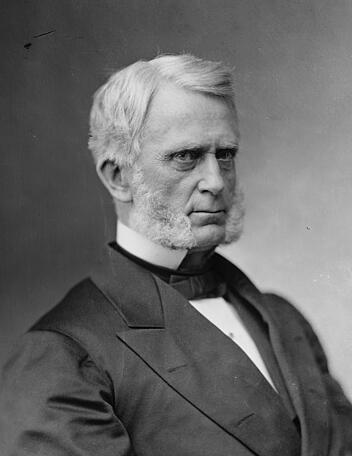
Jeremiah Wilbur Dwight (April 17, 1819 – November 26, 1885) was a U.S. Representative from New York and a member of the Republican Party who served three consecutive terms in Congress from 1877 to 1883. He was the father of John Wilbur Dwight, who also later served in the United States House of Representatives. His congressional service took place during a significant period in American history in the years following the Civil War and Reconstruction, when he participated in the legislative process and represented the interests of his New York constituents in the House of Representatives.
Dwight was born on April 17, 1819, in Cincinnatus, Cortland County, New York. He was the son of Elijah Dwight (1797–1868) and Olive Standish Dwight (1795–1874). Through his mother, he was descended from Myles Standish of Plymouth Colony, and through his father he was part of the prominent New England Dwight family, being a great-grandson of Joseph Dwight (1703–1765). In 1830 he moved with his parents to Caroline, New York, and in 1836 the family relocated again to Dryden, in Tompkins County, which would remain the center of his personal, business, and political life.
Dwight attended local district schools and pursued further education at Burhan’s School in Dryden. After completing his schooling, he entered private enterprise and became engaged in a variety of business pursuits. Over the course of his early career he worked in mercantile trade, engaged in farming, invested in and managed real-estate holdings, and participated in the manufacture and sale of lumber. These activities established him as a significant local businessman and landholder in Dryden and the surrounding region.
Dwight’s prominence in local affairs led to his entry into public service. He served as chairman of the board of supervisors of the town of Dryden in 1857 and 1858, giving him an early role in county-level administration and finance. He was elected to the New York State Assembly from Tompkins County, serving in 1860 and 1861. With the outbreak of the Civil War, Governor Edwin D. Morgan appointed him in 1861 as a member of the senatorial district war committee, a body responsible for supporting the Union war effort at the state and local levels, including matters related to recruitment and the organization of resources.
In addition to his state and local offices, Dwight became active in Republican Party politics at the national level. He served as a delegate to multiple Republican National Conventions, participating in the conventions of 1868, 1872, 1876, 1880, and 1884. His repeated selection as a delegate reflected his standing within the party and his influence in New York Republican circles. Parallel to his political work, he maintained substantial business interests, notably in transportation. He served for many years as a director, member of the executive committee, and vice president of the Southern Central Railroad, contributing to the development of regional rail infrastructure and commerce in upstate New York.
Dwight was elected as a Republican to the Forty-fifth, Forty-sixth, and Forty-seventh Congresses, serving in the U.S. House of Representatives from March 4, 1877, to March 3, 1883. During his three terms in office he took part in the deliberations of the post-Reconstruction era, when Congress addressed issues of national economic development, veterans’ affairs, and the evolving relationship between the federal government and the states. As a member of the House of Representatives, he participated in the democratic process and represented the interests of his New York constituents, contributing to the legislative work of the period. After three terms, he declined to be a candidate for renomination in 1882.
Following his retirement from Congress in 1883, Dwight returned to Dryden and resumed his former business activities, including his interests in agriculture, real estate, and railroads. He remained a figure of local prominence and continued to be associated with Republican politics, including his role as a delegate to the 1884 Republican National Convention. Jeremiah Wilbur Dwight died in Dryden, New York, on November 26, 1885. He was interred in Green Hills Cemetery in Dryden, closing a life that combined business enterprise, local and state service, and three terms in the national legislature.
Congressional Record