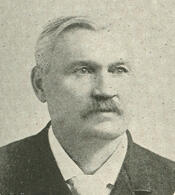
Jeremiah Vardaman Cockrell, also known as Vard Cockrell, (May 7, 1832 – March 18, 1915) was a U.S. Representative from Texas, serving in the United States Congress from 1893 to 1897, after having been a field commander in the Confederate States Army during the American Civil War. A member of the Democratic Party and a prominent figure in the political South–Cockrell–Hargis family, he contributed to the legislative process during two terms in office and represented the interests of his Texas constituents during a significant period in American history.
Cockrell was born near Warrensburg, Johnson County, Missouri, on May 7, 1832, to Joseph Cockrell, who served as sheriff of Johnson County, and Nancy (Ellis) Cockrell. His parents had migrated to Missouri from the Upper South, and he grew up in a frontier environment shaped by westward expansion and sectional tensions. He attended the common schools of the area and later studied at Chapel Hill College in Lafayette County, Missouri. He was the older brother of Francis Marion Cockrell, who, like him, served as a Confederate officer and later became a United States Senator from Missouri, further underscoring the family’s political prominence.
As a young man, Cockrell joined the westward movement to California during the Gold Rush of 1849. He worked near the Bear River as both a miner and a merchant, gaining early experience in business and frontier life. In 1853 he returned to Missouri, where he engaged in agricultural pursuits and studied law. For a period he also served as a minister in the Methodist Church, reflecting both his religious commitments and his growing role as a community leader. On April 7, 1852, he married Maranda “Jane” Douglas; the couple had five children together, and his family life remained an important foundation throughout his subsequent military and political career.
With the outbreak of the Civil War, Cockrell entered the Missouri State Guard and later joined the Confederate States Army as a lieutenant, eventually attaining the rank of colonel. He served throughout the conflict and took part in several major engagements in the Trans-Mississippi Theater. Within the 8th Division of the Missouri State Guard, he fought at the Battle of Carthage, the Battle of Wilson’s Creek, and the Siege of Lexington, all in Missouri. He was nominally in command at the Battle of Lone Jack, Missouri, in August 1862, a hard-fought engagement between Union and Confederate forces. In October 1862, he led a skirmish of State Guard troops and guerrillas, alongside Bill Truman, against Kansas forces at the Skirmish at Island Mound in Bates County, Missouri. This action is historically notable as the first time a regiment of African American soldiers engaged in combat against Confederate forces; the Black troops held their ground and contributed to a Union victory. In 1864 Cockrell was wounded so severely that he could not return to field duty, effectively ending his active military service before the close of the war.
At the conclusion of the Civil War, Cockrell moved with his family to Sherman, Texas, where he resumed civilian life and established himself in the legal profession. He practiced law and quickly became involved in local public affairs. In 1872 he was appointed Chief Justice of Grayson County, Texas, a position that placed him at the center of county judicial administration during the turbulent Reconstruction and post-Reconstruction years. He also participated in party politics, serving as a delegate to the Democratic state conventions in 1878 and 1880, thereby helping to shape the direction of the Democratic Party in Texas during a period of political realignment in the South.
Seeking new opportunities in the developing regions of Texas, Cockrell and his family later moved from northern Texas to Jones County, in the central part of the state. There he continued his judicial career and was appointed judge of the Thirty-ninth judicial district court in 1885. He was subsequently elected to that judgeship in 1886 and re-elected in 1890, reflecting the confidence of the local electorate in his legal judgment and public service. His years on the bench in both Grayson and Jones Counties solidified his reputation as a respected jurist and community leader.
In 1892, Cockrell was elected as a Democrat to the United States House of Representatives from Texas, entering the Fifty-third Congress and serving through the Fifty-fourth Congress, from 1893 to 1897. During his two terms in office, he participated in the democratic process at the national level and contributed to the legislative work of the House of Representatives at a time marked by debates over economic policy, regional development, and the lingering effects of Reconstruction. As a Representative from Texas, he represented the interests of his constituents and the broader concerns of his state. He chose not to be a candidate for renomination in 1896 and concluded his congressional service at the end of his second term in 1897.
After leaving Congress, Cockrell returned to private life in Jones County, Texas, where he engaged in farming and stock raising. He remained a figure of local prominence, drawing on his long experience in law, the judiciary, and national politics. His family continued to play a role in Texas public life; notably, his son Joseph E. Cockrell later founded the Southern Methodist University School of Law, extending the family’s influence into legal education and the development of the legal profession in the region.
Jeremiah Vardaman Cockrell died in Abilene, Texas, on March 18, 1915, at the age of 82. He was interred in the Masonic Cemetery in Abilene. His life spanned the era from antebellum America through the Civil War and Reconstruction into the early twentieth century, and his career as a Confederate officer, Texas jurist, and Democratic member of the United States House of Representatives reflected the complex political and social transformations of his time.
Congressional Record