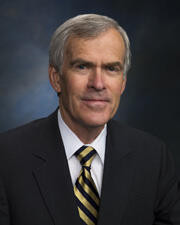
Jesse Francis “Jeff” Bingaman Jr. (born October 3, 1943) is an American retired politician and attorney who represented New Mexico in the United States Senate from January 3, 1983, to January 3, 2013. A member of the Democratic Party, he served five terms in the Senate and previously held statewide office as the 25th Attorney General of New Mexico from 1979 to 1983. Over the course of his three decades in Congress, he became a leading voice on energy, natural resources, environmental protection, and public lands policy, and he served as Chairman of Committee Outreach for the Senate Democratic Caucus as well as the longtime chair of the Senate Committee on Energy and Natural Resources.
Bingaman was born in El Paso, Texas, the son of Frances Bethia (née Ball) and Jesse Francis Bingaman. His family soon settled in Silver City, New Mexico, where he was raised. His father taught at Western New Mexico University, and his mother taught in the local public school system, grounding him early in the life of New Mexico’s educational and civic institutions. As a youth he was active in Scouting and, at age 15, earned the rank of Eagle Scout. He graduated from Silver High School in 1961.
Following high school, Bingaman attended Harvard University, where he earned a Bachelor of Arts degree in government in 1965. He then enrolled at Stanford Law School, receiving his Juris Doctor in 1968. During this period he developed an interest in public service and public policy that would shape his later legal and political career. After his admission to the bar, he entered private practice in New Mexico, working as an attorney alongside his wife. In 1969 he served as counsel to the New Mexico Constitutional Convention, gaining early experience in legislative drafting and state constitutional issues. From 1968 to 1974, he was a member of the U.S. Army Reserve, completing basic training at Fort Dix, New Jersey, as a private and graduating in April 1969 from the chaplain enlisted assistant technician course at the Army Chaplain School at Fort Hamilton, New York.
Bingaman’s early legal career included a period of service in the New Mexico Attorney General’s office, where he worked briefly as a staff attorney. In 1978 he ran for the leadership of that office and was elected Attorney General of New Mexico, taking office in 1979. As attorney general he focused on environmental and antitrust issues, reflecting concerns that would remain central to his later legislative work. Limited by the state constitution from seeking another term in that office, he announced his candidacy for the United States Senate on January 14, 1981, becoming the first major candidate to enter the race for New Mexico’s Class I Senate seat.
In the 1982 election, Bingaman was elected to the U.S. Senate, defeating one-term Republican incumbent Harrison Schmitt, a former astronaut who had walked on the Moon. Bingaman’s campaign criticized Schmitt for insufficient attention to New Mexico’s local concerns, encapsulated in the slogan, “What on Earth has he done for you lately?” He took office on January 3, 1983, and was subsequently reelected four times, serving until his retirement on January 3, 2013. His Senate tenure spanned a significant period in American history, including the end of the Cold War, the post–September 11 era, and major debates over energy, health care, and foreign policy. Although he generally maintained a low national profile, he became one of the Senate’s most experienced members; by the time of his retirement he was the ninth most senior senator. He was very popular in New Mexico and faced serious opposition only once, in his 1994 reelection campaign.
Throughout his Senate career, Bingaman held key committee assignments that reflected both New Mexico’s interests and his policy priorities. He served on the Committee on Armed Services, including the Subcommittees on Emerging Threats and Capabilities, Personnel, and Strategic Forces, where he helped oversee defense policy and the nation’s nuclear weapons complex, an issue of particular importance to New Mexico’s national laboratories. He was best known for his work on the Committee on Energy and Natural Resources, which he chaired for many years, and where he focused on energy policy, public lands, and environmental protection. He also served on the Committee on Finance—sitting on the Subcommittees on Health Care; Energy, Natural Resources, and Infrastructure (which he chaired); International Trade, Customs, and Global Competitiveness; and Fiscal Responsibility and Economic Growth—and on the Committee on Health, Education, Labor, and Pensions, including its Subcommittees on Children and Families and on Primary Health and Aging. In addition, he was a member of the Joint Economic Committee. Within the Senate Democratic Caucus, he served as Chairman of Committee Outreach, helping coordinate committee work and legislative strategy. He also participated in several caucuses, including as co-chair of the Congressional Competitiveness Caucus, and as a member of the International Conservation Caucus and the Senate Diabetes Caucus.
Bingaman’s legislative record was marked by a strong emphasis on environmental protection, energy policy, and conservation. He consistently supported measures to protect wildlife and public lands and became a leading advocate for clean energy policies. He spoke publicly in favor of the Clean Energy Act of 2007, emphasizing the importance of developing clean technology and green jobs and backing the elimination of certain tax breaks for oil and gas companies. Beginning in 2006, he worked to enact legislation that would have reduced greenhouse gas emissions through a “cap and trade” system, with the goal of returning emissions to 1990 levels by 2030 and increasing federal funding for research and development of green technologies. Although those efforts did not ultimately succeed in becoming law, they helped frame the national debate over climate policy. On immigration, reflecting his representation of a border state, he advocated a combination of increased border enforcement—including more patrol agents and the use of surveillance technology—with the creation of a guest worker program to allow immigrants seeking honest work to enter legally. He voted against the Secure Fence Act of 2006, opposed declaring English the official language of the U.S. government, and supported continued federal funding for self-declared “sanctuary cities.”
On social and civil liberties issues, Bingaman generally aligned with the majority of his party. He supported abortion rights and received a 100 percent rating from NARAL Pro-Choice America. He backed reinstatement of the Fairness Doctrine in broadcasting. Although he voted for the Defense of Marriage Act in 1996, he later opposed efforts to amend the Constitution to ban same-sex marriage and received favorable ratings from gay rights organizations, including an 89 percent rating from the Human Rights Campaign. He twice voted against proposed constitutional amendments to ban flag desecration and supported affirmative action programs. On criminal justice, he favored a pro‑rehabilitation approach, supporting programs aimed at preventing youth crime, reducing high school dropout rates, and combating drug abuse. He was an outspoken critic of the detention policies at the Guantanamo Bay facility, arguing that the indefinite holding of detainees without basic due process rights was inconsistent with the rule of law and damaging to the United States’ international standing, and he warned that U.S. practices toward prisoners could influence how American service members might be treated if captured.
Bingaman also played a role in major foreign policy and national security debates. On October 11, 2002, he was among the 23 senators who voted against authorizing the use of military force in Iraq, reflecting his concerns about the war’s justification and potential consequences. Domestically, he was a reliable Democratic vote on core economic and social legislation, while maintaining a reputation for pragmatism and a relatively low-key public style. In the 110th Congress (2007–2009), he and fellow New Mexico Senator Pete Domenici formed the longest-serving Senate duo, and because Domenici was the state’s longest-serving senator, Bingaman spent 26 years as New Mexico’s junior senator despite having greater seniority than most of his colleagues; during that period he was the most senior junior senator in the chamber. On April 28, 2008, he endorsed Senator Barack Obama for the 2008 Democratic presidential nomination. On February 18, 2011, Bingaman announced that he would not seek reelection in 2012, and he formally retired from the Senate on January 3, 2013, concluding the second-longest Senate tenure in New Mexico history, behind only Domenici.
After leaving Congress, Bingaman remained active in public policy and legal education. He returned to Stanford Law School, his alma mater, as a fellow at the Steyer–Taylor Center for Energy Policy and Finance, continuing his long-standing engagement with energy and environmental issues in an academic and advisory capacity. In 2022 he published “Breakdown: Lessons for a Congress in Crisis,” in which he examined the erosion of congressional norms, identified key obstacles to effective governance, evaluated their impact on eight major legislative efforts during his Senate career, and proposed reforms aimed at improving the functioning of Congress.
Congressional Record