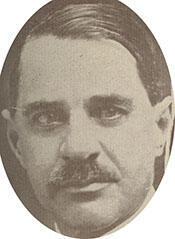
James Witherell (June 16, 1759 – January 9, 1838) was an American politician who served as a United States Representative from Vermont and as a judge of the Supreme Court for the Territory of Michigan. A member of the Republican (Democratic-Republican) Party, he held office in both state and territorial government during a formative period in the early United States, participating in the legislative process and representing the interests of his constituents in Congress and on the frontier.
Witherell was born in Mansfield, in the Province of Massachusetts Bay, on June 16, 1759. After completing preparatory studies, he entered military service during the American Revolutionary War. From 1775 to 1783 he served in the Continental Army, beginning as a private and rising to the rank of adjutant in the Eleventh Massachusetts Regiment. He was severely wounded in the Battle of White Plains in 1776, an experience that marked his early adulthood and reflected his long-standing engagement in public service.
Following the Revolutionary War, Witherell pursued professional training in both medicine and law. He studied medicine and law and was licensed to practice medicine in 1788. That same year he moved to Hampton in the Vermont Republic, and in 1789 he settled in Fair Haven, where he continued to practice his profession. On November 11, 1790, he married Amy Hawkins; the couple had six children. His family would go on to play a significant role in Michigan’s legal and political life, with his son Benjamin F. H. Witherell later serving as a justice of the Michigan Supreme Court and his grandson Thomas W. Palmer becoming a United States Senator from Michigan.
Witherell quickly became active in Vermont public affairs. He served as a member of the Vermont House of Representatives from 1798 to 1802, participating in the legislative work of the newly admitted state. He was associate county judge from 1801 to 1803 and then judge of Rutland County from 1803 to 1806, while also serving as an executive councilor from 1802 to 1806. These judicial and executive roles in Vermont established his reputation as a capable jurist and public official and prepared him for later responsibilities at the federal and territorial levels.
As a member of the Republican (Democratic-Republican) Party representing Vermont, Witherell was elected to the Tenth Congress and served one term in the United States House of Representatives from March 4, 1807, until May 1, 1808. His service in Congress occurred during a significant period in American history, as the young republic grappled with issues of trade, slavery, and relations with European powers. While in Congress, he argued in favor of the federal act that abolished the transatlantic slave trade and voted for the measure, which took effect in 1808. He resigned his seat on May 1, 1808, to accept an appointment by President Thomas Jefferson as one of the judges of the Supreme Court for the Territory of Michigan.
Witherell’s judicial career in the Michigan Territory spanned nearly two decades. As a judge of the territorial supreme court, he helped shape the legal framework of the region as American settlement expanded. During the War of 1812, he was in command of the troops at Detroit in the absence of General William Hull and was taken prisoner when Hull surrendered the post to British forces. While on parole from the British, he resided in Fair Haven, Vermont, before being exchanged and returning to his judicial duties in Detroit in the Michigan Territory. In his capacity as a territorial judge, he also participated in important educational legislation: on April 30, 1821, Governor Lewis Cass and Judges John Griffin and James Witherell approved an act that changed the name of the Catholepistemiad or University of Michigania to the University of Michigan and placed control of the institution in the hands of a board of trustees consisting of twenty members plus the governor.
After serving as a Supreme Court justice for nearly twenty years, Witherell resigned his judgeship in 1828 to accept a new territorial executive position. President John Quincy Adams appointed him Secretary of the Territory of Michigan, an office he held until May 1830. During the first three months of 1830 he served as Acting Governor of the Territory of Michigan, overseeing territorial administration at a time when the region was moving toward eventual statehood. His combined legislative, judicial, and executive service made him a central figure in the development of Michigan’s territorial government.
James Witherell died at his home in Detroit on January 9, 1838, less than a year after the Michigan Territory was admitted to the Union as the State of Michigan. He was originally interred at the Russell Street Cemetery in Detroit and was later reburied in Elmwood Cemetery in the same city. His career, spanning military service in the Revolution, legislative work in Vermont, a term in the United States Congress, and long judicial and executive service in the Michigan Territory, reflected the broad scope of public responsibilities undertaken by early American officeholders.
Congressional Record