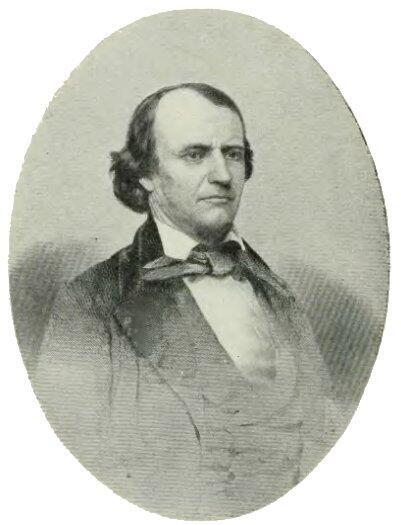
James Thorington (May 7, 1816 – June 13, 1887) was a frontiersman, lawyer, judge, and one-term U.S. Representative from Iowa’s 2nd congressional district. Born in Wilmington, North Carolina, he moved with his parents in 1827 to Montgomery, Alabama. He attended common schools and later pursued more formal education at the military school in Fayetteville, North Carolina, from 1830 to 1832, followed by studies at the University of Alabama at Tuscaloosa from 1832 to 1835. After leaving the university, he began the study of law in Montgomery, laying the foundation for a long career in public service and the legal profession.
Thorington’s early adulthood included a period of frontier experience that contributed to his reputation as a frontiersman. He interrupted his legal studies to trap and trade on the upper Missouri and Columbia Rivers from 1837 to 1839, engaging directly in the economic and exploratory activity of the American West during a period of territorial expansion. In 1839 he settled in Davenport, in what would become the state of Iowa, then a developing community on the Mississippi River. His arrival in Davenport marked the beginning of his sustained involvement in local affairs and public office.
In Davenport, Thorington quickly emerged as a civic leader. He was elected mayor of Davenport in 1843, a position he held until 1847, guiding the community through its early municipal development. While serving as mayor, he was admitted to the bar in 1844 and commenced the practice of law in Davenport. At the same time, he undertook judicial and administrative responsibilities at the county level. He served as probate judge of Scott County, Iowa, from 1843 to 1851, overseeing matters of estates and guardianships, and as clerk of the district court from 1846 to 1854, managing the official records and proceedings of the county’s principal trial court.
Thorington’s prominence in local government and the legal community led to his election to the United States House of Representatives. In 1854 he was elected as a Whig to represent Iowa’s 2nd congressional district in the Thirty-fourth Congress, serving from March 4, 1855, to March 3, 1857. As a member of the Independent Party representing Iowa, he contributed to the legislative process during his single term in office. His service in Congress occurred during a significant period in American history, marked by sectional tensions over slavery and the realignment of national political parties. While he was in Congress, the Iowa Republican Party was founded, and he was a charter member of the new organization; for that reason, he has been styled as the first Republican congressman from Iowa, reflecting his early alignment with the emerging Republican movement even though he had been elected as a Whig.
With the dissolution of the Whig Party and the rise of the Republican Party, Thorington sought to continue his congressional career under the new partisan banner. In 1856 he was a candidate for the Republican Party’s nomination for his seat in the House of Representatives. At the district convention, however, he lost the nomination on the ninth ballot to Timothy Davis, who subsequently won the general election. Thorington thus concluded his congressional service after a single term, returning to Iowa public life at a time when the nation was moving toward civil conflict.
After leaving Congress, Thorington remained active in county government and law enforcement. He served as sheriff of Scott County from 1859 to 1863, a period that overlapped with the early years of the Civil War, and then as county recorder from 1864 to 1868, responsible for maintaining official records of property and other legal instruments. These roles extended his long record of administrative and judicial service at the local level and underscored his continued influence in the civic affairs of Davenport and Scott County.
In the 1870s, Thorington’s public service took on an international dimension. He was appointed United States consul at Aspinwall, Colombia (now Colón, Panama), on January 21, 1873. On May 27, 1873, he was also appointed commercial agent at the same city, reflecting the strategic importance of the Isthmus of Panama as a transit route between the Atlantic and Pacific Oceans. He served in both positions until October 21, 1882, representing U.S. commercial and consular interests in a key port city during an era of growing American involvement in hemispheric trade and transit.
James Thorington died on June 13, 1887, while on a visit to his daughter in Santa Fe, in the New Mexico Territory. His remains were returned to Iowa, and he was interred in Oakdale Cemetery in Davenport. His life encompassed the roles of frontiersman, municipal leader, county judge and official, diplomat, and one-term member of Congress, and his career reflected both the local development of Iowa and the broader political and territorial transformations of the United States in the nineteenth century.
Congressional Record