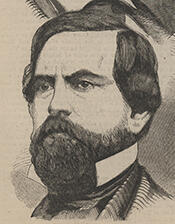
James Adams Stallworth (April 7, 1822 – August 31, 1861) was a Democratic U.S. Representative from Alabama who served in the House of Representatives from 1857 to 1861. Born near Evergreen, Conecuh County, Alabama, he spent his early years in the rural South during the antebellum period. He attended the local Old Field Piney Woods Schools, typical informal country schools of the era that provided basic instruction to children in sparsely settled areas. His upbringing in Evergreen, a small but developing community in southwestern Alabama, shaped his familiarity with agricultural life and the concerns of rural constituents that would later inform his political career.
After his early schooling, Stallworth engaged as a planter, participating in the plantation-based agricultural economy that dominated Alabama in the mid-nineteenth century. While managing his agricultural interests, he pursued the study of law, a common path for ambitious young men seeking entry into public life. He read law in the traditional manner of the time rather than attending a formal law school, and in 1848 he was admitted to the bar. Following his admission, he commenced the practice of law in Evergreen, Alabama, where he combined his legal work with his ongoing involvement in planting.
Stallworth entered public office at a relatively young age. He served as a member of the Alabama House of Representatives from 1845 to 1848, representing his locality in the state legislature during a period of expansion and political realignment in the South. His service in the state house provided him with legislative experience and exposure to the issues confronting Alabama, including questions of internal improvements, states’ rights, and the expansion of slavery into new territories. After his term in the legislature, he continued to build his legal career and public reputation.
In addition to his legislative service, Stallworth held important prosecutorial responsibilities at the state level. He served as solicitor for the second judicial circuit of Alabama in 1850 and again in 1855. As circuit solicitor, he acted as a prosecuting attorney for the state in that judicial district, handling criminal cases and representing the public interest in court. These positions enhanced his standing as a lawyer and public official and furthered his familiarity with the legal and social conditions of his region.
Stallworth sought to extend his political career to the national level in the 1850s. He was an unsuccessful candidate for election in 1854 to the Thirty-fourth Congress, a contest that took place amid rising sectional tensions and the fracturing of national political parties. Despite this initial defeat, he remained active in Democratic Party politics and continued to cultivate support among voters in his district. His persistence was rewarded in the next electoral cycle.
Elected as a Democrat to the Thirty-fifth and Thirty-sixth Congresses, Stallworth served in the U.S. House of Representatives from March 4, 1857, to January 21, 1861. During his two terms in Congress, he represented Alabama at a time of mounting national crisis over slavery, states’ rights, and the future of the Union. As a member of the Democratic Party, he participated in the legislative process and contributed to debates that preceded the outbreak of the Civil War, advocating for the interests of his Alabama constituents within the broader sectional conflicts of the period. His service in Congress coincided with the administrations of Presidents James Buchanan and the early days of Abraham Lincoln’s election, when Southern states began to consider secession.
Stallworth’s congressional career ended as Alabama moved toward separation from the Union. On January 21, 1861, following Alabama’s secession earlier that month, he withdrew from Congress, aligning his actions with those of other Southern representatives whose states had left the Union. His departure marked the close of his federal service just weeks before the formal start of the Civil War in April 1861.
After leaving Congress, Stallworth returned to Alabama, where his life was cut short in the first year of the conflict. He died near Evergreen, Alabama, on August 31, 1861. He was interred in Evergreen Cemetery, in or near the community where he had been born, practiced law, engaged in planting, and built his political career. His life and service reflected the trajectory of many Southern Democratic leaders of his generation, whose careers were deeply intertwined with the sectional controversies that culminated in the dissolution of the Union and the onset of civil war.
Congressional Record