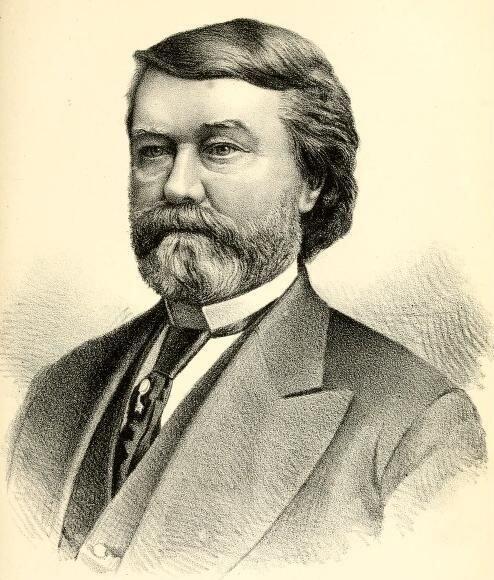
James Washington Singleton (November 23, 1811 – April 4, 1892) was a U.S. Representative from Illinois, lawyer, militia officer, railroad executive, and state legislator whose career spanned medicine, law, agriculture, transportation development, and public service. He was born at “Paxton,” his family’s estate in Frederick County, Virginia, on November 23, 1811. Raised in the Shenandoah Valley, he received his early education at the Winchester Academy in Winchester, Virginia, an institution that prepared many young men of the region for professional and public life.
After completing his studies at Winchester Academy, Singleton initially pursued the study of medicine and practiced for a time, reflecting the broad professional training common among ambitious young men of his era. He subsequently turned to the study of law, a field that offered wider opportunities in the rapidly developing western states. In 1834 he moved west to Mount Sterling, Illinois, then a growing community on the frontier of the young state. He continued his legal studies there and was admitted to the bar in 1838, commencing the practice of law in Mount Sterling. Alongside his legal work, he engaged in agricultural pursuits, establishing himself as both a professional man and a landowner in his adopted state.
Singleton quickly became active in Illinois civic and military affairs. In 1844 he was elected brigadier general of the Illinois Militia, a position that placed him in a prominent role during the so‑called Mormon War, the period of conflict and tension between state authorities and members of The Church of Jesus Christ of Latter-day Saints in western Illinois. His militia service enhanced his public profile and helped launch a long career in state politics. He was chosen as a delegate to the Illinois constitutional convention of 1847, where he participated in revising the state’s fundamental law, and he continued to balance his legal practice, farming interests, and growing political responsibilities.
By mid-century Singleton had become a significant figure in Illinois politics. He served as a member of the Illinois House of Representatives from 1850 to 1854, representing his region during a time of rapid growth and increasing sectional tension in national affairs. In 1854 he moved to Quincy, Illinois, a major commercial and transportation center on the Mississippi River, which provided a broader base for his legal and business activities. He was again a member of the Illinois House of Representatives in 1861 and also served as a delegate to the state constitutional convention that same year, contributing to Illinois’s constitutional and legislative responses at the outset of the Civil War.
During the Civil War era Singleton also undertook responsibilities that extended beyond Illinois. In 1862 Governor Richard Yates appointed him as a member of a commission to confer with British and Canadian authorities on the establishment of continuous water communication between the United States and Canada, an initiative aimed at improving trade and transportation links through inland waterways and the Great Lakes system. Although he sought to translate his state and regional prominence into national office, he was an unsuccessful candidate for election in 1868 to the Forty-first Congress. In addition to his political work, Singleton became deeply involved in railroad development, constructing the Quincy & Toledo and the Quincy, Alton & St. Louis Railroads and serving as president of both companies, thereby playing a key role in expanding transportation infrastructure in Illinois and the broader Midwest.
Singleton’s most prominent national service came later in life. A Democrat, he was elected to the United States House of Representatives as a representative from Illinois to the Forty-sixth and Forty-seventh Congresses, serving from March 4, 1879, to March 3, 1883. During his tenure in Congress he represented the interests of his Illinois constituents at a time when issues of reconstruction’s legacy, economic development, transportation, and agricultural policy were central to national debate. His background in law, agriculture, and railroads informed his work in the House, although specific committee assignments and legislative initiatives are less fully documented than his broader public career.
After leaving Congress in 1883, Singleton returned to private life in Illinois. He resumed his agricultural pursuits on his farm near Quincy and continued to be identified with the region where he had lived and worked for decades. In his later years he gradually withdrew from active public affairs, though he remained a figure of local and state prominence. Around 1891 he moved to Baltimore, Maryland, where he spent the final period of his life. James Washington Singleton died in Baltimore on April 4, 1892. His body was returned to his native Virginia, and he was interred in Mount Hebron Cemetery in Winchester, symbolically closing a life that had begun in the Shenandoah Valley and reached its fullest expression in the political and economic development of Illinois.
Congressional Record