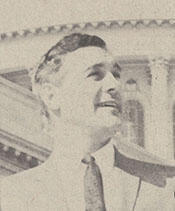
James Lindsay Seward (October 30, 1813 – November 21, 1886) was an American lawyer, state legislator, United States Representative, and long-serving Georgia political figure. Born in Dublin, Laurens County, Georgia, on October 30, 1813, he moved with his family in 1826 to Thomas County, Georgia, which would remain the principal setting of his professional and political life. Raised in the developing frontier region of south Georgia, he came of age as the state expanded its agricultural and commercial base, a context that shaped his later legal and political career.
Seward pursued legal studies in Georgia and prepared for the bar through the customary apprenticeship and reading of law then prevalent in the early nineteenth century. He was admitted to the state bar in 1835 and commenced the practice of law in Thomasville, the county seat of Thomas County. Establishing himself as a practicing attorney in Thomasville, he quickly became a prominent member of the local bar and entered public life at a relatively young age, combining his legal work with growing involvement in Democratic Party politics.
In 1835, the same year he began his law practice, Seward was elected to the Georgia House of Representatives. He served in the state House from 1835 through 1839, participating in legislative affairs during a period of rapid growth and political realignment in Georgia. After several years devoted primarily to his legal practice and local affairs, he returned to the Georgia House of Representatives in 1847 and served continuously in that body through 1852. During these terms he solidified his reputation as a Democratic leader in south Georgia and positioned himself for higher office.
Seward was elected in 1852 as a Democrat to represent Georgia’s 1st congressional district in the United States House of Representatives for the 33rd Congress. He took his seat in March 1853 and was reelected to two additional terms, serving in the 33rd, 34th, and 35th Congresses. His tenure in the House extended through March 3, 1859, encompassing the increasingly contentious national debates over slavery, sectionalism, and the future of the Union in the years immediately preceding the Civil War. After three consecutive terms, he declined to seek reelection in 1858 and returned to Georgia at the close of his service.
Following his departure from Congress, Seward resumed the practice of law in Thomasville and remained active in Democratic Party affairs. He served as a delegate to the Democratic State conventions in 1858, 1859, and 1860, reflecting his continued influence in party councils. In 1859 he was elected to the Georgia Senate, where he served through 1865, a period that spanned the secession crisis, the Civil War, and the collapse of the Confederate state government. In 1860 he was chosen as a delegate to the Democratic National Conventions held in Charleston, South Carolina, and Baltimore, Maryland, participating in the fractious national party gatherings that preceded the presidential election of 1860.
In the years surrounding the Civil War and Reconstruction, Seward played a significant role in Georgia’s constitutional and political reorganization. He was a delegate to the Georgia constitutional convention of 1865, convened under presidential Reconstruction to restore the state to the Union and revise its fundamental law. He later served as a delegate to the Democratic Conservative Convention in 1870, which represented efforts by conservative Democrats to regain and consolidate political power in the postwar era. In 1877 he again took part in framing the state’s basic legal structure as a delegate to the Georgia constitutional convention that produced the Constitution of 1877, a document that would govern the state for decades.
Alongside his legal and political work, Seward was deeply involved in educational governance in Georgia. From 1860 through 1886 he served on the board of trustees of Young’s Female College in Thomasville, supporting the advancement of women’s education in the region. From 1865 through 1886 he was also a trustee of the University of Georgia in Athens, contributing to the oversight and development of the state’s principal institution of higher learning during the difficult Reconstruction and post-Reconstruction years. His long tenure on these boards reflected both his standing in the state and his commitment to higher education.
James Lindsay Seward remained a prominent figure in Thomasville and Georgia public life until his death. He died in Thomasville, Thomas County, Georgia, on November 21, 1886. He was interred in Laurel Hill Cemetery in Thomasville, closing a career that had spanned more than half a century of service as a lawyer, legislator, congressman, state senator, constitutional delegate, and educational trustee.
Congressional Record