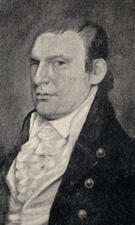
James Schureman (February 12, 1756 – January 22, 1824) was an American merchant and statesman from New Brunswick, in the Province of New Jersey, who became a prominent Federalist politician in the early United States. He represented New Jersey in the Continental Congress as well as in the United States House of Representatives and the United States Senate, and he served multiple terms as mayor of New Brunswick. Over the course of his national legislative career, he served as a Representative from New Jersey from 1789 to 1815, contributing to the legislative process during four terms in office and participating in the development of the new federal government.
Schureman was born in New Brunswick, New Jersey, on February 12, 1756. He was educated locally and attended Queen’s College (now Rutgers University) in New Brunswick, from which he graduated in 1775. His education at Queen’s College placed him among the early graduates of the institution and prepared him for both military and civic leadership in the revolutionary era. Shortly after completing his studies, he turned his attention to the patriot cause as tensions with Great Britain escalated into open conflict.
Upon graduating in 1775, Schureman raised a volunteer company in New Brunswick and served as its captain in the Middlesex County militia during the American Revolutionary War. He led this company at the Battle of Brooklyn on August 27, 1776, where he was captured by British forces. Held as a prisoner of war, he remained in captivity until early in the spring of 1777, when he escaped and rejoined the Continental Army at Morristown, New Jersey. After his return, he eventually resumed civilian life in New Brunswick, establishing himself in a mercantile career while continuing to serve in the local militia, thus combining commercial pursuits with ongoing public and military service.
Schureman’s political career began at the state level. He was elected to the New Jersey General Assembly, serving from 1783 to 1785, during the critical postwar years when the new nation was governed under the Articles of Confederation. In 1786, New Jersey sent him as a delegate to the Continental Congress, where he took part in national deliberations at a time of growing dissatisfaction with the existing federal framework. That same year he was among the delegates at the Annapolis Convention, which issued the call for what became the Constitutional Convention in Philadelphia and the drafting of a new United States Constitution. He continued in the Continental Congress during the 1787 session and then returned to the New Jersey General Assembly in 1788, maintaining an active role in both state and national affairs as the new constitutional system was being framed and adopted.
With the establishment of the federal government under the Constitution, Schureman was elected as a Federalist to the First United States House of Representatives, serving from 1789 to 1791. His service in Congress occurred during a formative period in American history, as the new government organized its departments, established fiscal policies, and defined the scope of federal authority. He later returned to the U.S. House for additional nonconsecutive terms, serving in the Ninth Congress from 1797 to 1799 and in the Fourteenth Congress from 1813 to 1815. Across these four terms in the House of Representatives, he participated in the democratic process and represented the interests of his New Jersey constituents during the administrations of George Washington, John Adams, and James Madison, including the years surrounding the Quasi-War with France and the War of 1812.
Between his House terms, Schureman also served in the United States Senate. He was elected to complete the unexpired term of Senator John Rutherfurd and served as a Federalist senator from New Jersey from 1799 to 1801. His time in the Senate coincided with the closing years of the Adams administration and the pivotal election of 1800, a period marked by intense partisan rivalry between Federalists and Democratic-Republicans. In addition to his federal service, Schureman remained deeply involved in New Jersey state government. He represented Middlesex County on the New Jersey Legislative Council (the upper house of the state legislature) for the 1808, 1810, and 1812–1813 sessions, serving as Vice-President of Council during the 1812–1813 session, thereby holding a leadership role in state legislative proceedings.
Alongside his national and state legislative duties, Schureman played a central role in the civic life of New Brunswick. He served multiple terms as mayor of the city, holding the office from 1792 to 1794, again from 1801 to 1813, and once more from 1821 until his death in 1824. His repeated elections as mayor reflected his standing in the community and his ongoing involvement in local governance, urban administration, and commercial development. Throughout these years, he continued his mercantile activities, embodying the combination of business and public service characteristic of many early American leaders.
James Schureman died in New Brunswick, New Jersey, on January 22, 1824. He was buried in the churchyard of the First Dutch Reformed Church in New Brunswick, located at Neilson and Bayard Streets. The church and cemetery, which still stand, mark his long association with the city where he was born, conducted his business, and devoted much of his life to public service at the local, state, and national levels.
Congressional Record