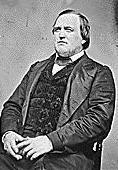
James Carroll Robinson (August 19, 1823 – November 3, 1886) was a U.S. Representative from Illinois who served multiple terms in Congress before and after the Civil War. He was born near Paris, in Edgar County, Illinois, on August 19, 1823. In 1825, when he was still a small child, he moved with his parents to neighboring Clark County, Illinois, which at that time was a sparsely settled part of the developing state. His formal education was limited, reflecting the frontier conditions of the region, and he largely educated himself while working to help support his family.
As a young man, Robinson engaged in agricultural pursuits, working the land in Clark County. When the Mexican War broke out, he enlisted and served as a corporal, gaining early experience in public service and military discipline. After his return from military service, he turned his attention to the study of law. Through independent study and practical training rather than extensive formal schooling, he prepared for the bar and was admitted to practice in 1850. He then commenced the practice of law in Marshall, the county seat of Clark County, where he quickly became a recognized member of the local bar.
Robinson’s legal career in Marshall formed the foundation for his entry into politics as a Democrat. Building on his reputation as an attorney and his connections in the agricultural community, he was elected as a Democrat to the Thirty-sixth, Thirty-seventh, and Thirty-eighth Congresses, serving from March 4, 1859, to March 3, 1865. His tenure in the House of Representatives coincided with the secession crisis, the Civil War, and the early stages of Reconstruction policy. During the Thirty-seventh and Thirty-eighth Congresses he served as chairman of the Committee on Mileage, a standing committee responsible for matters relating to the travel compensation of Members of Congress. In one of the most consequential votes of his congressional career, his vote on the Thirteenth Amendment to the Constitution, abolishing slavery, was recorded as “nay,” placing him among those Democrats who opposed the measure at that time.
Choosing not to seek renomination to the House in 1864, Robinson instead became a candidate for Governor of Illinois. Running as a Democrat in a state that had become a stronghold of the Republican Party during the Civil War, he was unsuccessful in that bid. Following his defeat in the gubernatorial race, he returned to Marshall and resumed the practice of law, reestablishing himself in his profession after his initial period of national service.
In 1869 Robinson moved to Sangamon County, Illinois, and settled in Springfield, the state capital, where he continued the practice of law. His relocation to Springfield placed him at the center of Illinois political life and facilitated his return to Congress. He was elected again as a Democrat to the Forty-second and Forty-third Congresses, serving from March 4, 1871, to March 3, 1875. During this second period of congressional service, he participated in the legislative debates of the Reconstruction era and represented his Illinois constituency as the nation adjusted to the postwar constitutional and political order. In 1874 he declined to be a candidate for renomination to the Forty-fourth Congress, thereby ending his career in the U.S. House of Representatives.
After leaving Congress for the second time, Robinson once more resumed the practice of law, continuing his legal work in Springfield. In the later years of his life he remained active in public affairs at the state level. In 1886 he was appointed a member of the Illinois Board of Livestock Commissioners, a body concerned with the regulation and improvement of the state’s important livestock industry, reflecting both his early background in agriculture and his long experience in public service.
James Carroll Robinson died in Springfield, Illinois, on November 3, 1886. He was interred in Oak Ridge Cemetery in Springfield, a burial place for many of the state’s prominent figures. His career spanned frontier Illinois, the Mexican War, the Civil War, and Reconstruction, and included multiple terms in Congress, a statewide campaign for governor, and service in both legal and agricultural regulatory roles.
Congressional Record