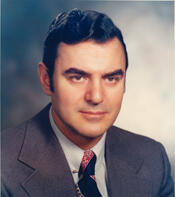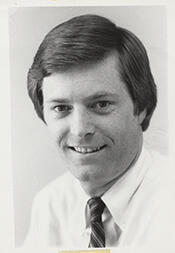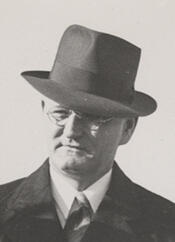
James Churchill Oliver (August 6, 1895 – December 25, 1986) was a U.S. Representative from Maine who served in the United States Congress from 1937 to 1961. Over the course of four terms in the House of Representatives, he served three consecutive terms as a Republican from 1937 to 1943 and later returned to Congress for a fourth term as a Democrat from 1959 to 1961. A member of both major political parties at different points in his career, he contributed to the legislative process during a significant period in American history and represented the interests of his Maine constituents through the late New Deal era, World War II, and the early years of the Cold War.
Oliver was born in South Portland, Cumberland County, Maine, on August 6, 1895. He attended the public schools of South Portland before enrolling at Bowdoin College in Brunswick, Maine. At Bowdoin he pursued a liberal arts education and received an A.B. degree in 1917, completing his studies just as the United States was entering World War I. His early life in coastal Maine and his education at one of the state’s leading institutions helped shape his later engagement in public service and politics.
With the nation’s entry into World War I, Oliver enlisted in the United States Army on June 4, 1917. He attended the Plattsburg Barracks Training Camp in New York, one of the principal officer training programs of the era, and was commissioned a captain on November 27, 1917. He was promoted to major of Infantry on October 9, 1918, reflecting rapid advancement during wartime. Subsequently transferred to the Inspector General’s Department, he continued his service in an oversight and administrative capacity until he was honorably discharged on July 22, 1919. His military experience during the First World War provided him with leadership credentials and familiarity with federal service that would later inform his congressional career.
Following his discharge, Oliver entered private business. By 1930 he was engaged in the general insurance business in Portland, Maine, a field in which he worked until 1937. His involvement in local affairs led him into municipal politics, and he served as a member of the board of aldermen of South Portland in 1932 and 1933. This local office provided his first formal experience in elective public service and helped build the political base from which he would successfully seek national office.
Oliver was elected as a Republican to the Seventy-fifth, Seventy-sixth, and Seventy-seventh Congresses, serving from January 3, 1937, to January 3, 1943. During these three consecutive terms, he participated in the democratic process in the House of Representatives and took part in deliberations over New Deal policies and the nation’s increasing involvement in world affairs on the eve of and during World War II. His service in Congress during this period coincided with major legislative debates over economic recovery, national defense, and foreign policy. In 1942 he was an unsuccessful candidate for renomination, bringing his initial period of congressional service to a close.
After leaving Congress in 1943, Oliver returned to uniformed service during World War II. He served as a lieutenant commander in the United States Coast Guard from January 26, 1943, to April 23, 1946, contributing to the wartime maritime and coastal defense efforts. Following his Coast Guard service, in 1946 he resumed civilian pursuits, engaging in the real estate and insurance business in both Maine and California. During this postwar period he also shifted his partisan affiliation. He became active in the Democratic Party and was the unsuccessful Democratic nominee for governor of Maine in 1952, reflecting his continued prominence in state politics despite the defeat.
Oliver remained a persistent candidate for federal office in the 1950s. He ran as a Democrat for Congress in 1954 and 1956 but was unsuccessful in both campaigns. After the 1956 election he unsuccessfully contested the election of Republican Representative Robert Hale to the Eighty-fifth Congress, challenging the outcome but failing to overturn it. Nonetheless, his efforts kept him in the public eye and within the leadership circles of his party. In 1958 he won election as a Democrat to the Eighty-sixth Congress, serving from January 3, 1959, to January 3, 1961. During this fourth term, he again represented Maine in the House of Representatives, now as a member of the Democratic Party, and participated in legislative debates at the dawn of the 1960s. He was an unsuccessful candidate for reelection in 1960 to the Eighty-seventh Congress. That same year, he served as a delegate to the 1960 Democratic National Convention, underscoring his ongoing influence within the party.
In his later years, Oliver continued his involvement in business and development. He worked as a real estate developer in Cape Elizabeth, Maine, contributing to the growth of the coastal community near his birthplace. Eventually he moved to Orlando, Florida, where he spent his final years. James Churchill Oliver died in Orlando on December 25, 1986, closing a long life that spanned service in two world wars, business endeavors in insurance and real estate, and a distinctive congressional career marked by representation of Maine in the House of Representatives as both a Republican and a Democrat.
Congressional Record