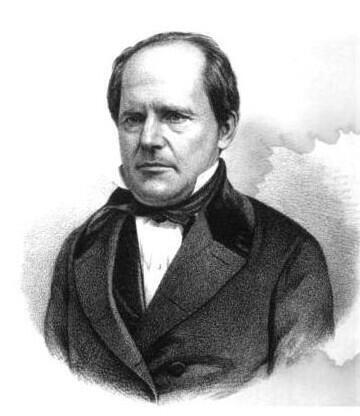
James Meacham (August 16, 1810 – August 23, 1856) was an American politician, Congregational minister, and professor who represented Vermont in the United States House of Representatives from 1849 until his death. He was born in Rutland Town, Vermont, to Lewis and Naomi Eayres Meacham. Raised in the Green Mountains during the early nineteenth century, he pursued a classical education that prepared him for a career in teaching, the ministry, and ultimately public service.
Meacham attended the academy in St. Albans, Vermont, and then enrolled at Middlebury College, from which he graduated in 1832. Immediately after graduation he embarked on an academic career, teaching at Castleton Seminary from 1832 to 1833 and at St. Albans Academy from 1833 to 1834. He returned to higher education as a tutor at Middlebury College from 1836 until 1838, establishing an early and enduring connection with the institution that would later recognize him as both professor and trustee.
Between his early teaching appointments, from 1834 until 1836, Meacham studied for the ministry at Andover Theological Seminary in Massachusetts, one of the leading centers of Congregational theological training in the United States. He was ordained as a Congregational minister in 1838 and soon thereafter assumed duties as pastor of the Congregational church in New Haven, Vermont. He served that congregation from 1839 to 1846, combining pastoral responsibilities with a growing interest in education and public affairs. In 1846 he returned to Middlebury College as a tutor and professor of Rhetoric and English Literature, a post he held from 1846 to 1850, further cementing his reputation as a scholar and educator.
Meacham’s personal life was marked by both family joy and early loss. On May 17, 1842, he married Caroline Bottum. The couple had one child, Elias B. Meacham (1843–1844), who died in infancy. Caroline herself died in 1843. On February 20, 1845, Meacham married Mary Gifford. They became the parents of two children: Emma P. Meacham, who later married William H. Davis, and Lewis Henry Meacham (1846–1878). Throughout his ministerial and academic career, his family life in Vermont provided a stable base from which he engaged in religious, educational, and eventually political work.
Meacham entered national politics as a member of the Whig Party. He was elected to the United States House of Representatives in 1849 to fill the vacancy caused by the resignation of Representative George P. Marsh during the Thirty-first Congress. He took his seat on December 3, 1849, and was reelected as a Whig to the Thirty-second and Thirty-third Congresses. After the demise of the Whig Party in the mid-1850s, he aligned with the emerging Opposition Party. In 1854 he was reelected to the Thirty-fourth Congress as an Opposition Party candidate, sometimes described in contemporary accounts as an Independent or member of an independent opposition coalition. Over the course of four consecutive terms, he represented Vermont during a significant period in American history, participating in the legislative process and representing the interests of his constituents as debates over slavery, sectionalism, and the future of the Union intensified.
During his congressional service, Meacham became particularly prominent in the Thirty-fourth Congress, when he served as chairman of the Committee on the District of Columbia. In that capacity he helped oversee legislation affecting the governance and development of the nation’s capital at a time of rapid institutional and political change. His work in Congress reflected both his Whig background—emphasizing institutional order, education, and moral reform—and the evolving positions of the Opposition Party as it confronted the breakdown of the Second Party System. His service in Congress, spanning from December 3, 1849, until his death on August 23, 1856, placed him among the mid-nineteenth-century lawmakers who grappled with the mounting tensions that would soon lead to the Civil War.
In addition to his legislative duties, Meacham remained closely connected to the world of learning and science. He served as a regent of the Smithsonian Institution from 1852 until 1856, participating in the early governance of the national institution dedicated to the “increase and diffusion of knowledge.” He also returned to Middlebury College in a leadership capacity, serving as a trustee from 1855 until 1856. These roles reflected the continuity of his commitments to education, scholarship, and public enlightenment even as he carried the responsibilities of a national legislator.
James Meacham died in Rutland, Vermont, on August 23, 1856, while still serving in the House of Representatives, placing him among the members of the United States Congress who died in office between 1790 and 1899. He was interred at West Cemetery in Middlebury, Vermont, near the college and communities with which he had been closely associated throughout his life. A cenotaph in his memory stands in the Congressional Cemetery in Washington, D.C., commemorating his service to the nation as a clergyman, educator, and four-term representative from Vermont.
Congressional Record