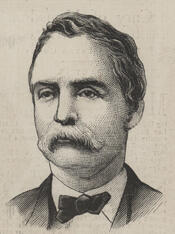
James Proctor Knott (August 29, 1830 – June 18, 1911) was a U.S. Representative from Kentucky, a prominent Democratic politician, and the 29th governor of Kentucky, serving from 1883 to 1887. He served as a Representative from Kentucky in the United States Congress from 1867 to 1883, completing six terms in office during a significant period in American history. Over the course of his public career, he was known for his legal acumen, his influential role in congressional deliberations, and his celebrated oratorical skill, particularly a widely reprinted satirical speech on railroad expansion.
Knott was born in Kentucky on August 29, 1830. Little is recorded in these sources about his early childhood or formal education, but he read law as a young man and was admitted to the bar, beginning a legal career that would underpin his later political life. In 1850 he moved from Kentucky to Missouri, where he quickly established himself in legal and political circles. His relocation to Missouri marked the beginning of his public career and set the stage for his first major statewide office.
In Missouri, Knott’s rise was rapid. He was elected Missouri Attorney General and served from 1859 to 1861. As the secession crisis deepened and the Civil War approached, he was required to swear an oath of allegiance to the federal government as a condition of continuing in office. A staunch Democrat with strong states’ rights sympathies, Knott refused to take the oath and resigned in 1861 rather than comply. For this refusal he was disbarred and briefly imprisoned, an episode that effectively ended his Missouri career but enhanced his standing among many Democrats who opposed federal wartime policies.
Knott returned to Kentucky in 1863 and resumed the practice of law, soon reentering politics in his native state. A member of the Democratic Party, he was elected to the U.S. House of Representatives as a Representative from Kentucky and served in Congress from 1867 to 1871, participating actively in the legislative process during the Reconstruction era and representing the interests of his constituents. Although he did not stand for re-election in 1870, instead making an unsuccessful run for governor of Kentucky, his first period in Congress established him as a notable Democratic voice on constitutional and legal questions.
During his early congressional service, Knott achieved national prominence for a speech delivered in 1871 ridiculing a bill to subsidize the westward expansion of railroads. In this address, he lampooned the then-remote town of Duluth, Minnesota, in a piece of extended satire that came to be known as the “Duluth speech.” The speech, formally titled “The Untold Delights of Duluth,” mocked speculative railroad promotion and federal subsidies and was widely reprinted in newspapers and other publications across the country, bringing Knott national acclaim as a humorist and orator. The notoriety of this speech remained one of the defining features of his public reputation.
Knott returned to Congress in 1875, again as a Democratic Representative from Kentucky, and continued to serve until 1883, completing a total of six terms in the House between his two periods of service. During this later tenure he rose to positions of greater influence, most notably serving as chair of the House Judiciary Committee. In that capacity he played a central role in shaping and reviewing federal legislation on legal and constitutional matters at a time when the nation was grappling with the aftermath of the Civil War, Reconstruction policies, and evolving questions of federal authority. His service in Congress thus spanned much of the Reconstruction and post-Reconstruction period, and he was regarded as an important participant in the democratic process at the national level.
In 1883 Knott left Congress and made a successful run for governor of Kentucky, becoming the state’s 29th governor and serving from 1883 to 1887. As governor, he pursued an ambitious reform agenda, securing major improvements in the state’s educational system, including measures to strengthen public schooling and expand educational opportunities. His efforts at tax reform, however, met with strong resistance, and he was largely stymied in that area. Following his gubernatorial term, Knott continued his legal practice in Frankfort and remained a respected figure in Kentucky Democratic politics. He served as a special assistant to Kentucky’s attorney general in 1887 and 1888, and he declined two federal appointments offered by President Grover Cleveland—one as Territorial Governor of Hawaii and another as a member of the Interstate Commerce Commission.
Knott remained active in public affairs into the 1890s. In 1891 he was chosen as a delegate to Kentucky’s constitutional convention, contributing to the framing of the state’s fundamental law. The following year, in 1892, he accepted an academic appointment as a professor of civics and economics at Centre College in Danville, Kentucky. In 1894 he and Centre College president William C. Young organized a law department at the college, and Knott became its first dean. Under his leadership, the law school was established on a firm footing and became an important training ground for Kentucky lawyers. He continued in this role until an illness forced his retirement in 1902.
In his later years, Knott resided in Lebanon, Kentucky. He died at his home there on June 18, 1911, and was buried in Ryder Cemetery in Lebanon. His legacy in Kentucky was recognized during his lifetime: Knott County, Kentucky, formed in 1884 while he was governor, was named in his honor. Remembered as a skilled lawyer, influential legislator, reform-minded governor, and celebrated orator, James Proctor Knott left a lasting imprint on both Kentucky and the broader political life of the United States in the latter half of the nineteenth century.
Congressional Record