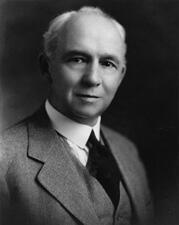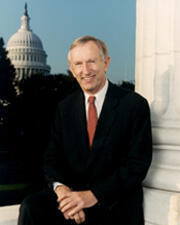
James Merrill Jeffords (May 11, 1934 – August 18, 2014) was an American lawyer and politician from Vermont who served in the United States Congress from 1975 to 2007. Over the course of ten terms in Congress—fourteen years in the United States House of Representatives and eighteen years in the United States Senate—he represented Vermont during a significant period in American history. Originally a Republican and later an Independent, James M. Jeffords contributed to the legislative process as both a House member and a Senator, participating in the democratic process and representing the interests of his constituents at the national level.
Jeffords was born in Rutland, Vermont, the son of Olin M. Jeffords, who served as Chief Justice of the Vermont Supreme Court. Raised in Rutland, he attended local schools before enrolling at Yale University, from which he graduated in 1956. Following his undergraduate studies, he served for three years in the United States Navy, an experience that preceded his legal training. He then attended Harvard Law School, receiving his law degree in 1962. After law school, Jeffords continued his military affiliation by serving in the United States Navy Reserve while beginning his legal career in southern Vermont.
Settling in Shrewsbury, Vermont, Jeffords became active in local politics and government as a Republican. He practiced law while engaging in party and community affairs, including service as chairman of the Shrewsbury Republican committee. His involvement in local politics led to his election to the Vermont Senate in 1966, and he served as a state senator from 1967 to 1969. Building on this legislative experience, he successfully ran for statewide office and was elected Vermont Attorney General in 1968, holding that post from 1969 to 1973. During his tenure as attorney general, he gained statewide recognition, which he parlayed into a bid for higher office.
In 1972, Jeffords sought the Republican nomination for governor of Vermont but was unsuccessful in the primary. Two years later, however, he turned to federal office and in 1974 won election as the at-large Representative for Vermont in the United States House of Representatives. He took his seat in the House in January 1975, marking the beginning of his long career in Congress. Jeffords served in the House from 1975 to 1989, winning reelection multiple times and establishing himself as a moderate Republican voice from New England. His fourteen years in the House coincided with major national debates on economic policy, energy, and social programs, in which he participated as Vermont’s sole Representative.
In 1988, Jeffords successfully ran for the United States Senate, winning the seat and beginning his Senate service in January 1989. As a Senator from Vermont, he was reelected in 1994 and 2000, ultimately serving in the Senate until 2007. During his Senate career, Jeffords became known for his independent-minded approach, particularly on issues such as education, the environment, and social policy. He rose to key leadership positions, including chairmanship of the Committee on Environment and Public Works and the Committee on Health, Education, Labor, and Pensions, where he played a central role in shaping legislation affecting environmental protection, public health, labor standards, and federal education policy.
In 2001, following his 2000 reelection, Jeffords made a decision that had far-reaching political consequences. Citing policy differences with the national Republican Party, particularly on education funding and environmental issues, he left the Republican Party to become an Independent and began caucusing with the Senate’s Democrats. His switch changed control of the Senate from Republican to Democratic, marking the first time in American history that a single senator’s party change had altered the majority control of the chamber. From that point forward, he served as an Independent aligned with the Democratic caucus, while continuing to represent Vermont’s interests in a closely divided Senate.
Jeffords chose not to run for reelection in 2006, citing health concerns, and he retired from the Senate at the end of his term in January 2007. He was succeeded in the Senate by Bernie Sanders, who had also represented Vermont’s at-large congressional district in the House. After leaving office, Jeffords returned to his longtime home in Shrewsbury, Vermont, in 2007, stepping back from public life. Following the death of his wife, he moved to the Washington, D.C., area to live closer to his children. James M. Jeffords died on August 18, 2014, from complications associated with Alzheimer’s disease, and he was buried in Shrewsbury, closing the life of a prominent Vermont public servant whose congressional career spanned more than three decades.
Congressional Record