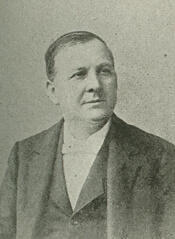
James Hall Huling (March 24, 1844 – April 23, 1918) was an American Republican businessman and politician from West Virginia who served as a United States Representative in the Fifty-fourth Congress. He was born in Williamsport, Lycoming County, Pennsylvania, on March 24, 1844, at a time when the region was developing rapidly as a center of the lumber industry. His early life in Williamsport placed him in a community where commerce and river trade were central to local economic life, influences that would later shape his own business pursuits.
Huling attended Lycoming College in Williamsport, Pennsylvania, receiving a formal education that prepared him for both business and public service. During the Civil War, he served in the Pennsylvania Cavalry in 1863, aligning himself with the Union cause at a critical moment in the nation’s history. His wartime service coincided with some of the most intense periods of the conflict, and like many young men of his generation, he returned from military duty to a country undergoing rapid political and economic change.
After the war, Huling engaged in the lumber business, an industry closely associated with his native region. In 1870 he moved to West Virginia, then a relatively new state formed during the Civil War, where he continued in the lumber trade. He remained in that line of work until 1874, when he left the lumber business and turned more fully to other commercial and civic pursuits. His relocation to West Virginia marked the beginning of a long association with Charleston and the state’s emerging political and economic life.
Huling’s prominence in Charleston grew steadily, and he entered municipal politics in the 1880s. He served as mayor of Charleston, West Virginia, from 1884 to 1888, overseeing the city during a period of growth and modernization in the post-Reconstruction era. As mayor, he was involved in the local administration and development of the city’s infrastructure and public services. At the conclusion of his term, he declined a renomination, choosing not to seek an additional term in municipal office, but his service established him as a significant Republican figure in the region.
Building on his local reputation, Huling advanced to national office as a member of the Republican Party. He won election from West Virginia’s 3rd Congressional District in 1894 as a Republican to the Fifty-fourth Congress and served one term in the United States House of Representatives from March 4, 1895, to March 3, 1897. His service in Congress occurred during a significant period in American history marked by debates over tariffs, monetary policy, and the role of the federal government in a rapidly industrializing economy. As a member of the House of Representatives, James Hall Huling participated in the democratic process, contributed to the legislative work of the 54th Congress, and represented the interests of his West Virginia constituents in the national legislature.
After completing his single term in Congress, Huling did not return to federal office but instead resumed his business activities in Charleston. Remaining a respected figure in the community, he continued to be identified with the Republican Party and with the commercial life of the city. He lived in Charleston for the remainder of his life, maintaining his ties to both the business sector and the civic affairs of his adopted state.
James Hall Huling died in Charleston, West Virginia, on April 23, 1918. He was interred in Spring Hill Cemetery in Charleston. His career spanned service in the Civil War, engagement in the lumber industry, leadership as mayor of Charleston, and representation of West Virginia’s 3rd District in the United States House of Representatives from 1895 to 1897, reflecting a life closely intertwined with the political and economic development of West Virginia in the late nineteenth century.
Congressional Record