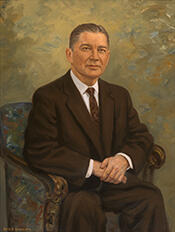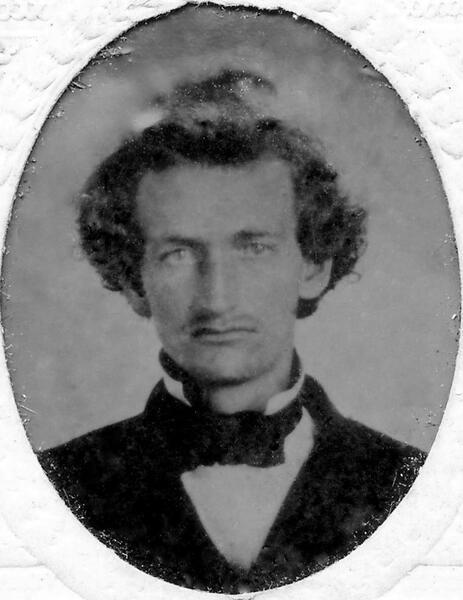
James M. Hinds (December 5, 1833 – October 22, 1868) was an American lawyer, Republican politician, and Reconstruction-era congressman who became the first member of the United States Congress to be assassinated while in office. He represented Arkansas in the United States House of Representatives from June 24, 1868, until his death at the hands of a member of the Ku Klux Klan later that year. A white Northerner who settled in the post–Civil War South, Hinds was a strong advocate of civil rights for formerly enslaved African Americans and of public education for both black and white children during the turbulent Reconstruction period following the American Civil War.
Hinds was born on December 5, 1833, in a small town in upstate New York, where he was raised before leaving home at the age of nineteen to pursue opportunities in the expanding West. He studied law and graduated in 1856 from the Cincinnati Law School in Cincinnati, Ohio, an important regional center for legal education in the antebellum Midwest. Soon after his graduation, he moved to Minnesota, then a young and rapidly developing state, where he opened a private law practice. His professional abilities and local standing led to his election as district attorney of his county, marking his first significant public office and introducing him to the practical workings of law and politics on the American frontier.
Seeking new prospects in the aftermath of the Civil War, Hinds moved in mid-1865 to Little Rock, the capital city of Arkansas, one of the eleven former Confederate states. He arrived to find Arkansas heavily degraded by the conflict: its economy and labor system, long dependent on slavery, were in disarray, and years of fighting between Confederate and Union forces had caused population decline and the destruction of millions of dollars’ worth of property. In Little Rock, Hinds formed a law partnership with Elisha Baxter, one of the state’s leading Unionists. Baxter had fought for the Union Army during the war, was later selected to serve on the Arkansas Supreme Court by the newly established Reconstruction government, and would eventually become governor of Arkansas. Through this association, Hinds became closely involved with the state’s emerging Republican leadership and the broader project of Reconstruction.
Like many Northerners who moved south during Reconstruction, Hinds underestimated the depth and persistence of white Southern resentment toward African Americans and toward Northern “outsiders.” He believed that, following President Abraham Lincoln’s Emancipation Proclamation in 1863, the Union victory in the Civil War, and the adoption of the Fourteenth Amendment to the United States Constitution, freedmen in the South should enjoy the same civil and political liberties as African Americans in the North. His conviction that these rights should be fully implemented in the former Confederate states, and his willingness to press for them publicly, led many white Southerners to denounce him as a “carpetbagger,” a pejorative term used to disparage Northerners who moved south during Reconstruction. These views and his courage in advancing them were later recalled and eulogized by Logan H. Roots, a contemporary Republican who also represented Arkansas in Congress.
Hinds’s most important early political role in Arkansas came with the reorganization of the state under federal Reconstruction policy. In 1867, he was elected as a Republican delegate from Pulaski County to the Arkansas Constitutional Convention, convened under the Reconstruction Acts to rewrite the state’s fundamental law as a condition of readmission to the Union. At the convention, which met in October 1867, Hinds was chosen chairman of the Committee on the Elective Franchise. In that capacity he successfully advocated for constitutional provisions establishing the right to vote for adult freedmen—black males over the age of twenty-one—and for the creation of a system of public education open to both black and white children. The new constitution that emerged from the convention in February 1868, and was ratified in March, reflected these priorities and became a cornerstone of Reconstruction policy in Arkansas.
On the strength of his work at the convention and his growing prominence in the state Republican Party, Hinds was elected in early 1868 as a Republican to the United States House of Representatives from Arkansas’s 2nd congressional district. He traveled to Washington, D.C., in April 1868, where he played a role in arranging for Arkansas to become the first former Confederate state readmitted to the Union under the terms of the 1867 Reconstruction Acts. His national profile increased further in May 1868, when he served as a delegate to the 1868 Republican National Convention in Chicago, which nominated Ulysses S. Grant for the presidency. After Congress formally seated him on June 24, 1868, Hinds took his place in the House of Representatives, where he aligned with the Radical Republican program of enforcing civil rights and restructuring Southern society on the basis of equal citizenship.
Following the convention, Hinds returned to Arkansas in August 1868 and campaigned vigorously for Grant’s election and for the continued protection of civil and political rights for former slaves. His public advocacy, however, made him a target for violent white supremacist organizations, particularly the Ku Klux Klan, which had become increasingly active in Arkansas and other Southern states during that election season. While campaigning for Grant in the 1868 presidential election, Hinds received threats and was repeatedly targeted by Klan members because of his support for black suffrage and Republican Reconstruction policies.
The hostility culminated in his assassination in the fall of 1868. In October 1868, while traveling through Monroe County, Arkansas, to a political meeting with fellow Republican leader Joseph Brooks, Hinds was ambushed and shot by a Klansman. He died of his wounds on October 22, 1868, still in office as a member of Congress. His murder underscored the extreme violence directed against Reconstruction officials and civil rights advocates in the postwar South and marked a grim milestone as the first assassination of a sitting U.S. congressman.
Congressional Record