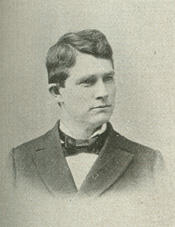
James Franklin Hanly (April 4, 1863 – August 1, 1920) was an American politician and lawyer who served one term as a Republican Representative from Indiana in the United States Congress from March 4, 1895, to March 3, 1897, and later as the 26th governor of Indiana from 1905 to 1909. A prominent advocate of temperance and prohibition, he founded the Flying Squadron of America, often called Hanly’s Flying Squadron, which campaigned nationally for prohibition and played an important role in arousing public support for a constitutional ban on liquor. Over the course of his career he moved from mainstream Republican politics to become one of the nation’s most visible prohibitionists and was the Prohibition Party’s candidate for President of the United States in the 1916 election.
Hanly was born in a log cabin near St. Joseph, Champaign County, Illinois, on April 4, 1863, the youngest of seven children of Elijah and Anna Calton Hanly. His mother, who was blind, taught him to read at home, and he developed an early reputation for intellectual curiosity and strong powers of argument. As a boy he lived for a time on a farm near the village of Homer, Illinois, where he attended the Liberty rural school for one year and became known as a formidable debater. At the age of sixteen he left home to pursue further schooling, attending common schools and the Eastern Illinois Normal School at Charleston, Illinois, until 1879. To support himself he worked a variety of odd jobs, often sleeping in barns while he studied, an experience that later informed his populist and reformist rhetoric.
In 1879 Hanly moved to Warren County, Indiana, where he began a career in education, teaching in the Indiana public schools from 1881 to 1889. That same year he met Eva Augusta Rachel Simmer, whom he married in 1881; the couple had five children, although only one survived childhood, a personal tragedy that marked his private life. While teaching, Hanly became acquainted with Judge Joseph M. Rabb of Williamsport, Indiana, who encouraged him to take an active role in Republican politics and to speak on behalf of the party. Under Rabb’s influence Hanly studied law, was admitted to the bar in 1889, and joined Rabb’s law office in Williamsport. He later practiced law with Ele Stansbury, a young attorney who would go on to serve as Indiana Attorney General, and Hanly quickly gained a reputation as an energetic advocate and powerful orator.
Hanly’s formal political career began with his election to the Indiana State Senate in a special election in 1889 to fill a vacant seat, in which he defeated George W. Cronk. He served in the state senate from 1890 to 1891, where his vigorous oratory and reform-minded positions attracted statewide attention. Building on this prominence, he ran as a Republican for the United States House of Representatives and was elected to the Fifty-fourth Congress, representing Indiana from March 4, 1895, to March 3, 1897. His single term in Congress coincided with a significant period in American political and economic history, and he participated in the legislative process and represented the interests of his Indiana constituents as a member of the House of Representatives. During his term, however, the Democratic-controlled Indiana General Assembly realigned his district in what was widely regarded as a partisan gerrymander, and the altered boundaries contributed to his defeat in his 1896 bid for reelection.
After leaving the House, Hanly remained active in Republican politics and in 1899 sought the party’s nomination for the United States Senate. In the Republican legislative caucus he was defeated by Albert J. Beveridge, a contest that exposed and deepened divisions within the state party. Progressive, largely anti-prohibition Republicans rallied to Beveridge, while the more conservative and prohibitionist wing supported Hanly. The bitter contest caused a major rift in the Indiana Republican Party, and after his defeat Hanly briefly withdrew from elective politics. The split within the party worsened in subsequent years, with progressives increasingly distancing themselves from the conservative and prohibitionist faction. Hanly, however, soon returned to the public arena, embarking on a speaking tour across Indiana. His speeches, often fiery and frequently invoking the words and example of Abraham Lincoln, helped rebuild his political base and prepared the ground for a statewide campaign.
Hanly reentered electoral politics in 1904 and secured the Republican nomination for governor of Indiana. In the general election he defeated Democrat John W. Kern by 84,364 votes, winning a hard-fought contest in which he delivered excoriating attacks on the Democratic Party, which he described as “unholy” and “great only in its ability to destroy.” He characterized the Democratic campaign as “selfish” and motivated by a desire to “obtain the flesh pot of office.” Taking office in January 1905, Hanly quickly established himself as a party maverick, pursuing his own reform agenda rather than adhering strictly to the party platform. As governor he crusaded against liquor, gambling, horse racing, and political corruption, and he did not hesitate to prosecute members of his own administration for embezzlement. He used his popularity and the support of the Republican-controlled General Assembly to secure legislation banning gambling on horse races in Indiana, including at the Indiana State Fair, and he undertook a broad reorganization of state government aimed at making key bureaus—particularly law enforcement, correctional institutions, and state-run charities—operate on a non-partisan basis. He also introduced more rigorous accounting practices, requiring detailed expense reports from state employees, instituting regular audits, and working with the state treasurer to create new accounts that allowed closer monitoring of public expenditures.
Hanly’s gubernatorial tenure was marked by both reform and controversy. In 1907 he signed into law the nation’s first compulsory sterilization statute, authorizing the sterilization of certain individuals in state custody under the then-fashionable banner of eugenics, a measure that enjoyed broad progressive support at the time. The law later became a subject of intense criticism; Governor Thomas R. Marshall ordered the practice halted in 1909, and in 1921 the Indiana Supreme Court declared the statute unconstitutional. Hanly also confronted a major scandal involving public officials’ misuse of expense accounts to pay gambling debts at the French Lick Springs Hotel, owned by Thomas Taggart, chairman of the Democratic National Committee. Denouncing Taggart for operating a “Monte Carlo,” Hanly ordered state police raids on French Lick and nearby West Baden in July 1906, seizing slot machines, roulette wheels, playing cards, dice, gambling records, and other devices. He brought suit against the corporations operating the French Lick Springs and West Baden Springs hotels, seeking forfeiture of their properties for profiting from illegal gambling. John W. Kern, his former gubernatorial opponent, represented the hotels, and the litigation continued beyond Hanly’s term; in 1910 an Orange County jury found in favor of the hotels.
Temperance and prohibition were at the center of Hanly’s public philosophy, and as governor he became best known for his efforts to curb the liquor trade. He argued that alcohol’s most tragic effects fell on the children of alcoholics and believed that curbing liquor sales was a moral and social imperative. Hanly championed a local-option bill that would allow Indiana counties to ban the sale of alcohol. When the General Assembly failed to pass the measure during its two regular sessions in his term, he called a special session in 1908 to secure its enactment. Once the bill became law, 72 of Indiana’s 92 counties voted to go dry, banning the sale of liquor within their borders. The timing and substance of the law made it a central issue in the subsequent election and alienated many progressives within the Republican Party. By pushing the measure through a special session, Hanly effectively removed one of the party’s key platform planks and contributed to Republican losses at the polls. After leaving office, he broke with the Republican Party altogether and devoted himself fully to the prohibition cause.
Even before his term as governor ended, Hanly had begun working closely with the Anti-Saloon League, and he played a significant role in unifying the often-fractious prohibition movement around the goal of a national constitutional amendment banning the sale of liquor. From 1910 to 1920 he traveled widely as a prohibition lecturer across the United States and in 1919 extended his advocacy to France. In 1914 he organized the Flying Squadron of America, commonly known as Hanly’s Flying Squadron, a temperance organization composed of three teams of revivalist-style speakers who toured cities nationwide between September 30, 1914, and June 6, 1915, staging mass meetings and rallies in support of prohibition. Having left the Republican Party, Hanly joined the Prohibition Party and emerged as one of its leading national figures. In 1915 he was nominated by the Prohibition Party for governor of Indiana but declined the nomination and instead ran as the Progressive Party’s candidate. The following year he accepted the Prohibition Party’s nomination for President of the United States in the 1916 election. Running on a national prohibition platform with vice-presidential nominee Ira Landrith, Hanly was overwhelmingly defeated; the ticket received 221,030 popular votes, approximately 1.2 percent of the total.
In addition to his political and lecturing activities, Hanly continued to practice law and remained engaged in legal questions surrounding prohibition. In April 1920 he argued Hawke v. Smith before the United States Supreme Court, a case challenging the validity of the Eighteenth Amendment on the ground that Ohio had attempted to overturn its ratification through a statewide referendum. On June 1, 1920, the Court issued a unanimous decision in favor of Hanly’s position, holding that Ohio could not rescind its ratification after the national tally had been taken and thereby upholding the constitutional amendment and the federal prohibition regime. Hanly also wrote on other subjects, including authoring “A Day in the Siskiyous: An Oregon Extravaganza,” reflecting his broader literary interests beyond politics and reform.
In the final months of his life Hanly continued to travel and speak in support of prohibition. While on a trip to Ohio in 1920 to deliver anti-liquor lectures, he was involved in an automobile–train collision near Dennison, Ohio. He died from his injuries on August 1, 1920. James Franklin Hanly was interred at Hillside Cemetery near Williamsport, Indiana, closing the life of a figure who had risen from modest frontier origins to national prominence as a congressman, governor, and leading advocate of the temperance and prohibition movements.
Congressional Record