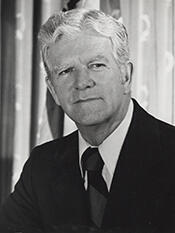
James King Gibson (February 18, 1812 – March 30, 1879) was a nineteenth-century American politician, merchant, sheriff, postmaster, and banker from Virginia who served one term in the United States House of Representatives. A member of the Conservative Party representing Virginia during the Reconstruction era, he participated in the legislative process at a significant moment in American history, representing the interests of his constituents in the post–Civil War South.
Gibson was born in Abingdon, Washington County, Virginia, on February 18, 1812. He attended the common schools in his youth, receiving the basic education typical of the period. Little is recorded about his family background, but his early life in Abingdon, then an important commercial and legal center in southwestern Virginia, helped shape his later involvement in local business and public affairs.
As a young man, Gibson sought opportunities beyond his native state and moved to Huntsville, Alabama, in 1833. His stay there was brief, and he returned to Abingdon in 1834, where he engaged in mercantile pursuits. Establishing himself as a merchant, he became part of the commercial life of the town, a role that provided both economic stability and a platform for entry into local public service.
Gibson’s public career began at the county level. In 1834 and 1835 he served as deputy sheriff of Washington County, Virginia, a position that involved assisting in the enforcement of local laws and the administration of county affairs. He was subsequently appointed postmaster of Abingdon in 1837, a federal appointment he held until 1849. As postmaster, he oversaw the local mail system during a period of expanding communication and transportation networks, further enhancing his standing in the community. In addition to his public offices, he continued his involvement in business, and over time he became associated with agricultural pursuits and banking, reflecting the diversified economic activities of prominent local citizens in that era.
Gibson entered national politics during Reconstruction. He was elected as a Conservative to the United States House of Representatives from Virginia in 1869 and took his seat in the Forty-first Congress on January 28, 1870. His term lasted until March 3, 1871. As a member of the Conservative Party representing Virginia, he contributed to the legislative process during his one term in office, participating in debates and votes at a time when Congress was addressing the readmission of former Confederate states, the implementation of Reconstruction policies, and the political and economic reintegration of the South into the Union. He declined to stand for reelection in 1870, choosing instead to return to private life.
After leaving Congress, Gibson resumed and expanded his engagement in agricultural pursuits and banking in and around Abingdon. His activities in these fields reflected both his earlier mercantile experience and the broader economic transition of southwestern Virginia in the postwar period, as the region sought to recover from the Civil War and adapt to changing market conditions. He remained a respected figure in local business and community affairs until the end of his life.
James King Gibson died in Abingdon, Virginia, on March 30, 1879. He was interred in Sinking Spring Cemetery in Abingdon, a burial ground that contains the graves of many of the town’s leading citizens, underscoring his long-standing connection to the community he had served in various civic, economic, and political roles.
Congressional Record