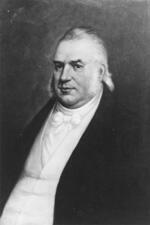
James Fenner (January 22, 1771 – April 17, 1846) was an American politician who served as a United States Senator from Rhode Island and as the 7th, 11th, and 17th Governor of Rhode Island on three separate occasions. A member of the Republican (Democratic-Republican) Party during his early career and later of the Law and Order Party of Rhode Island, he played a significant role in the political life of his state in the early nineteenth century. He was the son of Arthur Fenner, the fourth governor of Rhode Island, and continued his family’s prominent involvement in public affairs.
Fenner was born in Providence, in the Colony of Rhode Island and Providence Plantations, on January 22, 1771. Raised in a politically active household during the closing years of the colonial era and the American Revolution, he was exposed early to questions of governance and public service through his father’s career. His upbringing in Providence, then a growing commercial and intellectual center, helped shape his later engagement in state and national politics.
Fenner pursued higher education at Brown University, then known as the College of Rhode Island, in Providence. He graduated in 1789, at a time when the new federal Constitution had just gone into effect and the institutions of the United States were taking shape. His university education provided him with a grounding in classical studies and the law and political thought of the period, preparing him for a life in public service. On November 17, 1792, he married Sarah Whipple Jenckes, his first cousin once removed. The couple had four children: Almira Theodosia (January 17, 1793 – October 10, 1872), Sarah, Freelove (ca. 1799 – August 2, 1817), and Arthur (ca. 1810 – March 8, 1832).
James Fenner served as a Senator from Rhode Island in the United States Congress from 1805 to 1807. A member of the Republican Party, commonly known at the time as the Democratic-Republican Party, he contributed to the legislative process during one term in office. His service in Congress occurred during a significant period in American history, as the young republic confronted issues of foreign policy, trade, and the balance of power between the federal government and the states. As a member of the Senate, Fenner participated in the democratic process and represented the interests of his Rhode Island constituents in the national legislature. He resigned his Senate seat in 1807, giving up his senatorship in order to assume the governorship of Rhode Island, two years after the death of his father in office.
Fenner’s gubernatorial career was extensive and spanned several decades. He first served as Governor of Rhode Island from 1807 to 1811, succeeding to a position his father had held and guiding the state through the years surrounding the Embargo Act and rising tensions that would culminate in the War of 1812. Elected as a Democratic-Republican, he was again chosen governor from 1824 to 1831, a period marked by national debates over internal improvements, banking, and the expansion of democratic participation. In these early terms he was aligned with the dominant Jeffersonian and later Jacksonian currents in American politics, reflecting Rhode Island’s evolving political landscape.
In the 1840s, Fenner returned to public life for a final time. He was elected governor for a third period of service, holding office from 1843 to 1845 as a member of the Law and Order Party of Rhode Island. This party emerged in response to the Dorr Rebellion and the contentious struggle over expanding the franchise and revising the state’s colonial charter. During this last term, Fenner became the first governor to serve under the new Rhode Island Constitution, adopted in 1842, which replaced the old charter of 1663 and redefined the state’s political framework. His leadership in this era placed him at the center of Rhode Island’s transition from colonial-era institutions to a modern constitutional order.
In his later years, Fenner resided at his mansion, “What Cheer,” in Providence, a name reflecting a traditional Rhode Island greeting and emblematic of his deep roots in the state. He remained a respected elder statesman, associated with a long period of Rhode Island’s political development from the early republic through the age of reform. James Fenner died at “What Cheer” on April 17, 1846, and was interred in the North Burial Ground in Providence. His long career in both the United States Senate and the Rhode Island governorship, together with his family’s multigenerational service, left a lasting imprint on the civic history of his state.
Congressional Record