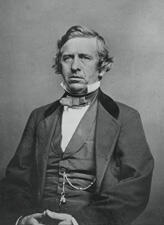
James Edward English (March 13, 1812 – March 2, 1890) was a United States representative and later U.S. senator from Connecticut, and governor of Connecticut. A member of the Democratic Party, he served in the United States Congress during a significant period in American history and contributed to the legislative process during three terms in office. Over the course of his public career, he also held numerous state and local offices and became a prominent businessman in New Haven.
English was born in New Haven, Connecticut, on March 13, 1812, and attended the common schools. At the age of sixteen he was apprenticed as a carpenter, a trade that introduced him to the building and lumber industries. He later entered business on his own and became a successful entrepreneur. English established the English and Welch Lumber Company, which grew into a substantial enterprise, and he played a major role in restructuring the New Haven Clock Company, helping to transform it into one of the largest clock manufacturers in the country. In addition to his lumber interests, he engaged in banking and manufacturing, building a considerable fortune and a reputation as a leading citizen of New Haven. He was twice married, first to Caroline A. Fowler and later to Anna Robinson Morris, and he was the father of four children.
English’s public career began at the local level in New Haven. He served on the New Haven board of selectmen from 1847 to 1861, and he was a member of the city’s common council in 1848 and 1849. His effectiveness in municipal affairs led to election to the Connecticut General Assembly. He served in the Connecticut House of Representatives in 1855 and then in the Connecticut Senate from 1856 to 1858. In 1860 he was the Democratic candidate for lieutenant governor of Connecticut, but he was unsuccessful in that bid. These early legislative and executive experiences in state and local government laid the groundwork for his later national prominence.
English entered national politics as a Democrat and was elected to the United States House of Representatives, serving in the Thirty-seventh and Thirty-eighth Congresses from March 4, 1861, to March 3, 1865. His service in Congress thus coincided with the Civil War, a critical period in American history. Although a member of the Democratic Party, he took a notable stand on the question of slavery. In 1864, during consideration of the Thirteenth Amendment to the Constitution, which abolished slavery, English left the bedside of his ill wife to travel to the U.S. Capitol in order to cast his vote. Defying much of his party, he voted “aye” on the amendment. Contemporary accounts reported that his affirmative vote prompted applause on the House floor “and the tide turned” in favor of passage. English later remarked that he believed the vote had ruined his standing among Democrats, but that he considered it the right course, saying, “I suppose I am politically ruined, but that day was the happiest of my life.” He chose not to be a candidate for renomination in 1864 and left the House at the end of his second term.
After leaving the House of Representatives, English remained active in Connecticut politics. He was an unsuccessful candidate for governor in 1866, but he was elected as the twenty-sixth governor of Connecticut on April 1, 1867. He served his first gubernatorial term from May 1, 1867, to May 5, 1869, and was elected again in 1868. Defeated for reelection in 1869, he returned to the governorship in 1870 and served another term from May 4, 1870, to May 16, 1871. During his tenure as governor, he dealt with important issues arising from the state’s economic development, including a dispute between the railroad and shipping interests. His administration helped resolve that conflict through approval of the construction of two new bridges, balancing competing commercial demands. In the closely contested 1871 gubernatorial election, English again ran for reelection and won the popular vote, but a canvassing committee later found that the election had been tainted by stolen votes and erroneous totals. The committee declared the election fraudulent and awarded the governorship to his Republican opponent, Marshall Jewell.
English continued to serve in state government even after his gubernatorial defeats. He was elected once more to the Connecticut House of Representatives in 1872, returning to the legislative work with which he had begun his political career. His long experience and prominence in the Democratic Party led to his selection for service in the United States Senate. He was appointed as a Democrat to the U.S. Senate from Connecticut to fill the vacancy caused by the death of Senator Orris S. Ferry and served from November 27, 1875, to May 17, 1876, when a successor was elected. Although the existing record has sometimes broadly characterized his congressional career as extending from 1861 to 1877 over three terms in office, his actual Senate service was by appointment during this brief interval in the Forty-fourth Congress. He was an unsuccessful candidate in 1876 for election to complete the term, after which he returned to private life. As a member of the Senate, English participated in the democratic process and represented the interests of his Connecticut constituents during the post–Civil War and Reconstruction era.
Following his departure from the Senate, English resumed his manufacturing, commercial, and banking activities in New Haven. He remained a figure of local influence and respect, drawing on his long experience in business and public affairs. His role in the passage of the Thirteenth Amendment continued to be remembered as a defining moment of conscience in his career, even as later cultural portrayals sometimes misrepresented his record. In Steven Spielberg’s 2012 film “Lincoln,” both English and his Connecticut colleague Augustus Brandegee were given fictional names and were erroneously depicted as voting against the amendment, contrary to the historical record of English’s decisive “aye.”
James Edward English died in New Haven, Connecticut, on March 2, 1890, at the age of seventy-seven years and 354 days. He was interred at Evergreen Cemetery in New Haven. His life encompassed significant roles as a tradesman-turned-industrialist, municipal leader, state legislator, governor, and member of both houses of the United States Congress, and he left a lasting imprint on the political and economic life of Connecticut in the nineteenth century.
Congressional Record