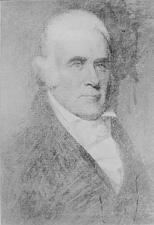
James DeWolf (often written during his lifetime as James D’Wolf; March 18, 1764 – December 21, 1837) was an American slave trader, merchant, and politician who became one of the wealthiest men in Rhode Island and, by the end of his life, was said to be the second-richest person in the United States. A member of the Republican Party, more precisely the Democratic-Republican and later Crawford Republican faction, he served nearly twenty-five years in the Rhode Island House of Representatives and represented Rhode Island in the United States Senate from 1821 to 1825. His fortune was built on extensive involvement in the transatlantic slave trade, related commercial enterprises, and investments in sugar and coffee plantations in Cuba.
DeWolf was born in Bristol, Rhode Island, on March 18, 1764, the son of Mark Anthony DeWolf (November 8, 1726 – November 9, 1793) and Abigail Hazel Potter (February 2, 1726 – February 7, 1809). He was one of nine children and had four brothers—Charles (1745–1820), John (1760–1841), William (1762–1829), and Levi DeWolf (1766–1848)—who, along with other members of the extended DeWolf and Potter families, would also become involved in maritime trade and the slave trade. He grew up in a prominent Bristol mercantile family already engaged in overseas commerce; his father and his uncle Simeon Potter had been active in slave trading since 1769, laying the foundation for what became one of the most significant slave-trading dynasties in New England.
Going to sea at an early age, DeWolf served as a sailor on American privateers during the latter part of the American Revolutionary War. He participated in several naval encounters and was captured twice by the British, experiences that hardened his maritime skills and reputation. After the war, in his twenties, he was selected as captain of a ship and quickly moved into command and ownership roles in commercial ventures. He began to engage directly in the slave trade, often purchasing “seasoned” enslaved Africans from Cuba and other ports in the West Indies and transporting them primarily to markets in the southern United States. Although Rhode Island outlawed participation in the African slave trade in 1787, DeWolf and his family continued to finance and command slaving voyages to West Africa in defiance of the law.
DeWolf’s slave-trading career was marked by both scale and notoriety. In 1791 he was indicted for murder by a grand jury in Newport, Rhode Island, in a case widely reported in the New England press. He was alleged to have ordered the killing of an African woman enslaved aboard the ship Polly, which he commanded in 1789, after she contracted smallpox. According to accounts, she was treated to the best of the crew’s knowledge, then bound to a chair and lowered overboard to prevent the spread of disease to the crew and the remaining captives. When DeWolf learned of the indictment, he left for the Gold Coast of Africa. The Rhode Island judge ultimately accepted a nolle prosequi from the prosecuting attorney, ending the case there. DeWolf was later charged in connection with the incident in Saint Thomas, where he was then living. In 1794, depositions taken in St. Eustatius from two crew members, including one who had participated in the act and was considered immune to smallpox, asserted that the killing was necessary to save the rest of those on board and was justifiable under contemporary maritime law. In 1795, DeWolf testified in court in Saint Thomas, West Indies, without opposition, and a Danish judge ruled in his favor.
Over the course of his career, DeWolf financed or participated in at least twenty-five additional slaving voyages, usually in partnership with brothers, nephews, and other relatives. The DeWolf family as a whole is believed to have transported more than 11,000 enslaved Africans to the United States before the federal ban on the African slave trade took effect in 1808. His nephew George DeWolf continued to engage in the trade illegally until about 1820. To support and profit from this commerce, James DeWolf owned a rum distillery in Bristol that produced goods for exchange in West Africa, and with his brothers and nephews he helped establish the Bank of Bristol and an insurance company, the Mount Hope Insurance Company. From 1805 to 1807, Mount Hope insured some fifty slaving voyages. A member of the extended family also established a slave auction house in Charleston, South Carolina, a principal destination for many of their ships. With the wealth generated by these activities, DeWolf acquired and operated three sugar and coffee plantations in Cuba, which, like plantations in the U.S. Deep South, depended on enslaved labor.
In addition to his slave-trading and plantation interests, DeWolf diversified into other enterprises that tied New England’s economy to slavery. During the War of 1812, he fitted out privateers under authority from the President of the United States. One of his vessels, the Yankee, became the most successful American privateer of the war, capturing approximately forty British ships valued at more than $5 million. He also became a pioneer in New England’s emerging cotton textile industry. In 1809 he joined a consortium that founded the Arkwright Manufacturing Company, which built the Arkwright Mills in Coventry, Rhode Island, in 1810. These mills, like others in the region, relied on cotton grown by enslaved people in the Deep South, reinforcing the economic interdependence of northern industry and southern slavery well into the nineteenth century.
DeWolf’s political career developed alongside his expanding commercial influence. He was first elected to the Rhode Island House of Representatives in 1798 and served until 1801. He returned to the House from 1803 to 1812, again from 1817 to 1821, and later from 1829 to 1837, accumulating nearly twenty-five years of service in the state legislature. From 1819 to 1821 he served as speaker of the Rhode Island House, becoming one of the most influential figures in state politics during the Federal period. His legislative career reflected the interests of a powerful mercantile and manufacturing elite in a small but commercially active state.
DeWolf advanced to national office when he was elected by the Rhode Island General Assembly as a Democratic-Republican, later associated with the Crawford Republican faction, to the United States Senate. He served as a Senator from Rhode Island in the United States Congress from March 4, 1821, to October 31, 1825. During his single term in office he sat in the Senate during a significant period in American history marked by debates over economic policy and the expansion of slavery. As a member of the Senate, he participated in the legislative process and represented the interests of his constituents and of Rhode Island’s commercial community. He resigned before the completion of his six-year term and returned to his extensive business and state political activities.
On January 7, 1790, DeWolf married Nancy Ann Bradford (August 6, 1770 – January 2, 1838) of Bristol, Rhode Island, daughter of William Bradford, a deputy governor of Rhode Island and future United States senator. Together they had twelve children: James “Gentleman Jim” DeWolf II (1790–1845), who married Julia Lynch Post (1797–1878); Francis LeBaron DeWolf (1793, died young); Mary Ann DeWolf (1795–1834), who married first Lieutenant Raymond Henry Jones Perry (1789–1826) and second General William Hyslop Sumner (1780–1861); a second Francis LeBaron DeWolf (1797–1825), who married Eleanor Post (1799–1872); Mark Antony DeWolf (1799–1851), who married Sophie de Chappotinf (1802–1879); William Henry “The Commodore” DeWolf (1802–1853), who married Sarah Ann Rogers (1802–1864); Harriet DeWolf (1804–1863), who married Jonathan Prescott Hall (1796–1862); Catherine Hersey DeWolf (1806–1853), who married first Joshua Dodge (c. 1803–1872), a descendant of the Crowninshield family, and second Andrew Jackson Davis (1826–1910); Nancy Bradford DeWolf (1808–1856), who married Fitz-Henry Homer (1799–1856); William Bradford DeWolf (1810–1862), who married Mary Russell Soley (1805–1881) and whose daughter Harriette married Lloyd Aspinwall; and Josephine Maria DeWolf (1812–1901), who married Charles Wally Lovett (1801–1873). DeWolf named one of his vessels, the brig Nancy, in honor of his wife. He was a leading figure in the Bristol, or Rhode Island, branch of the DeWolf family, whose activities in the slave trade would later draw extensive historical scrutiny.
DeWolf died in New York City on December 21, 1837, at the age of seventy-three. At the time of his death he was widely regarded as a millionaire and was reputed to be the second-wealthiest man in the United States. His estate included properties in Rhode Island, New York, Maryland, Kentucky, and Ohio, reflecting the geographic reach of his investments. His body was returned to his hometown and interred in the DeWolf private cemetery on Woodlawn Avenue in Bristol. In the twenty-first century, his and his family’s central role in the American slave trade has been examined in scholarship and public history, and he is featured prominently in the Emmy-nominated 2008 documentary “Traces of the Trade: A Story from the Deep North,” co-produced and directed by his descendant Katrina Browne, which explores the DeWolf family’s legacy as one of the largest slave-trading dynasties in United States history.
Congressional Record