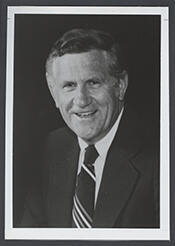
James Herbert Budd (May 18, 1851 – July 30, 1908) was an American lawyer and politician who served as a member of the U.S. House of Representatives for California’s 2nd congressional district from 1883 to 1885 and as the 19th governor of California from 1895 to 1899. A Democrat representing California during a significant period in American political and economic development, he played a role in the legislative process at both the federal and state levels and was the last Democrat to serve as governor of California until the election of Culbert Olson 40 years later.
Budd was born on May 18, 1851, in Janesville, Wisconsin, to Joseph H. Budd and Lucinda (Ash) Budd. In Wisconsin, his father practiced law and operated Western Novelty Works, a company that manufactured farm machinery, exposing the younger Budd early to both the legal profession and the world of commerce and industry. In 1858, when Budd was seven years old, the family emigrated west and settled in Stockton, California, a growing commercial center in the San Joaquin Valley. He attended local grammar and high schools in Stockton before enrolling at the University of California, Berkeley. While at Berkeley he joined the Zeta Psi fraternity and completed his studies, graduating in 1873.
After his graduation from the University of California, Budd returned to Stockton to study law. He was admitted to the California bar in 1874, beginning a legal career that would underpin his later political life. His public career in the courts commenced when he was appointed deputy district attorney of San Joaquin County, a position that gave him practical experience in public prosecution and local governance. Parallel to his legal work, Budd served in the California National Guard from 1873 to 1891, rising from the rank of cadet to brigadier general in command of the Guard’s 3rd Brigade. In that capacity he developed leadership and administrative skills and worked with a number of future political figures, including Marion De Vries, who later served in Congress as one of his staff officers.
Budd entered national politics in the early 1880s. In the 1882 elections, the Democratic Party nominated him as its candidate for California’s 2nd congressional district in the U.S. House of Representatives. Running at a time when railroad power and influence were central public issues in California, his campaign was based on fighting railroad corruption. To dramatize his opposition, he refused to travel by railroad during the campaign, choosing instead to move about the district by buckboard wagon, a practice that earned him the nickname “Buckboard Jim.” He won the election, becoming the first Democrat to represent the district since the Civil War, and served a single term in the Forty-eighth Congress from 1883 to 1885. During his time in the House, Budd was influential in securing federal appropriations for the dredging of the Stockton Channel, improving access for shipping into the Port of Stockton along the San Joaquin River and advancing the economic interests of his constituents. Although he had the opportunity to continue in national office, he declined the Democratic nomination for the 1886 elections and returned to private life and legal practice in California.
Budd reemerged on the statewide political stage in the 1890s. For the 1894 general election, the California Democratic state convention nominated him as the party’s candidate for governor. His campaign again focused on the power of railroad corporations, particularly the Southern Pacific Railroad. He proposed that the only lasting solution to the “railroad question” was for the state government to own and operate a line, with limited nationalization, and he advocated a 25 percent reduction in railroad fares. In response to the fiscal pressures of the lingering Long Depression, he also called for a property tax assessment ceiling of 45 cents per $100 of valuation to restrain state expenditures. The gubernatorial campaign was bitter and highly personal. Republican-leaning newspapers accused Budd of having raped a teenage maid, Nancy Neff, in 1876, alleging that she became pregnant, bore a child who soon died, and later contracted smallpox and was sent by Budd to a hospice after being compelled to sign over her property to him. Budd categorically denied the charges, calling the story an “infamous falsehood” fabricated by partisan opponents. He acknowledged knowing Neff but insisted he had always treated her as a brother would and had never harmed her. Despite these serious allegations, Budd’s campaign retained public support, and he gained favorable notice for several dramatic personal interventions, including quieting a runaway team of horses and helping extinguish a fire in Willows.
In the 1894 election, Budd narrowly defeated Republican candidate Morris M. Estee by approximately 0.4 percent of the vote, a margin of roughly 1,200 votes. The strong third-place showing of Jonathan V. Webster of the People’s Party, who received about 18 percent of the vote, helped divide the opposition and contributed to Budd’s victory. The contest was notable as the first gubernatorial election in California conducted using the Australian (secret) ballot. In the wake of the close result, Republican leaders charged that Budd and his supporters had engaged in voter fraud. The California State Assembly appointed a special committee to investigate these claims, but after reviewing the evidence, the committee reported that it found no proof of electoral wrongdoing. Budd was inaugurated as the 19th governor of California on January 11, 1895, assuming office at a time of economic strain and intense debate over corporate regulation.
As governor, Budd pursued a reform agenda aimed at improving state administration and curbing the influence of powerful railroad interests. Early in his term he supported measures to refine and strengthen the Australian ballot system and advocated the consolidation or elimination of superfluous state departments and offices to reduce public expenditures. He sought to amend the California Constitution to impose stricter qualifications for members of the State Railroad Commission, with the goal of creating a regulatory body less susceptible to control by the Southern Pacific Railroad and other rail monopolies. In 1895 he successfully pushed legislation through the California State Legislature establishing the Bureau of Highways, an agency charged with planning, constructing, and maintaining a statewide road network. This institution later evolved into the California Department of Transportation (Caltrans), and in 1896 Budd authorized the purchase of the Lake Tahoe Wagon Road, which thereby became the first state highway in California. Although he achieved some reductions in state spending, including the closure of the State Printing Office, his broader program for enhanced railroad oversight and structural reform was significantly constrained by an increasingly hostile Republican majority in the legislature, which limited his ability to enact long-term regulatory changes. With his health deteriorating, Budd chose not to seek re-election in 1898, and his term concluded in January 1899. He would remain the last Democrat to occupy the Governor’s Office until Culbert Olson took office in 1939.
After leaving the governorship, Budd moved to San Francisco, where he resumed the practice of law and remained active in public affairs. He established a law practice in the city and served as an attorney to the Board of State Harbor Commissioners, advising on legal matters related to California’s maritime infrastructure and port operations. In 1900, Governor Henry Gage appointed him a regent of the University of California, returning him to the institution from which he had graduated and allowing him to participate in the governance of the state’s leading public university.
James Herbert Budd died on July 30, 1908, in Stockton, California, at the age of 57, and was interred in Rural Cemetery in that city. His legacy in California is reflected in both the state’s political history and its physical landscape. The Budd Center and Budd Shops at San Joaquin Delta College in Stockton were named in his honor, recognizing his contributions to the region, and Budd Lake in Yosemite National Park also bears his name, commemorating his role in the development of the state during a transformative era.
Congressional Record