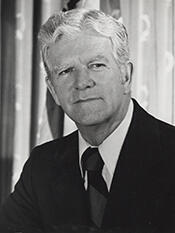
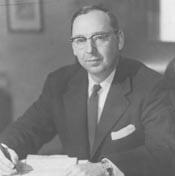
Col. James Dennis Brady (April 3, 1843 – November 30, 1900) was a U.S. Representative from Virginia, a Union officer in the American Civil War, and a lawyer in private practice. A member of the Republican Party representing Virginia, he contributed to the legislative process during one term in Congress, serving during a significant period in American history and participating in the democratic process on behalf of his constituents.
Brady was born in Portsmouth, Virginia, to Irish immigrant parents, Bartholomew and Elizabeth Brady. He was one of five children in the family. In 1855, when he was still a boy, both of his parents died in the Yellow Fever epidemic that swept Portsmouth and claimed the lives of approximately 10 percent of the town’s population. Orphaned at a young age, Brady’s early life was marked by the hardships common to many children of immigrant families in mid-nineteenth-century port cities, and this background would later inform his identification with both Unionist and Irish-American causes.
At the outbreak of the Civil War, Brady enlisted in the Union Army on March 9, 1861, as a private in Company A of the 37th New York Volunteers, known as the “Irish Rifles,” serving with the famed Irish Brigade in the Army of the Potomac. Over the course of the war he rose rapidly through the ranks, being commissioned as a lieutenant and then adjutant, and subsequently promoted to captain, major, lieutenant colonel, and finally colonel of the regiment. He was the last-named officer honorably mustered out of service on May 26, 1865, and claimed to be the “youngest colonel in the Army of the Potomac.” Brady fought in all of the major engagements in which the Irish Brigade took part and commanded the “Color Company” at the Battle of Fredericksburg in 1862. He was wounded multiple times: in the head while leading his company in the assault on Marye’s Heights at Fredericksburg; in the leg on the second day of the Battle of Fair Oaks, on the morning when General Oliver O. Howard lost his arm; in the mouth at Malvern Hill; and again in the arm at Cold Harbor on June 3, 1864, in an action in which a shot also passed through his abdomen. His conduct drew favorable notice from senior commanders, and he was personally complimented by Major General Winfield Scott Hancock at the Battle of Gettysburg on the afternoon that General Samuel K. Zook was mortally wounded, with Brady present at Zook’s side.
After the war, James Dennis Brady returned to Virginia, in keeping with the custom of the Irish Brigade by taking home its colors, or flag. He later donated this flag to the University of Notre Dame and wrote a book about it, titled Blue for the Union, Green for Ireland, reflecting both his service to the United States and his Irish heritage. In civilian life he studied law and entered private practice, working as a lawyer in the intervals between his periods of public service. His legal training and wartime reputation helped establish him as a prominent Republican figure in postwar Virginia, a state then undergoing the political and social transformations of Reconstruction and its aftermath.
Brady’s public career in Virginia began soon after the war. He was elected clerk of the court in Portsmouth and served in that capacity from 1865 to 1877, a position that placed him at the center of local judicial and administrative affairs during the turbulent Reconstruction era. In 1875 he made a successful run for the state senate, but the result was overturned due to a ballot-stuffing scandal. Reflecting his resilience in the face of political setbacks, he wrote, “…There is nothing that discourages me…,” and he remained active in Republican politics. His growing influence within the party was recognized at the national level when President Rutherford B. Hayes appointed him collector of internal revenue for the second district of Virginia, a post he held from 1877 to 1885. He was again appointed collector for the same district from 1889 to 1900, underscoring the confidence successive Republican administrations placed in his administrative abilities.
Brady’s congressional service came during this period of Republican ascendancy in federal appointments. As a Republican from Virginia, he was elected to the Forty-ninth Congress and served a single term from March 4, 1885, to March 3, 1887. He won his seat with 40.48 percent of the vote, defeating Democrat George E. Rives and Independent Republican Joseph P. Evans. During his term he participated in the legislative process at a time when issues of Reconstruction’s legacy, civil service reform, and economic development were prominent in national debate, representing the interests of his Virginia constituents in the U.S. House of Representatives. He chose not to be a candidate for renomination in 1886, returning instead to his other public and professional responsibilities.
In addition to his congressional service and revenue-collector duties, Brady was a significant figure in the national Republican Party. He served as a delegate to the Republican National Conventions of 1880, 1888, and 1896, taking part in the nomination of presidential candidates and the shaping of party platforms during a formative period in Gilded Age politics. Between these roles, he continued his work as a lawyer in private practice, maintaining his professional identity outside of elective and appointive office and reinforcing his standing as a civic leader in his community.
James Dennis Brady died on November 30, 1900, in Petersburg, Virginia, while still serving as collector of internal revenue for the second district. He was interred in St. Joseph’s Cemetery in Petersburg, Virginia. His life spanned from the antebellum era through the Civil War and Reconstruction into the dawn of the twentieth century, marked by military distinction, legal practice, and sustained public service at the local, state, and national levels.
Congressional Record