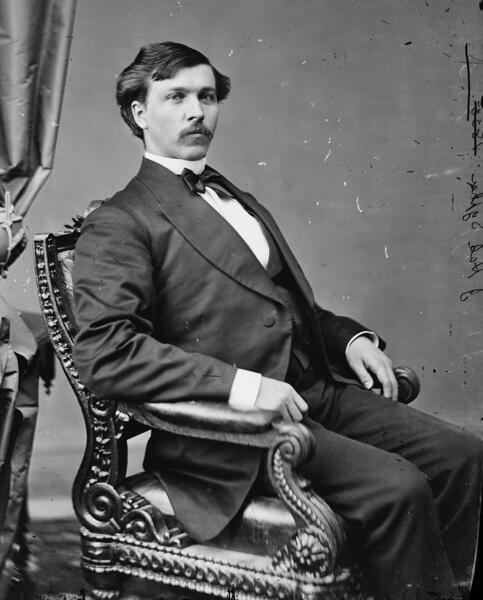
Jacob Hale Sypher (June 22, 1837 – May 9, 1905) was an attorney, Union Army officer, and Republican politician who represented Louisiana in the United States House of Representatives during the Reconstruction era. He served four terms in Congress, participating in the legislative process at a pivotal moment in American history and representing the interests of his Louisiana constituents following the Civil War.
Sypher was born near Millerstown, Perry County, Pennsylvania, on June 22, 1837. He attended local schools in Pennsylvania before pursuing higher education in New York. He enrolled at Alfred University in Alfred, New York, and graduated in 1859. His early life in rural Pennsylvania and his university education in the North helped shape the outlook he later brought to his military and political careers.
At the outbreak of the American Civil War, Sypher enlisted in the Union Army as a private in Battery A, 1st Ohio Light Artillery Militia, a three‑month unit. When that term of service expired, he continued his military career and was commissioned a first lieutenant in Battery B, 1st Ohio Light Artillery. In 1864, he was commissioned as a colonel to lead the 14th Rhode Island Heavy Artillery (Colored), a regiment of African American troops later re-designated as the 11th United States Colored Heavy Artillery of the United States Colored Troops. Although he held the colonelcy, Sypher did not exercise operational field command of the regiment, as he was assigned to court‑martial duty throughout the unit’s service. For his overall services during the war, he was brevetted brigadier general, reflecting official recognition of his contributions to the Union cause.
After the war, Sypher moved to northern Louisiana, where he purchased a plantation in an effort to establish himself in the postwar Southern economy. Finding plantation life not to his liking, he relocated to New Orleans. There he turned to the study of law and, after a short period of preparation, was admitted to the bar of the state of Louisiana. Establishing a legal practice in New Orleans, he entered public life as a member of the Republican Party at a time when Reconstruction policies were reshaping the political and social order of the former Confederate states.
Sypher was first elected as a Republican to the U.S. House of Representatives from Louisiana’s 1st congressional district in 1866. His service in Congress began on July 18, 1868, and extended until March 3, 1875, encompassing four terms during a significant period in American history. The elections of this era were often contested and marred by irregularities. In the 1868 election, he may initially have lost, but the balloting was so disputed that Congress invalidated the result and ordered a new election; Sypher won this second contest and secured his seat. He was re‑elected twice more, continuing to participate actively in the democratic process and in the legislative debates of Reconstruction, including issues related to civil rights, federal authority in the South, and the reintegration of the former Confederate states.
The 1872 election for Sypher’s seat became one of the most contentious of the Reconstruction period. Initially, Sypher appeared to have prevailed and was certified the winner, allowing him to be sworn in and to serve while the result was under challenge. His Democratic opponent, Effingham Lawrence, contested the election, alleging irregularities in the reported returns. After a lengthy investigation, the House of Representatives concluded that the returns were incorrect, in part because two competing sets of returns had been submitted. On March 3, 1875, the final day of that Congress, the House declared Lawrence the rightful winner and removed Sypher from office. Lawrence’s seating marked the first time since before the Civil War that a Democrat had been elected to Congress from Louisiana, signaling a major shift in the state’s political landscape.
Sypher’s final contested election took place against the backdrop of escalating violence and voter intimidation in Louisiana. During the 1872 campaign, the White League, a paramilitary organization aligned with the Democratic Party, was active in intimidating Black voters and suppressing the Republican vote. This campaign of coercion and violence contributed to Sypher’s eventual loss of his seat and is widely regarded as part of the beginning of the end of Reconstruction in Louisiana. In subsequent elections, even greater violence and more systematic suppression of Black voting occurred, enabling Democrats to regain control of the state legislature. The broader federal retreat from Reconstruction was underscored in 1877, when federal troops were withdrawn from Louisiana, effectively ending sustained federal enforcement of Reconstruction policies in the state.
After his congressional service ended, Sypher left Louisiana and moved to Washington, D.C., where he resumed the practice of law. He continued his legal career in the capital for the remainder of his life, remaining connected to the political and legal milieu shaped in part by the Reconstruction struggles in which he had participated. Jacob Hale Sypher died in Baltimore, Maryland, on May 9, 1905, closing a life that spanned the antebellum period, the Civil War, and the turbulent Reconstruction era in which he played a notable role as a Union officer and Republican congressman from Louisiana.
Congressional Record