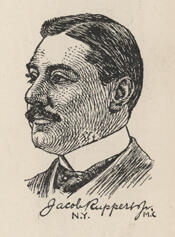
Jacob Ruppert Jr. (August 5, 1867 – January 13, 1939) was an American brewer, businessman, National Guard officer, baseball executive, and Democratic politician who served four terms as a United States Representative from New York from 1899 to 1907. He was born in New York City, the second of six children of brewer Jacob Ruppert Sr. and Anna (Gillig) Ruppert, both of German ancestry. His maternal grandfather, George Gillig, was a prominent brewer, and although Ruppert was a second‑generation American, he retained a noticeable German accent throughout his life. He grew up in the Jacob Ruppert Sr. House on Fifth Avenue in Manhattan, an upbringing that placed him at the intersection of immigrant enterprise and New York’s rising commercial elite.
Ruppert attended Columbia Grammar School in New York City and was accepted to Columbia College, but he chose instead to enter the family brewing business. Beginning in 1887, he worked at the Jacob Ruppert Brewing Company, starting at the lowest rung as a barrel washer, laboring 12-hour days for $10 a week. Over time he mastered the technical and managerial aspects of brewing and rose to become vice president and general manager of the company. Parallel to his early business career, he embarked on military service: in 1886, at age 19, he enlisted as a private in the Seventh Regiment of the National Guard of New York. He served in the ranks through 1889 and, in 1890, was promoted to colonel and appointed aide-de-camp on the staff of Governor David B. Hill. He later became a senior aide to Hill’s successor, Governor Roswell P. Flower, serving in that capacity until 1895. This combination of commercial experience and military service helped establish his public profile in New York.
Ruppert’s political career culminated in his election to the United States House of Representatives as a Democrat in the 1898 elections. Backed by Tammany Hall leader Richard Croker, he defeated Republican incumbent Philip B. Low in New York’s 15th congressional district and entered the 56th Congress on March 4, 1899. He was reelected in 1900, defeating Alderman Elias Goodman, and again in 1902, when he was renominated in the newly drawn 16th congressional district. A member of the Democratic Party, Ruppert served continuously in the House from March 4, 1899, to March 3, 1907, completing four terms during a significant period in American history marked by industrial expansion, urbanization, and the aftermath of the Spanish–American War. During these years he participated in the legislative process and represented the interests of his New York constituents in the House of Representatives, contributing to debates and votes that shaped federal policy at the turn of the twentieth century. He chose not to be a candidate for reelection in 1906 and left Congress at the close of the 59th Congress in 1907.
After leaving Congress, Ruppert expanded his business interests well beyond brewing. He served as president of the Astoria Silk Works and led the United States Brewers’ Association from 1911 to 1914. In January 1914, his father purchased the J&M Haffen Brewing Company in the Bronx for $700,000, intending to close the plant and redevelop the property. When Jacob Ruppert Sr. died in 1915, leaving an estate valued at $6,382,758, Jacob Jr. inherited control of the Jacob Ruppert Brewing Company and became its president. He also invested in substantial real estate holdings, including Pass-a-Grille Key in Florida. Earlier, in 1894, he had purchased South Brother Island in the East River and was the last person to reside there, remaining until 1909 when his house on the island burned down. On January 30, 1919, he acquired Eagle’s Rest, an estate in Garrison, New York, further reflecting his growing wealth and social standing.
Ruppert’s enduring national fame rests on his role as owner of the New York Yankees. A lifelong baseball enthusiast, he repeatedly attempted to purchase the New York Giants and in 1912 declined an opportunity to buy the Chicago Cubs, judging Chicago too distant from his New York base. Instead, he and Tillinghast L’Hommedieu Huston, a former United States Army engineer and fellow colonel, purchased the New York Yankees from Frank J. Farrell and William S. Devery before the 1915 season for $480,000. At that time the Yankees were a struggling American League franchise with limited on-field success. Ruppert and Huston quickly became assertive owners, challenging American League president Ban Johnson over the 1918 acquisition of pitcher Carl Mays from the Boston Red Sox, a dispute that went to court and contributed to the eventual dissolution of baseball’s National Commission and the creation of the Commissioner of Baseball. On Johnson’s recommendation, Ruppert hired Miller Huggins as manager after the 1917 season, a decision that created a lasting rift with Huston and led to Ruppert buying out his partner for $1.5 million in May 1922, making him sole owner.
Under Ruppert’s leadership, the Yankees were transformed from also-rans into a dominant baseball powerhouse. In January 1920, he purchased Babe Ruth from the Boston Red Sox, a move that dramatically increased both the team’s popularity and profitability. As the Yankees began to outdraw the New York Giants at the Polo Grounds, Giants owner Charles Stoneham raised their rent, prompting Ruppert and Huston to purchase land in the Bronx from the estate of William Waldorf Astor for $675,000 and to construct a new ballpark. Yankee Stadium, self-financed at a cost of $2.5 million, opened on April 18, 1923, as the first three-tiered ballpark and the first to be widely called a “stadium.” The Yankees won their first World Series that year, defeating the Giants, and went on to dominate the 1920s and 1930s, capturing multiple American League pennants and World Series titles, including the famed “Murderers’ Row” championship teams of 1927 and 1928 and three consecutive World Series victories in 1936, 1937, and 1938. Ruppert introduced uniform numbers to Yankees jerseys in 1929 to help occasional fans identify players, and after Commissioner Kenesaw Mountain Landis authorized farm systems in 1931, he acquired the Newark Bears and began building one of baseball’s earliest and most effective minor league networks. Though he and Ruth sometimes clashed publicly over contract terms, they remained personal friends; Ruth later recalled that Ruppert, who usually addressed people by their surnames, called him “Babe” only once, on the night before Ruppert died.
In his final years, Ruppert’s health declined. He suffered from phlebitis in April 1938 and spent much of that year confined to his Fifth Avenue apartment, listening by radio as the Yankees won yet another World Series, their seventh under his ownership. In November 1938 he entered Lenox Hill Hospital in Manhattan, where he died on January 13, 1939. He was survived by his brother George and his sister Amanda and was interred in the family mausoleum at Kensico Cemetery in Valhalla, New York. By the time of his death, the estate of $6.3 million left by his father in 1915 had grown under his management to approximately $120 million. His brother George, who had served as a Yankees vice president, declined the team presidency and supported the elevation of general manager Ed Barrow, under whom the club continued its success, winning a fourth consecutive World Series in 1939 and additional titles in the early 1940s. Ruppert’s heirs later mismanaged the brewery, selling the Yankees to Dan Topping, Del Webb, and Larry MacPhail in 1945; the brewery itself went out of business in 1965 after selling its Knickerbocker beer brand to Rheingold. Ruppert’s legacy endured in baseball and in New York civic memory: Yankee Stadium bore a plaque dedicated to him in 1940, now displayed in Monument Park at the current Yankee Stadium; Ruppert Stadium in Newark, New Jersey, and Ruppert Park in Manhattan were named in his honor; and on December 3, 2012, he was elected to the National Baseball Hall of Fame by the Pre-Integration Era Committee and formally inducted on July 28, 2013, cementing his reputation as one of the most influential owners in the history of Major League Baseball.
Congressional Record