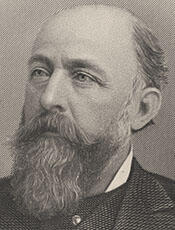
Jacob Romeis (December 1, 1835 – March 8, 1904) was an American businessman and Republican politician who represented Ohio in the United States House of Representatives from 1885 to 1889. His congressional service took place during a significant period in American history, and he participated in the legislative and democratic processes on behalf of his Ohio constituents for two consecutive terms. Over the course of his public career, Romeis combined experience in commerce, municipal government, and national politics.
Romeis was born on December 1, 1835, in Weisenbach, Bavaria, in the German Confederation. He attended the village schools in his native region before immigrating to the United States in 1847 with his parents. The family settled in Erie County, New York, where the young Romeis continued his education and adapted to life in his adopted country. This early immigrant experience shaped his perspective as he later entered business and public service.
After arriving in New York, Romeis attended the public and select schools of Buffalo, New York. His schooling in Buffalo provided him with the basic education and practical grounding necessary for a career in commerce and civic affairs. Upon completing his studies, he moved into the workforce at a time when transportation and trade were rapidly expanding in the United States.
Romeis first engaged in the shipping business and railroading, sectors that were central to the economic development of the mid-19th-century United States. In 1856 he moved to Toledo, Ohio, a growing transportation and commercial hub on the western end of Lake Erie. There he continued his business pursuits and became increasingly involved in local affairs. His standing in the community led to his election to the Toledo board of aldermen in 1874. He was reelected to the board in 1876 and served as its president in 1877, demonstrating both the confidence of his fellow citizens and his leadership within the city’s governing body.
Building on his municipal experience, Romeis was elected mayor of Toledo and served in that office from 1879 to 1885. As mayor, he oversaw the administration of a rapidly developing city during a period of industrial and urban growth in Ohio. His tenure in municipal government provided him with practical experience in public administration and governance, which he later carried with him to the national stage.
Romeis was elected as a Republican to the Forty-ninth and Fiftieth Congresses, serving as a U.S. Representative from Ohio from March 4, 1885, to March 3, 1889. As a member of the House of Representatives, he contributed to the legislative process and represented the interests of his Ohio constituents during a time of significant economic and political change in the United States. His service in Congress reflected his party affiliation and his commitment to participating in the democratic process at the federal level. Although he sought to continue his work in Washington, he was an unsuccessful candidate for reelection in 1888 to the Fifty-first Congress.
Following the conclusion of his congressional service, Romeis returned to Ohio and withdrew from national politics. He later engaged in fruit growing near Toledo, turning to agriculture and local enterprise in his later years. Remaining in the region that had been the center of his business and political life, he continued to be identified with the Toledo area even after leaving public office.
Jacob Romeis died in Toledo, Ohio, on March 8, 1904. He was interred in Woodlawn Cemetery in Toledo. His career, spanning immigration from Bavaria, business in shipping and railroading, municipal leadership as alderman and mayor, and two terms in the United States Congress, reflected the opportunities and responsibilities of public life in 19th-century America.
Congressional Record