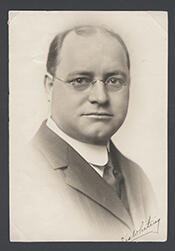
Jacob Edwin Meeker (October 7, 1878 – October 16, 1918) was a Republican member of the United States House of Representatives from Missouri, serving from 1915 until his death in 1918. He was born near Attica, Fountain County, Indiana, where he attended the local public schools. His early years in rural Indiana shaped both his religious vocation and his later public service, grounding him in the concerns of small-town and agricultural communities that would remain central to his work as a minister and, later, as a legislator.
Meeker pursued higher education at Union Christian College in Merom, Indiana, from which he graduated in 1900. While still a student there, he took on pastoral duties at a rural church in Vermilion County, Illinois, marking the beginning of his formal religious career. He was ordained as a minister in 1901 and continued to serve that Vermilion County congregation, combining his academic training with practical pastoral work. Seeking further theological education, he enrolled at Oberlin Theological Seminary in Oberlin, Ohio, and completed his studies there in 1904, preparing himself for broader responsibilities in the ministry.
In 1904 Meeker became a missionary for the Congregational Church in Eldon, Missouri, an appointment that brought him permanently into the state he would later represent in Congress. Two years later, in 1906, he moved to St. Louis, Missouri, to assume the pastorate of the Compton Hill Congregational Church. His leadership of this prominent urban congregation extended until his resignation in 1912. During these years he became increasingly engaged with the civic and social issues of a rapidly growing city, experience that helped to bridge his pastoral work with an emerging interest in law and public policy.
After leaving the active ministry, Meeker turned to the study of law as a means of expanding his public service. He enrolled at Benton College of Law in St. Louis and, upon completion of his legal studies, was admitted to the bar in 1914. This transition from the pulpit to the legal profession reflected his evolving commitment to address social and political issues through legislative and legal channels as well as through religious leadership. His legal training provided him with the tools to participate more directly in the formulation and interpretation of public policy.
Meeker was elected as a Republican to the Sixty-fourth Congress and took office on March 4, 1915, as a Representative from Missouri. He was subsequently re-elected to the Sixty-fifth Congress, serving continuously from March 4, 1915, until his death in 1918. During his two terms in the United States House of Representatives, he contributed to the legislative process at a time of profound national and international change, including the period of American involvement in World War I. As a member of the House of Representatives, Jacob Edwin Meeker participated in the democratic process and represented the interests of his Missouri constituents, bringing to his work the combined perspectives of a clergyman, lawyer, and public servant.
Meeker’s congressional service occurred during a significant period in American history, when questions of war, economic adjustment, and social reform were at the forefront of national debate. As a Republican member of the House, he took part in deliberations that shaped federal policy in these years, adding his voice to the broader legislative response to the challenges of the era. His background in both theology and law informed his approach to representation, emphasizing moral responsibility as well as legal and constitutional considerations in the exercise of his duties.
Jacob Edwin Meeker’s career was cut short by the influenza pandemic of 1918. He died in office in St. Louis, Missouri, on October 16, 1918, a victim of the Spanish flu, and thus became one of the members of the United States Congress who died while serving between 1900 and 1949. He was interred in Union Cemetery in Attica, Indiana, returning in death to the community near where he had been born. His life and service were later commemorated in the volume “Jacob E. Meeker, late a representative from Missouri, Memorial addresses delivered in the House of Representatives and Senate,” published in 1920, which recorded the tributes of his colleagues to his work and character.
Congressional Record