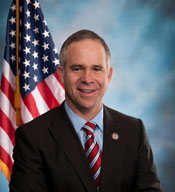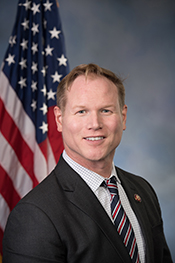
Jacob Andrew Joseph “Jake” LaTurner (born February 17, 1988) is an American politician and public affairs professional who served as a Representative from Kansas in the United States Congress from 2021 to 2025. A member of the Republican Party, he represented Kansas’s 2nd congressional district during a significant period in American history, contributing to the legislative process over two terms in office. LaTurner was born and raised in Galena, Cherokee County, Kansas, where he attended Galena High School. From an early age he was active in politics and public service, interests that would shape his subsequent career in state and national office.
After graduating from Galena High School, LaTurner enrolled at Pittsburg State University in Pittsburg, Kansas, where he earned an undergraduate degree in political science. While in college, he worked in the Pittsburg district office of former Kansas state treasurer and U.S. representative Lynn Jenkins, gaining early experience in constituent services and federal legislative affairs. According to Representative Henry Cuellar, as of 2023 LaTurner was enrolled alongside him in the master’s program in defense and strategic studies at the U.S. Naval War College, reflecting an ongoing interest in national security and strategic policy.
LaTurner first sought elective office in 2008, when he ran in the Republican primary for the Kansas Senate’s 13th district but lost to incumbent Senator Bob Marshall. He challenged Marshall again four years later and, in 2012, defeated him in a rematch. Taking office at age 24, LaTurner became the youngest member of the Kansas Senate. Representing the 13th district from 2013 to 2017, he drafted legislation to impose term limits on state legislators, reform the process for requesting public records, and address potential nepotism in state government, facing opposition from both Republican and Democratic legislative leaders, including House Speaker Ray Merrick and Senate Democratic leader Anthony Hensley. In February 2015 he was the lead sponsor of legislation allowing Kansas adults to carry firearms without a concealed carry permit, and in 2016 he authored a bill limiting property tax increases.
On April 25, 2017, Kansas Governor Sam Brownback appointed LaTurner as the 40th Kansas state treasurer, succeeding Ron Estes, who had been elected to the U.S. House of Representatives for Kansas’s 4th congressional district. At age 29, LaTurner became the youngest statewide official in the country, and after defeating State Senator Marci Francisco in the 2018 election, he became the youngest statewide elected official in the United States. As state treasurer from 2017 to 2021, he oversaw more than $350 million in unclaimed property and completed a 105‑county tour within his first five months in office, returning over $10 million during that tour and a record $25.5 million in unclaimed property in his first year. He emphasized that “every dollar we return to the people of Kansas is a dollar that goes back into their local communities,” and he worked to make the claims process more user‑friendly. He also administered the Kansas Learning Quest 529 Education Savings and ABLE Savings Programs, implementing changes that allowed individuals with disabilities to roll over funds from 529 education accounts into ABLE accounts and permitted Learning Quest 529 funds to be used for K–12 tuition. As treasurer, he continued a legal case against the U.S. Department of the Treasury seeking the return of proceeds from matured savings bonds to Kansas; although a lower court initially sided with the state, the United States Court of Appeals later reversed that decision, holding that the federal government would oversee the process of returning the bonds’ value directly to Kansans. In December 2020, Governor Laura Kelly announced she would appoint Lieutenant Governor Lynn Rogers to succeed LaTurner as treasurer, and Rogers took office on January 2, 2021.
While serving as treasurer, LaTurner entered federal electoral politics. On January 8, 2019, he announced his candidacy for the United States Senate in the 2020 election to succeed retiring four‑term Senator Pat Roberts. Launching his campaign at age 30, the minimum age required by the U.S. Constitution for senators, he ran as a conservative supporting President Donald Trump’s proposed Mexico–United States border wall, advocating fiscal restraint, and calling for term limits for federal officeholders. He publicly stated that he would withdraw from the race if Secretary of State Mike Pompeo chose to run and pledged to support Pompeo if that occurred. On September 9, 2019, LaTurner suspended his Senate campaign and instead announced a run for the U.S. House of Representatives in Kansas’s 2nd congressional district, challenging incumbent Republican Steve Watkins amid mounting controversies over Watkins’s résumé, voting record, and legal troubles, including charges related to voting and providing false information to law enforcement. Former Governor Jeff Colyer encouraged LaTurner to enter the House race, and LaTurner transferred approximately $470,000 in campaign funds from his Senate committee, giving him a financial advantage over Watkins. On August 4, 2020, he defeated Watkins in the Republican primary and went on to win the November 3, 2020 general election against Democratic Topeka Mayor Michelle De La Isla.
LaTurner took office as U.S. representative for Kansas’s 2nd congressional district on January 3, 2021, beginning the first of his two terms in the House of Representatives. His service in Congress occurred during a significant and turbulent period in American history, and as a member of the House he participated in the democratic process and represented the interests of his constituents in eastern Kansas. On January 6, 2021, during the joint session of Congress to count the Electoral College votes from the 2020 presidential election, he voted in favor of sustaining the objection to Arizona’s electoral votes after the proceedings were interrupted by the storming of the U.S. Capitol by supporters of President Trump. Before the session concluded, LaTurner received a positive COVID‑19 test and withdrew to quarantine, preventing him from voting on the subsequent objection to Pennsylvania’s electoral votes. In the days that followed, he voted against the impeachment of President Trump. During his tenure, LaTurner served on the Committee on Homeland Security—sitting on the Subcommittee on Cybersecurity, Infrastructure Protection and Innovation and the Subcommittee on Intelligence and Counterterrorism—the Committee on Oversight and Accountability, including its Subcommittee on Government Operations, and the Committee on Science, Space, and Technology, including its Subcommittee on Research and Technology. Over the course of his two terms, he contributed to the legislative process through committee work, oversight responsibilities, and the sponsorship and co‑sponsorship of legislation affecting both Kansas and the nation.
On April 18, 2024, LaTurner announced that he would not seek reelection to the House of Representatives, citing the toll that congressional service had taken on him and his family. He also stated that he did not intend to run for statewide office in the 2026 midterm elections, signaling a pause in his pursuit of elective positions after more than a decade in public office at the state and federal levels. Concluding his House service on January 3, 2025, he closed a chapter that had included roles as state senator, state treasurer, and U.S. representative, each marked by efforts to advance conservative policy priorities, administrative reforms, and constituent services.
Following his departure from Congress, LaTurner entered the private sector while maintaining a presence in public affairs. In 2025, he became a partner at PLUS Communications, a strategic communications and public affairs firm based in the Washington, D.C. area. In that capacity, he drew on his experience in Kansas state government and on Capitol Hill to advise clients on public policy, political strategy, and communications. His career has been documented in official and public sources, including his former U.S. House of Representatives website, his campaign and Kansas State Senate websites, the Biographical Directory of the United States Congress, the Federal Election Commission, the Library of Congress, Vote Smart, Follow the Money, and appearances on C‑SPAN.
Congressional Record