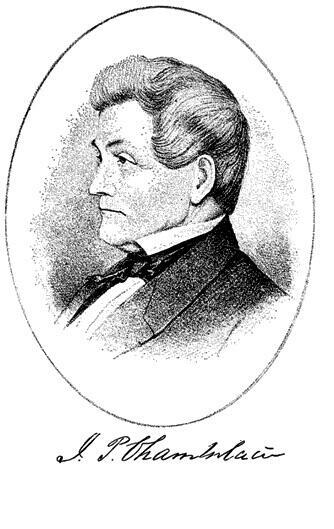
Jacob Payson Chamberlain (August 1, 1802 – October 5, 1878) was a U.S. representative from New York during the American Civil War. He was born in Dudley, Massachusetts, on August 1, 1802. In 1807 his family moved to western New York, where he was educated. As a young man he became a schoolteacher and farmer, establishing himself in the rural communities of the region. He served as town clerk of Varick, New York, gaining early experience in local administration and public affairs.
Chamberlain later settled in Seneca Falls, New York, where he embarked on an extensive business career. He owned and operated farms, flour mills, malthouses, distilleries, and woolen mills, becoming a prominent local entrepreneur. He was also one of the original organizers of the first bank in Seneca Falls, reflecting his growing influence in the commercial and financial life of the community. In addition to his business activities, he was active in civic affairs, serving in several local offices, including as a member of the school board and as president of the village.
Politically, Chamberlain’s affiliations evolved over time in step with broader realignments in New York and national politics. He began as a Bucktail Democrat, later joined the Whig Party, and ultimately became a member of the Republican Party when it was founded in the mid-1850s. A committed supporter of reform causes, he was an active supporter of the Methodist Episcopal Church and participated in the religious and moral life of his community. In 1848 he attended the Seneca Falls Convention, the landmark gathering for women’s rights, and was one of the signers of the Declaration of Sentiments, which called for equal rights for women.
Chamberlain’s growing prominence led to service at the state level. He was a member of the New York State Assembly in 1859, where he took part in legislative deliberations in the years immediately preceding the Civil War. As a member of the Republican Party representing New York, he then advanced to national office. Chamberlain was elected as a Republican to the Thirty-seventh Congress and served one term from March 4, 1861, to March 3, 1863. His service in Congress occurred during a significant period in American history, as the nation entered and fought the Civil War. During this term he contributed to the legislative process, participating in the democratic governance of the Union and representing the interests of his New York constituents at a time of national crisis. He was not a candidate for renomination at the end of his term.
After leaving Congress, Chamberlain returned to Seneca Falls and resumed his business and farming interests. He continued to be regarded as a leading citizen, drawing on his long experience in commerce, local government, and public service. His later years were spent in the same community where he had built his career and reputation, maintaining his involvement in local economic and civic affairs.
Jacob Payson Chamberlain died in Seneca Falls, New York, on October 5, 1878. He was interred in Restvale Cemetery in that community. His family connections included an uncle named Jacob Chamberlain and a cousin, Jacob M. Chamberlain, who lived in the same area; as a result, the three men are sometimes confused with one another in historical records and documents.
Congressional Record