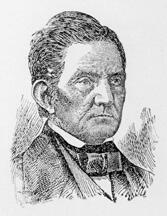
Jacob Burnet (sometimes spelled Burnett) was born on February 22, 1770, in Newark, New Jersey, the son of Dr. William Burnet. Raised in a family of public standing, he came of age in the early years of the American republic, a context that shaped his later career as a jurist and statesman. His family connections extended into other notable public roles; his half-brother, David G. Burnet, would later become the first president of the Republic of Texas, underscoring the broader political milieu in which Jacob Burnet’s life unfolded.
Burnet pursued higher education at the College of New Jersey (now Princeton University), from which he graduated in 1791. After completing his collegiate studies, he read law and prepared for a legal career. Seeking opportunity on the American frontier, he moved to the Northwest Territory and settled in Cincinnati in 1796. That same year, he was admitted to the bar, beginning a long and influential legal career in a region that was then undergoing rapid settlement and institutional development.
Burnet quickly became involved in the political and legal structuring of the emerging state of Ohio. He served as a member of the Territorial councils of Ohio from 1799 to 1802, participating in the formative governance of the territory. Following statehood, he continued in public service as a member of the Ohio State House of Representatives from 1814 to 1816. His influence on the fundamental law of the state was such that he came to be regarded as the “father of the Ohio constitution.” In recognition of his standing and expertise, Burnet was elected an associate justice of the Ohio Supreme Court in 1821, a position he held until his resignation in 1828. During this period, he was also elected a member of the American Antiquarian Society in 1815, reflecting his engagement with historical and scholarly pursuits.
Jacob Burnet’s national career culminated in his service in the United States Senate. A member of the Adams Party, he was elected to the U.S. Senate from Ohio to fill the vacancy caused by the resignation of William Henry Harrison. He entered the Senate on December 10, 1828, and served until March 3, 1831, completing one term in office. During these years, his tenure in Congress occurred at a significant period in American history, marked by evolving party alignments and the transition from the era of John Quincy Adams to that of Andrew Jackson. As a Senator from Ohio, Burnet contributed to the legislative process, participated in the democratic deliberations of the upper chamber, and represented the interests of his Ohio constituents on the national stage from 1827 to 1831 as part of this broader political realignment.
After leaving Congress, Burnet resumed the practice of law in Cincinnati, returning to the profession that had underpinned his public life. He also assumed important educational leadership roles, serving as president of Cincinnati College and of the Medical College of Ohio, thereby contributing to the intellectual and professional development of the region. His scholarly interests culminated in the publication of “Notes on the Early Settlement of the North-western Territory” in 1847, issued in Cincinnati by Derby, Bradley and Company. This work became, and remains, a primary reference on the early history and settlement of the Northwest Territory, cementing his reputation not only as a statesman and jurist but also as a key chronicler of the region’s formative years.
In his later years, Burnet resided in a mansion at the northwest corner of Seventh and Elm streets in Downtown Cincinnati, a visible symbol of his long-standing prominence in the city’s civic and professional life. He continued to be recognized as a figure of historical and legal importance in Ohio, with his career documented in works such as Elliot Howard Gilkey’s 1901 volume, “The Ohio Hundred Year Book: A Hand-book of the Public Men and Public Institutions of Ohio,” and in the official Biographical Directory of the United States Congress. Jacob Burnet died in Cincinnati on May 10, 1853, at the age of 83. He was interred in Spring Grove Cemetery in Cincinnati, leaving a legacy as a foundational figure in Ohio’s constitutional development, a respected jurist, an educator, and a United States Senator who helped shape the early legislative history of the nation.
Congressional Record