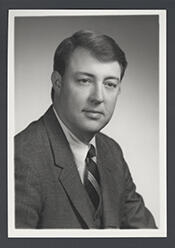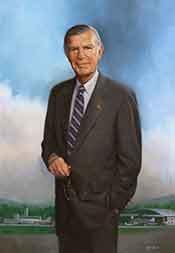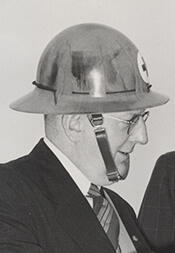
Ivor David Fenton (August 3, 1889 – October 23, 1986) was a Republican member of the U.S. House of Representatives from Pennsylvania who served twelve consecutive terms in Congress from 1939 to 1963. He represented his Pennsylvania constituents in the House of Representatives during a significant period in American history, spanning the end of the Great Depression, World War II, the early Cold War, and the beginnings of the modern civil rights era. Over the course of his long tenure, he contributed to the legislative process as a member of the Republican Party and participated actively in the democratic governance of the nation.
Fenton was born in Mahanoy City (Buck Mountain), Pennsylvania, where he spent his early years in the anthracite coal region of the state. He pursued higher education at Bucknell University in Lewisburg, Pennsylvania, and subsequently enrolled in Jefferson Medical College in Philadelphia. He graduated from Jefferson Medical College in 1912, entering a profession that would shape much of his early career and later public service. Following his medical degree, Fenton served an internship at Ashland State Hospital in Pennsylvania from 1912 to 1913, gaining clinical experience before returning to his native region.
After completing his internship, Fenton commenced the practice of medicine in Mahanoy City, establishing himself as a local physician. His medical career was soon interrupted by World War I, when he enlisted in the United States Army Medical Corps. Commissioned a lieutenant on August 8, 1917, he later rose to the rank of captain. Fenton served for twenty months with the 315th Infantry, 79th Infantry Division, including eleven months overseas with the American Expeditionary Forces in France. During his service he was a battalion surgeon for the 315th Regiment, providing medical care under combat conditions. For his actions, he was awarded the Silver Star and the World War I Victory Medal with two bronze battle clasps. At the conclusion of his military service, he returned to Mahanoy City and resumed his medical practice, continuing to serve the community as a physician.
Fenton’s entry into national politics came with his election as a Republican to the 76th United States Congress. He took office on January 3, 1939, and was subsequently reelected to the eleven succeeding Congresses, serving continuously until January 3, 1963. His congressional service thus extended over twelve terms, during which he represented Pennsylvania in the U.S. House of Representatives. Throughout these years he participated in debates and votes on major domestic and foreign policy issues arising from World War II, postwar reconstruction, and the evolving Cold War. As a member of the House, he represented the interests of his constituents from Pennsylvania’s coal and industrial regions, bringing to his legislative work the perspective of a physician and veteran.
During his congressional career, Fenton took notable positions on civil rights legislation and constitutional reform. He voted in favor of the Civil Rights Act of 1957, the first federal civil rights legislation enacted since Reconstruction, and supported the Civil Rights Act of 1960, which sought to strengthen protections for voting rights. He also voted in favor of the 24th Amendment to the U.S. Constitution, which prohibited the use of poll taxes in federal elections, thereby helping to remove a significant barrier to voting for many citizens. These votes placed him among those members of Congress who supported incremental federal action to expand civil and voting rights during the late 1950s and early 1960s.
Fenton’s long tenure in the House came to an end following redistricting in Pennsylvania. The redrawing of congressional boundaries forced him into an electoral contest against fellow incumbent Democrat George Rhodes in 1962. In that election he was an unsuccessful candidate for reelection, concluding his service in Congress on January 3, 1963, after nearly a quarter-century in the national legislature. His departure marked the close of a congressional career that had begun on the eve of World War II and extended into the early years of the Kennedy administration.
After leaving Congress, Fenton returned to public service in the field of health and welfare at the state level. He served as medical advisor to the Secretary of Welfare of the Commonwealth of Pennsylvania, applying his medical training and legislative experience to the administration of state welfare programs. In addition, he worked as a medical consultant to the State General Hospital of Pennsylvania, continuing his involvement in health care policy and practice. He remained active in these advisory and consultative roles until his retirement in January 1968.
In retirement, Fenton lived in Mahanoy City, maintaining his ties to the community where he had been born, practiced medicine, and launched his political career. He spent his later years in Pennsylvania and died on October 23, 1986, in Sunbury, Pennsylvania. His long life encompassed service as a physician, a decorated World War I officer, a twelve-term member of the U.S. House of Representatives, and a state medical advisor, reflecting a career devoted to both medicine and public service.
Congressional Record