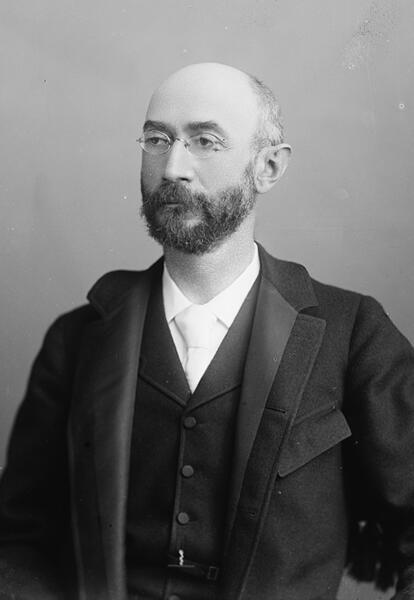
Isidor Straus (February 6, 1845 – April 15, 1912) was a Bavarian-born American businessman, politician, and philanthropist who became a prominent New York merchant and co-owner of R. H. Macy & Co. department store with his brother Nathan. A member of the Democratic Party, he served for just over a year as a member of the United States House of Representatives, representing New York’s 15th congressional district from 1893 to 1895, and more precisely from January 30, 1894, to March 3, 1895. He and his wife, Ida, died together in the sinking of the RMS Titanic in 1912, an event that fixed their story in public memory.
Straus was born on February 6, 1845, in Rhenish Bavaria, then part of the Kingdom of Bavaria, into a Jewish family that would later become prominent in American business and public life. His parents, Lazarus and Sara Straus, emigrated to the United States when Isidor was a child, settling first in the American South. He spent part of his youth in Georgia, where his family engaged in mercantile trade. Growing up in the antebellum South, he was exposed early to commerce and public affairs, experiences that shaped his later career as a businessman and civic leader. Although he did not receive an extensive formal university education, his early immersion in family business and self-directed study provided the foundation for his later success in retail and finance.
After the Civil War, Straus moved north and joined his father and brothers in expanding the family’s commercial enterprises. By the 1870s, the Straus family had become associated with R. H. Macy & Co. in New York City, initially as concessionaires operating the store’s china and glassware department. Through steady reinvestment and careful management, Isidor and his brother Nathan gradually increased their stake in the business. Eventually, the brothers became co-owners of Macy’s department store, transforming it into one of the nation’s leading retail institutions. Under their leadership, Macy’s pioneered modern department store practices, including fixed prices and large-scale advertising, and became a central fixture of New York’s commercial life. Isidor’s reputation as a fair-minded employer and civic-minded businessman enhanced his standing in the city’s political and philanthropic circles.
Straus’s prominence in business led naturally to involvement in public affairs and the Democratic Party. A committed Democrat, he supported tariff reform and other policies he believed would benefit consumers and the broader economy. He was elected to the United States House of Representatives in a special election held in January 1894 to fill the vacancy caused by the resignation of Representative Ashbel P. Fitch, who left Congress to become New York City Comptroller. Straus formally took his seat on January 30, 1894, and served until March 3, 1895, completing the remainder of the term in the Fifty-third Congress. His service in Congress occurred during a significant period in American history marked by economic turmoil and intense debate over trade policy, currency, and industrial regulation. During his one-year term, Straus was a champion of tariff reform, opposing the high rates of the McKinley Tariff and collaborating with West Virginia Congressman William Lyne Wilson on the Wilson–Gorman Tariff Act. He participated actively in the legislative process, representing the interests of his New York constituents, but chose not to run for re-election in the general election of November 1894, returning instead to his business and philanthropic endeavors.
In his private life, Straus married Ida Blun, with whom he had a large family that would continue the Straus tradition of public service and civic engagement. Their children included Jesse Isidor Straus (1872–1936), who married Irma Nathan (1877–1970) and later served as United States Ambassador to France from 1933 to 1936; Clarence Elias Straus (1874–1876), who died in infancy; Percy Selden Straus (1876–1944), who married Edith Abraham (1882–1957), daughter of Brooklyn merchant Abraham Abraham; Sara Straus (1878–1960), who married Dr. Alfred Fabian Hess (1875–1933); Minnie Straus (1880–1940), who married Dr. Richard Weil (1876–1917); Herbert Nathan Straus (1881–1933), who married Therese Kuhn (1884–1977) in 1907; and Vivian Straus (1886–1967), who first married Herbert Adolph Scheftel (1875–1914), with whom she had two of her three children, and later married George A. Dixon Jr. (1891–1956) in 1917. Among his great-great-granddaughters are singer Mikaela Mullaney Straus, known professionally as King Princess, and Wendy Rush (née Weil), the widow of Stockton Rush, founder of the deep-sea tourism company OceanGate, who lost his life in 2023 during a submersible dive to the wreck of the Titanic.
In the years after his congressional service, Straus remained deeply involved in the management and expansion of Macy’s and in a wide range of philanthropic and communal activities in New York. He was recognized as a leading figure in the city’s Jewish and civic life, supporting educational, charitable, and cultural institutions. His business acumen and public spirit made him a respected voice on economic and social questions, and he continued to exert influence behind the scenes in Democratic politics and urban affairs, even without holding further elective office.
In early 1912, Straus and his wife traveled to Europe, spending much of the winter at Cape Martin in southern France. In April they booked passage back to the United States on the RMS Titanic. As the Titanic crossed the North Atlantic, the couple exchanged marconigrams with their son and his wife, who were traveling in the opposite direction aboard the Amerika as the ships passed near each other. On the night of April 14, 1912, at about 11:40 p.m., the Titanic struck an iceberg. Once it became clear that the ship was sinking, Ida Straus refused to leave her husband’s side and would not enter a lifeboat without him. According to their friend and Titanic survivor Colonel Archibald Gracie IV, when he offered to ask an officer if Isidor could accompany Ida into a lifeboat, Isidor declined, refusing to be made an exception while women and children remained on board. Ida is reported to have said, “I will not be separated from my husband. As we have lived, so we will die, together.” She gave her fur coat to her maid and insisted that the maid take a place in a lifeboat. Witnesses later recalled seeing Isidor and Ida standing arm in arm on deck as the situation worsened, a scene described as a “most remarkable exhibition of love and devotion.” The Titanic sank at 2:20 a.m. on April 15, 1912. Isidor and Ida Straus perished along with approximately 1,495 others.
Straus’s body was recovered by the cable ship CS Mackay-Bennett and taken to Halifax, Nova Scotia, before being shipped to New York. He was initially interred in the Straus-Kohns Mausoleum at Beth-El Cemetery in Brooklyn and was later reinterred in the Straus Mausoleum at Woodlawn Cemetery in the Bronx in 1928. Ida’s body was never recovered; in her memory, the family collected water from the Titanic wreck site and placed it in an urn in the mausoleum. Isidor and Ida are memorialized on a cenotaph outside the mausoleum bearing a verse from the Song of Solomon (8:7): “Many waters cannot quench love—neither can the floods drown it.” An 18-karat gold-trimmed pocket watch, given to Straus for his 43rd birthday in 1888 and recovered from his body, later became a notable artifact of the disaster and was sold at auction in England on November 23, 2025, for a record-breaking £1.78 million (approximately $2.32 million).
In addition to the Woodlawn cenotaph, multiple memorials in New York City honor Isidor and Ida Straus. A memorial plaque on the main floor of Macy’s Department Store in Manhattan commemorates their contributions to the company and their deaths on the Titanic. The Isidor and Ida Straus Memorial stands in Straus Park at the intersection of Broadway and West End Avenue at 106th Street (Duke Ellington Boulevard) in Manhattan, one block from their former residence at 105th Street and West End Avenue, now the site of the Cleburne Building. The monument bears the inscription, “Lovely and pleasant they were in their lives, and in death they were not divided” (2 Samuel 1:23). New York City Public School P.S. 198, built in Manhattan in 1959 and located on Third Avenue between East 95th and 96th Streets, is named in their memory and shares its building with P.S. 77. At Harvard University, Straus Hall, one of the freshman residence halls in Harvard Yard, was given in honor of Isidor and Ida Straus by their three sons, further extending their legacy in American educational and civic life.
Congressional Record