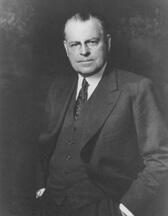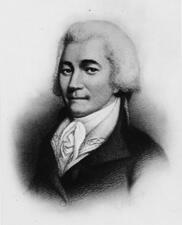
Isaac Tichenor (February 8, 1754 – December 11, 1838) was an American lawyer and politician who served as the third and fifth governor of Vermont and as a United States Senator from Vermont. A prominent member of the Federalist Party, he played a significant role in the political development of Vermont from its years as an independent republic through its early decades as a state in the Union, and he contributed to the legislative process in the United States Senate during a period of major national change.
Tichenor was born on February 8, 1754, in Newark, in the Province of New Jersey, the son of Daniel Tichenor and Susanna (Guerin) Tichenor. He was a descendant of Martin Tichenor (1625–1681), an early colonist and original settler of Newark, New Jersey, which placed him within a longstanding New England–Mid-Atlantic colonial family. He was educated locally and then attended the College of New Jersey (now Princeton University), from which he graduated in 1775. Following his graduation, he moved for a short time to Schenectady, New York, where he studied law in preparation for a legal and public career.
In 1777, during the American Revolution, Tichenor moved to Bennington in what is now Vermont, then a contested frontier region. He served as an Assistant Commissary General, helping to supply troops engaged in the revolutionary cause. He was elected captain and commander of a Bennington militia company, which was activated for service several times in Vermont and upstate New York, reflecting his early leadership in military as well as civil affairs. During this period he was also appointed a justice of the peace, beginning his long association with the administration of justice and local governance in Vermont.
With the emergence of the Vermont Republic, Tichenor quickly became a leading political figure. He was a member of the Vermont House of Representatives from 1781 to 1784 and served as Speaker of the House in 1783. In addition to his legislative duties, he acted as an agent from the Vermont Republic to the Continental Congress, presenting Vermont’s request for admission to the Union from 1782 to 1789 and working to secure recognition of Vermont’s status. After Vermont’s admission to the Union in 1791, he ran unsuccessfully for a seat in the United States House of Representatives against Matthew Lyon and Israel Smith, receiving 29 percent of the vote in the first round. He simultaneously advanced in the judiciary, serving as an associate justice of the Vermont Supreme Court from 1791 to 1794 and as Chief Justice in 1795 and 1796. Tichenor was also active in the Vermont militia, attaining the rank of major general as commander of its 2nd Division, which underscored his continuing role in the state’s defense and military organization.
Tichenor’s national legislative career began when he entered the United States Senate as a Federalist. He was elected to fill the unexpired term of Senator Moses Robinson, and he took his seat on October 18, 1796. He was re-elected to a full six-year term to begin on March 4, 1797, thus serving in the Senate during the administrations of George Washington and John Adams. However, he resigned from the Senate on October 17, 1797, when he was elected governor of Vermont. His service in Congress occurred during a significant period in American history, as the new federal government was consolidating its institutions and parties were forming around differing visions of federal power. As a member of the Senate, Isaac Tichenor participated in the democratic process and represented the interests of his Vermont constituents while supporting Federalist policies that favored a strong national government.
As governor, Tichenor became one of the dominant figures in early Vermont politics. A member of the Federalist Party, he first assumed the governorship in 1797, serving as the third governor of Vermont, and later returned to serve again as the fifth governor. His tenure in the governor’s office extended, with brief interruptions, from the late 1790s into the second decade of the nineteenth century, and he effectively controlled the state’s executive branch for about a decade. During the 1790s, when the Federalist Party dominated the federal government, many leading politicians in Vermont joined the opposing Democratic-Republican Party and resisted a strong national government. Tichenor nonetheless maintained his position as a Federalist, and his repeated elections reflected both his personal popularity and the gradual decline of the Federalist Party as a whole. His margins of victory narrowed over time: after his last consecutive victory in 1806, he lost the governorship in 1807, won narrowly again in 1808, and then lost in 1809, 1810, and 1817 by increasing margins, illustrating the shifting political landscape in Vermont and the nation.
In 1815, Tichenor returned to the United States Senate, again representing Vermont as a Federalist. He served in this second Senate tenure until 1821, overlapping with the period commonly known as the “Era of Good Feelings,” when the Federalist Party was in steep decline. His Senate service from 1795 to 1821, including his earlier and later terms, placed him at the center of national debates over issues such as federal authority, economic policy, and the evolving party system. By the end of his term in 1821, the Federalist Party had effectively ceased to exist as a national political force, and Tichenor’s career marked the transition from the Federalist-dominated 1790s to the more fluid party alignments of the early nineteenth century.
After completing his final Senate term in 1821, Tichenor retired from public life and resided in Bennington, Vermont. He lived there quietly for the remainder of his life, maintaining the status of an elder statesman in a state whose early institutions he had helped to shape. Isaac Tichenor died in Bennington on December 11, 1838, and was interred at Bennington Village Cemetery. At the time of his death, he was recognized as the last surviving governor to have served in the eighteenth century, a distinction that underscored the length of his public career and his connection to the founding generation of the United States.
Congressional Record