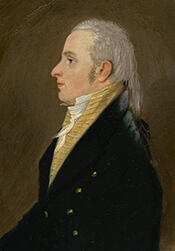
Isaac Darlington (December 13, 1781 – April 27, 1839) was an American politician, lawyer, and judge from Pennsylvania who served in both the Pennsylvania House of Representatives and the United States House of Representatives. A member of the Federalist Party, he represented Pennsylvania in the Fifteenth Congress from 1817 to 1819 and contributed to the legislative process during one term in office, participating in the democratic process and representing the interests of his constituents during a significant period in American history.
Darlington was born on December 13, 1781, in Westtown Township, Chester County, Pennsylvania. He came from a family that would be prominent in public affairs; he was a cousin of Edward Darlington and William Darlington, both of whom later served in Congress, and a second cousin of Smedley Darlington, who also became a U.S. Representative. He was educated in the traditions of the Society of Friends, attending the Friends School at Birmingham, Pennsylvania, where he studied under schoolmaster John Forsythe. After completing his own schooling, he taught at a country school for two or three years, gaining early experience in education before turning to the study of law.
Pursuing a legal career, Darlington read law under Joseph Hemphill, a noted attorney who would himself become a member of Congress. Darlington was admitted to the bar in 1801 and established a law practice in West Chester, Pennsylvania. His legal work quickly led him into public life. He was elected to the Pennsylvania House of Representatives as a representative of Chester County, serving from 1807 to 1808. He later returned to the state legislature when he was elected again in a special election in February 1816 to fill a vacancy, reinforcing his role as a local leader and advocate for his county.
In addition to his legal and legislative work, Darlington served in the militia during the period of the War of 1812. He held the rank of lieutenant and adjutant in the Second Regiment, Pennsylvania Volunteers in 1814 and 1815. This service complemented his growing public profile and reflected the broader mobilization of Pennsylvania citizens during the conflict. His combined experience in law, state government, and military service positioned him for higher office at the national level.
Darlington was elected as a Federalist to the U.S. House of Representatives, representing Pennsylvania in the Fifteenth Congress. He served from March 4, 1817, to March 3, 1819. During his single term in Congress, he sat as a member of the House of Representatives at a time when the nation was transitioning into the so‑called “Era of Good Feelings” following the War of 1812. As a Federalist, he participated in debates and legislative activity that addressed issues of national development and governance in the postwar period. He declined to be a candidate for renomination in 1818 to the Sixteenth Congress, thereby concluding his brief but notable tenure in the national legislature.
After leaving Congress, Darlington resumed and expanded his legal and judicial career. In 1820 he was appointed deputy attorney general for Chester County, Pennsylvania, a position that placed him at the center of county-level law enforcement and prosecution. The following year, in May 1821, he was appointed presiding judge of the judicial district comprising the counties of Chester and Delaware. He held this judicial post from May 1821 until his death, overseeing a broad range of civil and criminal matters and exerting significant influence on the administration of justice in southeastern Pennsylvania over nearly two decades.
Isaac Darlington died at his home in West Chester, Pennsylvania, on April 27, 1839. He was interred in the Friends Burying Ground in Birmingham, reflecting his Quaker background and local roots. His family continued his tradition of public service; his son-in-law, Thomas S. Bell, served as a member of the Pennsylvania State Senate and later as a justice of the Supreme Court of Pennsylvania. Through his work as legislator, congressman, and long-serving judge, Darlington played a sustained role in the legal and political life of Pennsylvania in the early nineteenth century.
Congressional Record