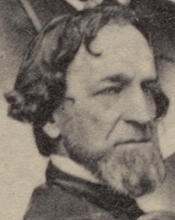
Isaac Newton Arnold (November 30, 1815 – April 24, 1884) was an American lawyer, legislator, and author who made his career in Chicago and served as a Republican Representative from Illinois in the United States Congress from 1861 to 1865. Born in Hartwick, Otsego County, New York, he was the son of Sophia M. Arnold and Dr. George Washington Arnold, Rhode Island natives who had migrated to New York after the Revolutionary War. He attended local common schools and, in 1831–1832, studied at Hartwick Seminary, where he joined the Philophronean Society and took part in debates on major public questions of the day, including the abolition of slavery. From 1832 to 1835 he taught school in Otsego County while reading law, first under Richard Cooper and later under Judge E. B. Morehouse of Cooperstown. Admitted to the bar in 1835 at the age of twenty, he became Morehouse’s law partner, beginning a legal career that would later underpin his prominence in Illinois politics.
In 1836 Arnold moved west to Chicago, then a small but rapidly growing settlement benefiting from the new commercial routes opened by the Erie Canal. He entered into partnership with Mahlon D. Ogden and soon developed a substantial practice, appearing in courts throughout northern Illinois and before the Illinois Supreme Court. In several cases before the state’s high court he was opposing counsel to Abraham Lincoln, with whom he became acquainted and eventually formed a lasting friendship. When Chicago was incorporated as a city in 1837, Arnold was elected its first city clerk, while Ogden was elected the city’s first mayor. Arnold soon left municipal office to concentrate on his legal practice, but his early election to city office marked the beginning of a long public career.
Arnold entered state politics as a Democrat and in 1842 was elected to the Illinois House of Representatives, where he served two terms from 1842 to 1846. During this period he also served as a Democratic presidential elector from Illinois in the 1844 election. Increasingly drawn to the antislavery cause, he broke with the Democratic Party over the expansion of slavery. In 1848 he was a delegate to the national Free Soil Convention and became one of the organizers of the Free Soil Party in Illinois. Under the Free Soil banner he returned to the Illinois House for an additional term from 1855 to 1856, aligning himself with the growing movement to prevent the spread of slavery into the western territories.
By 1860 Arnold had joined the newly formed Republican Party, whose platform more closely reflected his Free Soil and antislavery convictions. That year he was elected to the United States House of Representatives from Illinois, beginning his service in Congress in March 1861. A member of the Republican Party, he contributed actively to the legislative process during two terms in office, serving from 1861 to 1865 and representing the interests of his Chicago-area constituents during the critical years of the American Civil War. He was reelected in 1862, defeating Chicago mayor Francis Cornwall Sherman, the Democratic nominee. Throughout his tenure he was a strong supporter of President Abraham Lincoln, defending the administration against critics both inside and outside the Republican Party and consistently advocating for emancipation in the territories and the nation.
Arnold’s congressional service occurred during a transformative period in American history, and he played a notable role in the antislavery legislative program of the war years. In March 1862 he introduced a bill to abolish slavery in the U.S. territories; the measure became law in June 1862, marking a significant step toward national emancipation. In February 1864 he introduced the first resolution in Congress proposing a constitutional amendment to abolish slavery throughout the United States. In urging its adoption, he declared that the nation could have no permanent peace while slavery survived and that no compromise with the institution was either possible or desirable. Although other versions of the proposal would ultimately be adopted, Arnold is recognized as the first member of Congress to introduce a resolution explicitly calling for a constitutional amendment to end slavery. The Thirteenth Amendment to the United States Constitution was ratified in 1865, formally abolishing slavery nationwide.
In 1864 Arnold faced a difficult reelection environment. He was challenged by Democrat John L. Scripps, the Chicago postmaster whose appointment Arnold had opposed and who, by then, controlled extensive patronage. In addition, German Americans, who had comprised roughly a quarter of Arnold’s constituents in 1860, were increasingly dissatisfied with continued military drafts during the war. Assessing his prospects, Arnold withdrew from the race in favor of Republican John Wentworth, a popular former mayor of Chicago, who went on to win the seat. After leaving Congress in 1865, Arnold accepted a presidential appointment from Lincoln as Sixth Auditor of the Treasury Department, a post in which he served before deciding to leave Washington.
In 1866 Arnold returned permanently to Chicago and resumed the practice of law, while also devoting much of his time to historical and biographical writing. He rapidly completed a substantial work on his late friend, publishing The History of Abraham Lincoln and the Overthrow of Slavery in 1867. Intended as both a biography and a general history of the Civil War and emancipation, the book was criticized by some later scholars for insufficient depth of research but was an important early attempt to interpret Lincoln’s life and policies. Arnold then turned to an earlier and more controversial Revolutionary-era figure, publishing The Life of Benedict Arnold: His Patriotism and His Treason in 1880, the product of years of research into the career of the American general who defected to the British. Disturbed by what he regarded as sensational or unfair portrayals of Lincoln in contemporary works by William H. Herndon and Ward Hill Lamon, Arnold wrote a new study, The Life of Lincoln, published in 1884, which focused on Lincoln’s presidency and sought to rebut personal and controversial accounts. Widely reviewed in the United States and Great Britain, it was later described as one of the best of the early Lincoln biographies and was reprinted in the twentieth century, including a 1994 edition.
Isaac Newton Arnold died on April 24, 1884, in Chicago. He was buried in Graceland Cemetery, the city’s prominent burial ground for many of its leading citizens. By the time of his death he was remembered not only as a key Illinois political figure and antislavery legislator, but also as an early and influential biographer of Abraham Lincoln and Benedict Arnold, whose works continued to be read and reprinted long after his passing.
Congressional Record