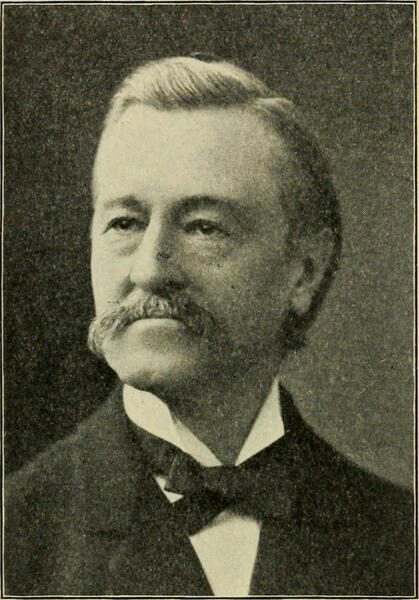
Hosea Washington Parker (May 30, 1833 – August 21, 1922) was a U.S. Representative from New Hampshire and a prominent Democratic lawyer and legislator in the late nineteenth and early twentieth centuries. Born in Lempster, Sullivan County, New Hampshire, he grew up in a rural New England community in the decades preceding the Civil War. He pursued classical studies as a young man, reflecting the traditional liberal-arts preparation common among aspiring professionals of his era.
Parker attended Tufts College in Medford, Massachusetts, and later continued his education at the Green Mountain Liberal Institute in South Woodstock, Vermont, from which he graduated. After completing his formal studies, he read law, following the customary apprenticeship model of legal education of the time. He was admitted to the bar in 1859 and commenced the practice of law in his native town of Lempster, establishing himself as a young attorney at the age of twenty-six.
Parker’s public career began almost simultaneously with his legal practice. In 1859 and 1860 he served as a member of the New Hampshire House of Representatives, participating in state legislative affairs on the eve of the Civil War. In 1860 he moved from Lempster to Claremont, New Hampshire, which would remain his principal residence for the rest of his life. A committed Democrat in a period when his party was often in the minority in New England, he became active in national party politics and served as a delegate to the Democratic National Conventions of 1868, 1880, 1884, and 1888, helping to shape the party’s platforms and presidential nominations over two decades.
As a member of the Democratic Party representing New Hampshire, Parker contributed to the legislative process during two terms in the United States House of Representatives. He was elected as a Democrat to the Forty-second and Forty-third Congresses and served from March 4, 1871, to March 3, 1875. His service in Congress occurred during a significant period in American history, in the later years of Reconstruction, when questions of economic policy, industrial regulation, and the re-integration of the former Confederate states were central to national debate. In Washington he participated in the democratic process and represented the interests of his New Hampshire constituents in a Congress grappling with the rapid industrialization of the country.
During his congressional tenure, Parker was noted for his role in matters relating to patent law and industrial monopolies. While serving in the House, he was largely responsible for the refusal of an extension of certain patents that underpinned the dominant position of the major sewing machine manufacturers. His efforts contributed to the overthrow of what was widely regarded as the “Sewing Machine monopoly,” opening the field to broader competition and limiting the duration of exclusive patent rights that had concentrated control in a few large firms. This work reflected contemporary concerns about monopolistic practices and the balance between encouraging invention and protecting the public interest.
Parker was an unsuccessful candidate for reelection in 1874 to the Forty-fourth Congress, ending his federal legislative service after two terms. Following his departure from Congress, he resumed the practice of law in Claremont, continuing a long legal career that spanned several decades. He remained engaged in public affairs in New Hampshire and, late in life, took part in the revision of the state’s fundamental law as a member of the New Hampshire constitutional convention in 1918, demonstrating his continued interest in governance and legal reform well into his eighties.
Hosea Washington Parker died in Claremont, New Hampshire, on August 21, 1922. He was interred in Mountain View Cemetery in Claremont. His long career as a lawyer, state legislator, national party delegate, and two-term U.S. Representative marked him as a significant Democratic figure in New Hampshire’s political history during a transformative period in the nation’s development.
Congressional Record