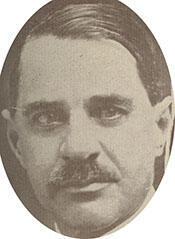
Homer Elihu Royce (June 14, 1819 – April 24, 1891) was an American lawyer, politician, and jurist who served two terms in the United States House of Representatives from 1857 to 1861. He was born in Berkshire, Franklin County, Vermont, the son of Elihu Marvin Royce and Sophronia (Parker) Royce. He grew up in a family with strong legal and political connections; his uncle, Stephen Royce, later served as chief justice of the Vermont Supreme Court and as governor of Vermont. Raised in rural northern Vermont, Homer Royce was educated in the local district schools and then attended academies in St. Albans and Enosburgh, where he received the classical and preparatory training typical of aspiring professionals of his generation.
After completing his preparatory education, Royce read law in the office of Thomas Child, a common path to the bar in the mid-nineteenth century. He was admitted to the bar in 1844 and began practicing law in his native Berkshire. For several years he was associated in practice with Thomas Child, Jr., establishing himself as a capable attorney in Franklin County. His growing reputation in the legal profession was later recognized by the University of Vermont, which conferred upon him the honorary degree of Master of Arts in 1851 and, three decades later, the honorary degree of Doctor of Laws (LL.D.) in 1882. On January 23, 1851, he married Mary T. Edmunds of Boston, Massachusetts; the couple had three children.
Royce’s public career began at the local and state level. In 1846 and 1847 he served as state’s attorney for Franklin County, Vermont, a position that placed him at the forefront of criminal prosecution and county legal affairs. In 1847 he also represented his hometown of Berkshire in the Vermont House of Representatives, marking his entry into legislative service. That same year he was chosen as a district delegate to the Whig National Convention, reflecting his early alignment with the Whig Party and his emerging prominence in state politics. Royce continued to be active in the Vermont legislature over a span of years; he was elected to the Vermont Senate from Franklin County in 1849, 1850, and 1851, and later returned to that body in 1861 and 1868, participating in debates over state policy during a period that encompassed the years immediately before and after the Civil War.
As the national political landscape shifted in the 1850s, Royce joined the newly formed Republican Party. In 1856 he was elected as a Republican representative to the United States House of Representatives from Vermont’s Third Congressional District by a majority of 5,960 votes, becoming the youngest member of the Vermont delegation in Washington. He took his seat in the Thirty-fifth Congress on March 4, 1857, and was reelected in 1858 by a majority of 4,129 votes, serving in the Thirty-sixth Congress until March 3, 1861. During his first term he was appointed to the House Committee on Foreign Affairs, where he participated in deliberations on the nation’s external relations at a time of growing sectional tension. As a member of the Republican Party representing Vermont, he contributed to the legislative process during his two terms in office, participating in the democratic process and representing the interests of his constituents during a significant period in American history.
Royce’s second term in Congress was marked by his involvement in one of the major foreign policy controversies of the late 1850s: proposals to acquire Cuba. Serving again on the Committee on Foreign Affairs, he helped draft a portion of the committee’s report opposing the annexation of Cuba, a measure that many in the South favored as a means of expanding slave territory. He also delivered a speech in the House criticizing President James Buchanan’s Cuban policy, aligning himself with other prominent Vermont Republicans, including Senator Jacob Collamer, who likewise spoke out against the acquisition. Royce’s stance reflected both the anti-slavery sentiments of his party and the broader New England skepticism toward territorial expansion that might strengthen the institution of slavery.
Declining to seek a third term in Congress in 1860, Royce returned to Vermont at the close of his service in March 1861 and resumed the practice of law. Over the next decade he remained a respected figure in the state’s legal community, and his judicial temperament and experience in both state and national government led to his elevation to the bench. In 1870 he was elected an associate justice of the Vermont Supreme Court, succeeding William C. Wilson. As an associate justice he participated in shaping Vermont jurisprudence during a period of post–Civil War adjustment and economic change, hearing appeals and authoring opinions that contributed to the development of state law.
Royce’s judicial career reached its apex in 1882, when he was appointed chief justice of the Vermont Supreme Court, succeeding John Pierpoint. Upon his promotion, John W. Rowell was appointed to fill the resulting associate justice vacancy. As chief justice, Royce presided over the state’s highest court for nearly a decade, overseeing its work and continuing to sit on and decide significant cases. His tenure coincided with a period of modernization in Vermont’s legal system and the broader transformation of American law in response to industrialization and changing social conditions. He remained in this position until 1890, when he resigned, bringing to a close a long public career that had spanned local prosecution, legislative service, national office, and judicial leadership.
In his later years, Royce resided in St. Albans, Vermont, a regional center in Franklin County not far from his birthplace. He died there on April 24, 1891. Homer Elihu Royce was interred in Calvary Cemetery in East Berkshire, Vermont, near the community where he had been born and where his legal and political career first took shape.
Congressional Record