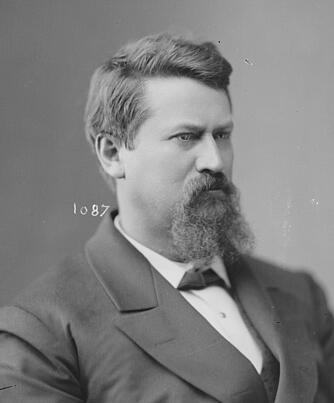
Hiram Barber Jr. (March 24, 1835 – August 5, 1924) was a Republican U.S. Representative from Illinois who served one term in the Forty-sixth Congress from 1879 to 1881. He was born in Queensbury, Warren County, New York, where he spent his early childhood before his family joined the westward movement that was reshaping the United States in the mid-nineteenth century. In 1846, he moved with his parents to Horicon, in Dodge County, Wisconsin, a frontier community in a rapidly developing state. He was the son of Hiram Barber, a noted politician and pioneer in Wisconsin, whose public career and involvement in local affairs helped shape the younger Barber’s interest in law and government.
Barber pursued his education in Wisconsin, attending the University of Wisconsin in Madison during its formative years as the state’s principal institution of higher learning. After his collegiate studies, he chose the law as his profession and continued his preparation in Albany, New York, then an important center for legal training and practice. He studied law there and was admitted to the bar in 1856. Following his admission, he returned to Wisconsin and commenced the practice of law at Juneau, the county seat of Dodge County, where he quickly became active in local legal and civic affairs.
Barber’s early career in public service developed through legal office in Wisconsin. He was elected prosecuting attorney of Jefferson County, Wisconsin, serving from 1861 to 1862, a period that coincided with the opening years of the Civil War. In that capacity he handled criminal prosecutions and represented the county in legal matters. His performance in local office led to broader responsibilities at the state level, and he served as assistant attorney general of Wisconsin in 1865 and 1866, participating in the legal work of the state government during the immediate post–Civil War era. In 1866, seeking a larger arena for his legal practice and public ambitions, Barber moved to Chicago, Illinois, where he resumed the practice of law in a major commercial and transportation center that was rapidly emerging as the dominant city of the Midwest.
Building on his legal reputation in Chicago and his family’s political background, Barber entered national politics as a member of the Republican Party. He was elected as a Republican to the Forty-sixth Congress and served as a Representative from Illinois from March 4, 1879, to March 3, 1881. His single term in the U.S. House of Representatives took place during a significant period in American history, marked by the later phase of Reconstruction’s aftermath, debates over economic policy, and the continuing development of the industrial economy. As a member of the House of Representatives, Hiram Barber Jr. participated in the legislative process, contributed to the work of the Forty-sixth Congress, and represented the interests of his Illinois constituents in the federal government. He sought renomination in 1880 but was unsuccessful, bringing his congressional service to a close after one term.
After leaving Congress, Barber continued his public and professional career in federal and state-related positions. From 1881 to 1888 he served as receiver of the United States land office at Mitchell, in what is now South Dakota, then part of the Dakota Territory. In this role he oversaw federal land transactions at a time when settlement and development on the Great Plains were accelerating, administering the disposition of public lands to settlers and speculators under federal land laws. At the conclusion of his service in Mitchell in 1888, he returned to Chicago and resumed the practice of law, reestablishing himself in the city’s legal community.
Barber’s later career was marked by long and steady judicial-related service in Cook County, Illinois. He was appointed master in chancery of the Cook County Superior Court in 1891, a position in which he assisted the court in equity matters by taking testimony, making findings of fact, and preparing recommendations in complex civil cases. He held this post from 1891 to 1914, a span of more than two decades, during which Chicago experienced rapid growth, industrialization, and significant legal and social change. His work as master in chancery reflected both his legal expertise and the confidence placed in him by the judiciary and the bar.
Following his retirement from the office of master in chancery in 1914, Barber withdrew from public life and active business pursuits. He spent his final years largely removed from official duties, dividing his time in the Midwest. Hiram Barber Jr. died at Lake Geneva, Wisconsin, on August 5, 1924. He was interred in Juneau Cemetery in Juneau, Wisconsin, returning in death to the community where he had begun his legal career. His life spanned from the antebellum era through World War I, and his public service in Wisconsin, Illinois, and the Dakota Territory reflected the broader patterns of American expansion, legal development, and political change in the nineteenth and early twentieth centuries.
Congressional Record