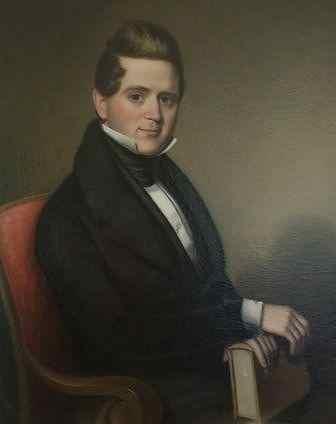
Hines Holt (April 27, 1805 – November 4, 1865) was an American lawyer and politician who served as a United States representative from Georgia. He was born near Milledgeville, Georgia, to Hines Holt and Mary Dixon Seward Holt. He completed his preparatory studies in Milledgeville and then attended the University of Georgia’s Franklin College in Athens, from which he graduated with a Bachelor of Arts degree in 1824. After his formal education, he studied law, preparing for a legal career that would underpin his later public service.
Upon admission to the bar, Holt established a law practice in Columbus, Georgia, where he became a prominent member of the local bar. In January 1846 he was among the first fifteen lawyers admitted to practice before the newly created Supreme Court of Georgia, an early distinction in the state’s appellate legal community. In 1838 he married Sarah Ann Perry; the couple had six children, four daughters and two sons. In 1855 Holt purchased the Wynn House in Columbus, a substantial residence that has survived as a historic structure and a reminder of his standing in the community.
Holt’s political activity began well before his brief service in the United States Congress. He served as a member of the Electoral College in the 1832 presidential election, participating in the formal selection of the president at a time of intense national debate over federal power and states’ rights. A decade later, in 1841, he was elected to the Georgia House of Representatives. That same year, he was chosen as a member of the Whig Party to fill a vacancy in the national legislature.
Holt was elected as a Whig to the Twenty-sixth United States Congress to fill the vacancy caused by the resignation of his cousin, Representative Walter T. Colquitt. He represented Georgia in the U.S. House of Representatives from February 1, 1841, to March 4, 1841, serving one term in office. Although his tenure in Congress was brief, it occurred during a significant period in American history marked by partisan realignment and debates over economic policy, and he participated in the legislative process and the democratic representation of his constituents during this transitional moment.
After leaving Congress, Holt resumed the active practice of law in Columbus. He continued to be involved in state affairs and, in 1859, was appointed Treasurer of Georgia, overseeing the state’s financial matters on the eve of the Civil War. That same year he was elected to the Georgia Senate, to which he was re-elected in 1860, reflecting sustained confidence in his leadership and experience during a period of mounting sectional tension.
With the secession of the Southern states and the formation of the Confederate States of America, Holt’s political career shifted to the Confederate government. He became a member of the House of Representatives of the First Confederate Congress in 1862, representing Georgia in the new national legislature. He served through the early sessions of that body and resigned his seat on March 1, 1863, after the third session, returning once more to private life and legal practice in Georgia as the war continued.
In the final year of his life, as Georgia and the former Confederate states confronted the consequences of defeat and the beginnings of Reconstruction, Holt remained engaged in public affairs. He was serving as a delegate to the State constitutional convention at Milledgeville when he died there on November 4, 1865. Hines Holt was buried in Linwood Cemetery in Columbus, Georgia, leaving a legacy as a lawyer, state official, and legislator who participated in both United States and Confederate political institutions during a turbulent era in American history.
Congressional Record