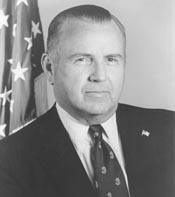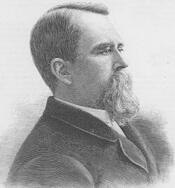
Hilary Abner Herbert (March 12, 1834 – March 6, 1919) was an American lawyer, Confederate Army officer, eight-term Democratic Representative from Alabama, and Secretary of the Navy in the second administration of President Grover Cleveland. Over a public career that spanned the late nineteenth and early twentieth centuries, he played a central role in the legislative revival of the United States Navy and later in its executive administration, while also being a prominent opponent of Reconstruction and African American suffrage.
Herbert was born in Laurensville, Laurens County, South Carolina, on March 12, 1834. In 1846, when he was twelve years old, he moved with his family to Greenville, Alabama, a relocation that would shape his subsequent legal and political career. He pursued higher education in the South’s leading institutions, attending the University of Alabama and later the University of Virginia. While at the University of Virginia he was a member of the Delta Kappa Epsilon fraternity (Eta chapter), an affiliation that reflected his integration into the social and professional networks of the antebellum Southern elite. After completing his studies, Herbert returned to Greenville, Alabama, where he established a law practice and entered the ranks of the local bar.
With the outbreak of the Civil War, Herbert left his legal practice and entered the Confederate Army as a second lieutenant. He soon became captain of the Greenville Guards, a local company that was incorporated into the Confederate forces, and was later promoted to colonel of the Eighth Regiment, Alabama Infantry. In this capacity he saw extensive combat in the Eastern Theater of the war. Herbert was wounded at the Battle of the Wilderness on May 6, 1864, one of the conflict’s most brutal engagements, and his service as a regimental commander marked him as a veteran of high standing in postwar Southern society.
After the war, Herbert returned to Greenville and resumed the practice of law, rebuilding his professional life amid the social and economic upheavals of Reconstruction. He became active in Democratic Party politics in Alabama, aligning himself with white Southern opposition to federal Reconstruction policies. In 1877, he was elected as a Democrat to the United States House of Representatives from Alabama, representing a district centered on Montgomery. He entered Congress at the end of Reconstruction and served continuously from 1877 to 1893, completing eight terms in office. During this period he participated fully in the legislative process and represented the interests of his Alabama constituents at a time of significant political and economic change in the postwar South.
Herbert’s congressional career was most notable for his long association with naval policy. He served as chairman of the House Committee on Naval Affairs, where he became a leading figure in the movement to rebuild and modernize the United States Navy after the long period of post–Civil War neglect. He was largely responsible for securing increased appropriations that contributed to the Navy’s revival in the 1880s and early 1890s. Nevertheless, he initially favored a more limited program than that advocated by Secretary of the Navy Benjamin F. Tracy in 1890, who, influenced by the writings of naval strategist Captain Alfred Thayer Mahan, called for a fleet of forty battleships. Under Herbert’s leadership in Congress, only four battleships were authorized at that time. Herbert also became well known for his efforts to reduce the funding of the United States Geological Survey, a campaign that led to a highly publicized feud with prominent paleontologist Othniel Charles Marsh.
Herbert’s record in Congress also reflected the racial politics of his era and region. He espoused explicitly racist views and was a vocal opponent of the Reconstruction Acts and of any extension of political rights to African Americans. On the House floor he argued against African American suffrage, claiming that Black citizens were unfit to exercise such rights and declaring that “the granting of universal suffrage to the Negro was the mistake of the nineteenth century.” These positions placed him firmly among the Southern Democrats who worked to dismantle Reconstruction-era reforms and restrict African American political participation.
In 1893, President Grover Cleveland appointed Herbert as Secretary of the Navy in Cleveland’s second administration. By this time Herbert had moved closer to Mahan’s school of naval thought and was prepared to support a more ambitious program of naval expansion. Despite the economic constraints imposed by the Panic and Depression of 1893, he secured authorization for five new battleships—the Kearsarge and Illinois classes—and sixteen torpedo boats, significantly strengthening the fleet. His tenure helped bring the Navy to a level of preparedness that proved important on the eve of the Spanish–American War, even though he left office before that conflict began. Herbert served as Secretary of the Navy until 1897, when Cleveland’s administration ended.
After leaving the Cabinet in 1897, Herbert remained in Washington, D.C., where he resumed the practice of law and continued to be active in public affairs. He wrote on historical and political subjects, including The Abolition Crusade and Its Consequences; Four Periods of American History (1912), in which he advanced a critical view of the antislavery movement, and a History of the Arlington Confederate Monument (1914), reflecting his continued identification with the Confederate cause and Southern memory of the Civil War. Herbert practiced law in Washington from 1897 until his death on March 6, 1919, six days before his eighty-fifth birthday. In recognition of his service as Secretary of the Navy and his role in the Navy’s late nineteenth-century expansion, the destroyer USS Herbert (DD-160) was later named in his honor.
Congressional Record