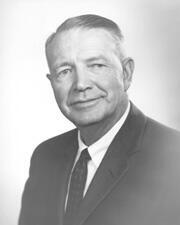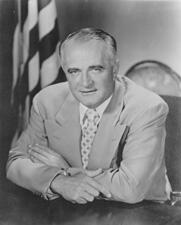
Herman Orville Welker (December 11, 1906 – October 30, 1957) was an American lawyer and Republican politician from Idaho who served one term in the United States Senate from 1951 to 1957. A staunch conservative and prominent supporter of the second Red Scare, he became closely associated with Senator Joseph McCarthy and was widely known in Washington as “Little Joe from Idaho.” His Senate career, marked by vigorous anticommunism and controversial tactics, ended with his defeat for reelection in 1956, and he died less than a year after leaving office.
Welker was born in Cambridge, Washington County, Idaho, the youngest of seven children of John Thornton Welker and Anna Zella Shepherd Welker. His parents had moved from North Carolina to Idaho, where they established a potato farm, and he was a grandson of the Reverend George W. Welker of North Carolina. He attended grade school in Cambridge and high school in nearby Weiser, graduating from Weiser High School in 1924. That fall he enrolled at the University of Idaho in Moscow, initially in a general studies program. While at the university he became a member of the Sigma Chi fraternity. In 1926 he entered the University of Idaho College of Law and completed his legal studies there, receiving an LL.B. degree in 1929.
Even before formally completing law school, Welker began his legal and political career. In April 1929 he was appointed prosecuting attorney for Washington County, Idaho. He graduated from law school in May and was admitted to the bar later that year. He was subsequently elected and re-elected as county prosecutor, serving from 1929 to 1935. In 1930 he married Gladys Taylor Pence; the couple had one daughter, Nancy. After leaving the prosecutor’s office, Welker moved to Los Angeles in 1937, where he engaged in private law practice for several years. With the onset of World War II, he enlisted in the U.S. Army Air Forces in 1943 and served until 1944. Following his military service, he returned to Idaho and established a law practice in Payette. His growing prominence in state affairs led to his election to the Idaho State Senate, where he served from 1949 to 1951 as a member of the Idaho Republican Party.
In 1950, with both of Idaho’s U.S. Senate seats on the ballot, Welker sought national office. He entered the Republican primary and defeated two prominent figures, Congressman John Sanborn and Governor C. A. Robins, securing the party’s nomination. In the general election he faced former Democratic Senator D. Worth Clark and won, earning a seat in the United States Senate. Welker took office in January 1951 and served a single six-year term, representing Idaho during a significant period in American history that encompassed the Korean War and the height of Cold War tensions. In the Senate he gained assignments to several important committees, including the Armed Services Committee and the Judiciary Committee, and he participated actively in the legislative process on behalf of his constituents.
Welker quickly distinguished himself as one of the most conservative and strongly anticommunist members of the Senate, emerging as a leading spokesman for the right wing of the Republican Party. He became a close ally of Senator Joseph McCarthy of Wisconsin and an ardent supporter of McCarthy’s investigations into alleged communist influence and subversion in the federal government. His alignment with McCarthy and his vigorous backing of the second Red Scare led colleagues and observers to refer to him as “Little Joe from Idaho.” During the 1954 Senate proceedings to censure McCarthy for his investigative methods and for his role in “red scare” communist witch hunts and the related “lavender scare” targeting homosexuals in government, Welker served as McCarthy’s chief defender on the Senate floor. He was one of 22 Republicans—out of 46 Republican senators—who voted against McCarthy’s censure.
Welker’s anticommunist zeal extended into some of the most controversial episodes of the era. Along with Republican Senator Styles Bridges of New Hampshire, he played a key role in the pressure campaign against Democratic Senator Lester C. Hunt of Wyoming, a vocal opponent of McCarthy’s tactics. Welker threatened that if Hunt did not resign from the Senate and abandon his 1954 reelection campaign, he would see to it that the arrest of Hunt’s son for soliciting an undercover policeman was fully prosecuted and widely publicized, emphasizing the younger Hunt’s alleged homosexuality. He also threatened Inspector Roy Blick of the Washington, D.C., police Morals Division with the loss of his job if he failed to pursue the case. Under this pressure, Hunt ultimately took his own life in his Senate office on June 19, 1954; a Republican, Edward D. Crippa, was subsequently appointed by acting Republican Governor Clifford Joy Rogers of Wyoming to fill the vacancy. The episode was later noted by commentators, including Alex Ross in The New Yorker, as an event loosely dramatized in the novel and film “Advise & Consent.”
In addition to his role in anticommunist politics, Welker took distinctive positions on judicial nominations. In 1955 he was one of only two non-Southern senators to vote against the confirmation of John Marshall Harlan II to the United States Supreme Court, stating that he opposed Harlan because he was not satisfied that the nominee adhered firmly enough to the doctrine that American sovereignty “could not and must not be diluted.” The following year, he was one of only five senators from outside the former Confederacy to vote against the nomination of Simon Sobeloff to the U.S. Court of Appeals for the Fourth Circuit. Welker also intersected with American sports history: in the early 1950s he alerted Washington Senators baseball club owner Clark Griffith to the talents of Harmon Killebrew, a young player from Payette, Idaho, who was then batting .847 for a semi-professional team. Acting on Welker’s tip, farm director Ossie Bluege traveled to Idaho and, despite interest from the Boston Red Sox, signed Killebrew to a $50,000 contract on June 19, 1954. Killebrew went on to a Hall of Fame Major League career, hitting 573 home runs.
In 1956 Welker sought a second Senate term. He again won the Republican nomination, defeating John Sanborn in the primary, but faced a strong challenge in the general election from 32-year-old Democrat Frank Church of Boise. The campaign was fought in part over regional development issues, including the proposed Hells Canyon Dam and whether it should be publicly or privately owned; one of Church’s aides later remarked that “The campaign was Frank Church against Idaho Power. They fought him tooth and nail.” In the November election, Welker was defeated in a landslide, receiving about 39 percent of the vote to Church’s 56 percent, a margin of 46,315 votes. His loss increased Democratic control of the Senate and provoked anger within Republican ranks; Joseph McCarthy, among others, accused President Dwight D. Eisenhower of failing to provide sufficient support for Welker’s reelection effort. Welker’s term concluded in January 1957, ending his service in Congress after one term.
Following his departure from the Senate, Welker returned to private life in Idaho. He resumed the practice of law in Boise and also engaged in farming, continuing his connection to the agricultural life that had shaped his early years. Within a few months, however, his health deteriorated. He traveled to Bethesda, Maryland, for treatment at the National Institutes of Health and was admitted there on October 16, 1957, where physicians diagnosed a brain tumor. Despite prompt surgical intervention, Welker died in Bethesda on October 30, 1957, at the age of 50, less than ten months after leaving office. Earlier that year he had attended the funeral of his close ally Joseph McCarthy, who also died in Bethesda. Herman Welker’s funeral was held at Fort Myer, Virginia, and he was interred with military honors in Arlington National Cemetery, closing the career of a deeply influential and highly controversial figure in mid-twentieth-century American politics.
Congressional Record