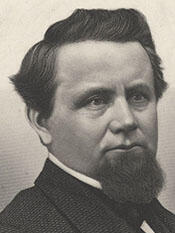
Henry Van Aernam (March 11, 1819 – June 1, 1894) was a United States Representative from New York and a physician who served four terms in Congress as a member of the Republican Party. His congressional service, which spanned the years from 1865 to 1883, occurred during a transformative period in American history, encompassing the Civil War’s aftermath and the era of Reconstruction.
Van Aernam was born on March 11, 1819, in Marcellus, Onondaga County, New York. He pursued an academic course in his youth before turning to the study of medicine. He attended Geneva Medical College in New York and Willoughby Medical College in Ohio, institutions that prepared him for a professional career as a physician. After completing his medical studies, he established a medical practice and became a respected practitioner.
By the late 1850s, Van Aernam had entered public life. He was elected to the New York State Assembly as the representative for Cattaraugus County’s 1st District and served in the legislature in 1858. At the close of the legislative session in the spring of that year, he returned to his medical practice. A committed opponent of slavery and a “slavery-hating abolitionist,” he was a charter member of the Republican Party, aligning himself early with the new political organization that opposed the expansion of slavery and advocated for Unionist and reformist policies.
During the American Civil War, Van Aernam put his medical training at the service of the Union cause. He enrolled in the Union Army as a surgeon in the 154th Regiment, New York Volunteer Infantry. He served in this capacity from September 26, 1862, to November 5, 1864, providing medical care to soldiers during some of the most difficult years of the conflict. His wartime service enhanced his public standing and reinforced his reputation as a dedicated Unionist and abolitionist.
Van Aernam was elected as a Republican to the Thirty-ninth and Fortieth Congresses, serving in the U.S. House of Representatives from March 4, 1865, to March 3, 1869. As a Representative from New York, he participated in the legislative process during the critical Reconstruction period, representing the interests of his constituents while contributing to national debates over the restoration of the Union and the rights of formerly enslaved people. After his initial congressional service, he was appointed Commissioner of Pensions on May 1, 1869, a position of considerable importance in the postwar era, when the federal government was expanding its support for veterans and their families. He held this office until May 31, 1871, when he resigned and returned to private life.
Van Aernam later returned to Congress, being elected again as a Republican to the Forty-sixth and Forty-seventh Congresses. In this second period of service, he held office from March 4, 1879, to March 3, 1883. Across his four terms in the House of Representatives, he remained an active participant in the democratic process, working within the Republican Party to advance policies shaped by his wartime experience, his abolitionist convictions, and his concern for veterans and their dependents. After leaving Congress in 1883, he resumed the practice of medicine in Franklinville, New York, continuing his long-standing professional career.
In his personal life, Van Aernam married Amy Melissa Etheridge on November 30, 1845. The couple had two children: a daughter, Isadora, and a son, Charles Duane. His family connections extended into the broader history of western New York; his sister, Ann Van Aernam, married Benjamin Fuller, an early settler of Little Valley, New York. Ann and Benjamin named a son after him, Henry Van Aernam Fuller (1841–1863), who served in the Union Army and was killed in action at the Battle of Gettysburg, a loss that underscored the family’s deep involvement in the Civil War.
Henry Van Aernam died in Franklinville, Cattaraugus County, New York, on June 1, 1894, at the age of 75 years, 2 months, and 21 days. He was interred at Mount Prospect Cemetery in Franklinville. His career as a physician, state legislator, Civil War surgeon, federal pension administrator, and four-term Republican member of Congress reflected a life closely intertwined with the major political and social upheavals of nineteenth-century America.
Congressional Record